Point-in-Time Cybersecurity Audit vs Continuous Security Monitoring
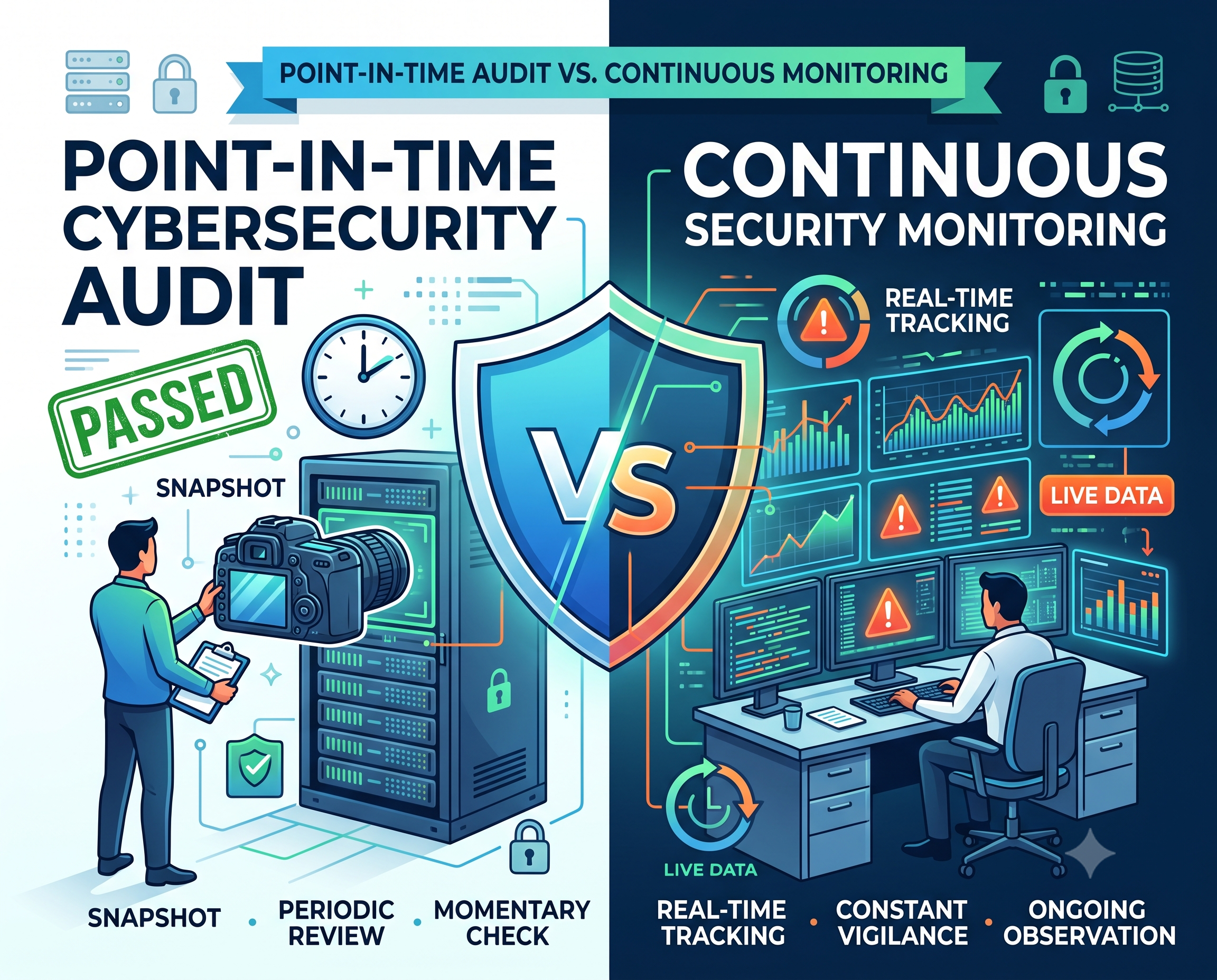
Cybersecurity audits and continuous security monitoring are both important parts of an enterprise cybersecurity program. However, they serve different purposes. A point-in-time cybersecurity audit evaluates an organization's security controls and security posture during a defined assessment period, while continuous security monitoring provides ongoing visibility into security conditions and changes.
A cybersecurity audit can help organizations determine whether their security controls meet defined requirements at the time of assessment. Continuous monitoring helps security teams identify changes, deviations, and security control issues between formal assessments.
Organizations do not necessarily have to choose between the two approaches. A mature cybersecurity program can use periodic audits for formal assurance and continuous monitoring to maintain security visibility throughout the year.
What Is a Point-in-Time Cybersecurity Audit?
A point-in-time cybersecurity audit is a structured assessment of an organization's cybersecurity controls, configurations, policies, processes, and evidence during a specific period.
The objective is to determine whether the organization meets defined security requirements, internal policies, regulatory expectations, contractual requirements, or selected cybersecurity frameworks.
The audit provides a snapshot of the organization's security posture during the assessment period.
What Does a Cybersecurity Audit Typically Examine?
The exact scope of an audit depends on the organization's requirements and the purpose of the assessment.
- Security policies and procedures
- Access control
- User permissions
- Endpoint security configurations
- Network security controls
- Vulnerability and patch management
- Security logging
- Incident response procedures
- Backup and recovery controls
- Security monitoring
- Configuration management
- Security awareness processes
- Compliance evidence
- Risk management processes
What Is Continuous Security Monitoring?
Continuous security monitoring is the ongoing observation of security controls, systems, endpoints, configurations, and other security conditions to identify changes and deviations from expected security requirements.
Instead of checking security only during a scheduled audit, continuous monitoring allows organizations to maintain visibility into their security environment over time.
Continuous security monitoring can help identify configuration changes, security control failures, compliance deviations, configuration drift, and other conditions that may affect an organization's security posture.
What Can Continuous Security Monitoring Track?
- Security configuration changes
- Endpoint compliance
- Security baseline deviations
- Security control status
- Patch status
- High-risk endpoint settings
- Device security posture
- Policy compliance
- Configuration drift
- Security posture changes
- Audit evidence
- Remediation status
Point-in-Time Audit vs Continuous Monitoring
The biggest difference between the two approaches is when security information is evaluated and how that information is used.
- Point-in-time audits evaluate security during a defined assessment period
- Continuous monitoring observes security conditions over an extended period
- Audits provide structured security assessments
- Continuous monitoring provides ongoing security visibility
- Audits identify whether controls meet requirements during the assessment
- Continuous monitoring identifies changes and deviations after controls are implemented
- Audits are generally periodic
- Continuous monitoring is ongoing or performed at defined monitoring intervals
Why Point-in-Time Audits Alone May Not Be Enough
A point-in-time audit can provide valuable information about an organization's security posture, but security environments are constantly changing.
After an audit is completed, organizations may install new software, change configurations, add new endpoints, modify user permissions, delay patches, or change security policies.
These changes can introduce security risks even when the organization successfully met its requirements during the original audit.
Security Changes Can Occur After an Audit
Several types of changes can affect security posture between formal assessments.
- New software installations
- Operating system updates
- Configuration changes
- New devices
- Security policy changes
- Disabled security controls
- Delayed security patches
- Firewall changes
- Remote access changes
- Changes in user privileges
Why Continuous Security Monitoring Matters
Continuous security monitoring helps organizations maintain visibility into security conditions after a formal audit has been completed.
Instead of waiting until the next audit to discover a security deviation, security teams can identify important changes closer to when they occur.
Detecting Configuration Drift
Configuration drift occurs when a system or endpoint gradually moves away from its approved or secure configuration.
Continuous monitoring can compare the current state of an endpoint or security control against an approved baseline and identify deviations that require investigation.
Monitoring Security Controls
Continuous monitoring can help organizations determine whether important security controls remain enabled and configured according to organizational requirements.
Monitoring Security Posture
Monitoring security conditions over time can help security teams understand whether the organization's overall security posture is improving, remaining stable, or becoming weaker.
Key Differences Between Audit and Continuous Monitoring
Although both approaches support cybersecurity assurance, their objectives and operating models are different.
- Assessment timing: An audit evaluates security during a defined period, while monitoring continues over time.
- Primary objective: An audit provides formal assessment and assurance, while monitoring provides ongoing visibility.
- Security visibility: An audit provides a snapshot, while monitoring tracks changes over time.
- Configuration drift: An audit may identify drift during assessment, while monitoring can identify drift between assessments.
- Evidence: An audit reviews evidence for a defined assessment period, while monitoring can continuously collect security information.
- Remediation: Audits can produce findings that require remediation, while monitoring can identify deviations earlier.
- Operational visibility: Continuous monitoring provides greater visibility into changing security conditions.
Can Continuous Monitoring Replace a Cybersecurity Audit?
Continuous security monitoring does not automatically replace a cybersecurity audit.
A cybersecurity audit provides a structured assessment of security controls, processes, and evidence against defined requirements.
Continuous monitoring provides ongoing visibility into security conditions and helps organizations identify changes between formal assessments.
Both approaches can therefore complement each other within an enterprise cybersecurity program.
How Continuous Monitoring Supports Cybersecurity Audits
Continuous monitoring can strengthen an organization's audit program by maintaining visibility into security controls throughout the year.
Maintaining Current Security Evidence
Continuous monitoring can collect information about endpoint configurations, security controls, compliance status, and other relevant security conditions.
This can help organizations maintain more current security information instead of collecting evidence only immediately before an audit.
Finding Problems Before the Audit
Continuous monitoring can identify security deviations before the next formal assessment.
Security teams can investigate and remediate these issues earlier, reducing the risk of unresolved findings accumulating until the audit period.
Tracking Remediation
Continuous monitoring can help organizations track whether identified security issues have been corrected and whether affected systems have returned to the required security state.
Continuous Monitoring and Audit Readiness
Audit readiness means maintaining the controls, evidence, processes, and documentation required to demonstrate that security requirements are being addressed.
Continuous monitoring can support audit readiness by providing ongoing visibility into security controls and their current status.
- Monitor important security controls throughout the year
- Detect deviations from approved security baselines
- Maintain current security information
- Track remediation activities
- Identify recurring security issues
- Support evidence collection
- Reduce last-minute audit preparation
- Improve security posture visibility
Configuration Drift and the Audit Gap
One of the major limitations of relying only on periodic audits is the gap between assessment periods.
Consider an organization that completes a cybersecurity audit in January. During the audit, its endpoints meet the required security baseline.
In March, a configuration change disables an important security setting on several endpoints. If the organization relies only on periodic audits, the issue may remain undetected until the next assessment.
Continuous security monitoring can detect the configuration change closer to when it occurs and alert the organization that the affected endpoints no longer meet the expected baseline.
Example: Point-in-Time Audit vs Continuous Monitoring
Consider an organization with thousands of enterprise endpoints.
During a cybersecurity audit, the organization evaluates endpoint configurations and determines that most systems comply with the approved security baseline.
The audit provides useful evidence about the organization's security posture during the assessment period.
After the audit, employees receive software updates, administrators change configurations, new endpoints are enrolled, and some systems may develop security deviations.
Continuous monitoring can track these changes and identify endpoints that no longer meet the organization's security requirements.
In this example, the audit provides formal assessment while continuous monitoring helps maintain security visibility between assessments.
Benefits of Point-in-Time Cybersecurity Audits
- Provides a structured security assessment
- Creates formal audit evidence
- Identifies security control weaknesses
- Supports compliance requirements
- Provides documented findings
- Evaluates security processes
- Supports management reporting
- Establishes an assessment baseline
- Helps identify areas requiring improvement
Benefits of Continuous Security Monitoring
- Provides ongoing security visibility
- Detects configuration drift
- Identifies security deviations earlier
- Supports continuous security assurance
- Improves endpoint visibility
- Tracks security control status
- Supports audit readiness
- Provides current security posture information
- Helps prioritize remediation
- Reduces dependence on periodic security snapshots
Limitations of Point-in-Time Cybersecurity Audits
Point-in-time audits are valuable, but they have limitations when they are used as the only method of security visibility.
- Security conditions can change after the assessment
- Configuration drift can occur between audits
- New vulnerabilities can emerge
- New endpoints can be introduced
- Security controls can become disabled
- Evidence can become outdated
- Security issues may remain undetected until the next assessment
Limitations of Continuous Security Monitoring
Continuous monitoring also has limitations and should be implemented as part of a broader cybersecurity program.
- Requires appropriate monitoring technology
- Requires clearly defined security baselines
- Generates security information that must be analyzed
- Requires processes for investigating deviations
- Requires remediation capabilities
- Does not automatically replace formal audits
- Monitoring coverage must be reviewed regularly
How to Combine Auditing and Continuous Monitoring
Organizations can achieve stronger security assurance by combining periodic cybersecurity audits with continuous security monitoring.
- Define security requirements and control objectives.
- Establish approved security baselines.
- Perform periodic cybersecurity audits.
- Continuously monitor important security controls.
- Detect deviations from approved security conditions.
- Investigate identified security issues.
- Prioritize findings based on risk.
- Remediate identified issues.
- Verify that remediation restored the required security state.
- Maintain evidence of security controls and remediation.
- Use monitoring results to improve future audits and security policies.
Role of Security Baselines
Security baselines define the expected security configuration or control state for systems, devices, applications, or environments.
A baseline provides a reference point for continuous monitoring.
When the current state differs from the approved baseline, the organization can investigate whether the deviation represents a security risk or an authorized change.
Examples of Security Baselines
- Required operating system versions
- Approved security configurations
- Firewall settings
- Authentication requirements
- Encryption requirements
- Endpoint protection settings
- Remote access controls
- Application restrictions
- Security policy settings
- Required security controls
Continuous Monitoring and Security Posture
Security posture represents the overall security condition of an organization's environment.
Continuous monitoring provides information that can help security teams understand how this posture changes over time.
Instead of asking only whether an organization passed an audit, security teams can also evaluate whether important security controls remain effective and whether security conditions are changing.
Continuous Monitoring and Compliance
Compliance programs often require organizations to demonstrate that security controls are implemented and maintained.
Continuous monitoring can support this objective by providing ongoing visibility into relevant security controls and their status.
However, monitoring requirements and evidence requirements vary depending on the regulation, framework, contract, and organization. Continuous monitoring should therefore be aligned with the specific compliance requirements that apply to the organization.
Continuous Monitoring and Risk Reduction
Continuous monitoring can contribute to risk reduction by helping organizations identify security deviations earlier.
Earlier visibility gives security teams more time to investigate, prioritize, and remediate issues before they become larger security problems.
Monitoring should therefore be connected to an effective remediation process rather than being used only as a reporting mechanism.
From Detection to Remediation
Detecting a security deviation is only the first step. Organizations need a defined process for responding to detected issues.
- Detect the security deviation.
- Validate the finding.
- Identify affected systems.
- Assess the potential security impact.
- Prioritize the issue.
- Apply the required remediation.
- Verify the corrected configuration.
- Record remediation evidence.
- Continue monitoring the system.
How Enterprises Should Approach Security Assurance
Enterprises should avoid treating cybersecurity assurance as an activity that happens only before an audit.
A stronger approach combines formal assessments with continuous security visibility.
- Use audits to formally assess security controls
- Use continuous monitoring to observe security conditions
- Use security baselines to define expected configurations
- Use monitoring to detect deviations
- Use remediation processes to address findings
- Use evidence collection to support audit readiness
- Use security posture metrics to track improvement
Point-in-Time Audit vs Continuous Monitoring: Which Is Better?
There is no universal answer because the two approaches solve different security problems.
A point-in-time cybersecurity audit is valuable when an organization needs a structured assessment of security controls, processes, configurations, and evidence.
Continuous security monitoring is valuable when an organization needs ongoing visibility into security conditions and changes.
For mature cybersecurity programs, both approaches can work together to provide stronger security assurance.
Frequently Asked Questions
What is a point-in-time cybersecurity audit?
A point-in-time cybersecurity audit is a structured assessment of an organization's security controls, processes, configurations, and evidence during a defined assessment period.
What is continuous security monitoring?
Continuous security monitoring is the ongoing observation of security controls, systems, configurations, endpoints, and other relevant security conditions to identify changes and deviations.
Can continuous monitoring replace a cybersecurity audit?
Continuous monitoring does not automatically replace a cybersecurity audit. Monitoring provides ongoing visibility, while an audit provides a formal assessment against defined requirements.
What is the biggest difference between an audit and continuous monitoring?
The primary difference is timing and purpose. An audit evaluates security during a defined assessment period, while continuous monitoring tracks security conditions and changes over time.
Why is configuration drift important?
Configuration drift can cause systems to move away from approved security baselines after an audit has been completed. Continuous monitoring can help identify these deviations between formal assessments.
Does continuous monitoring improve audit readiness?
Continuous monitoring can support audit readiness by maintaining current visibility into security controls, configurations, deviations, and remediation activities.
Are periodic cybersecurity audits still important?
Yes. Periodic audits provide structured assurance, formal findings, and evidence that security controls and processes meet defined requirements.
What should organizations monitor continuously?
Organizations should prioritize security controls and configurations that are important to their risk profile, security baselines, compliance requirements, and operational environment.
Conclusion
Point-in-time cybersecurity audits and continuous security monitoring serve different but complementary purposes.
A cybersecurity audit provides a structured assessment of security controls and evidence during a defined period. Continuous security monitoring provides ongoing visibility into changes, security deviations, configuration drift, and control status.
Organizations that rely only on periodic audits may have limited visibility into what happens between assessment periods. Organizations that implement continuous monitoring without formal assessment may lack the structured assurance and evidence provided by an audit.
Combining periodic cybersecurity audits with continuous security monitoring creates a stronger security assurance model. Audits can validate security controls, while continuous monitoring helps organizations maintain those controls and identify deviations throughout the year.
This approach moves cybersecurity assurance from a periodic snapshot toward an ongoing process of visibility, assessment, remediation, and verification.
Recommended Solution
See how MOBISEC solves this in practice
Topics