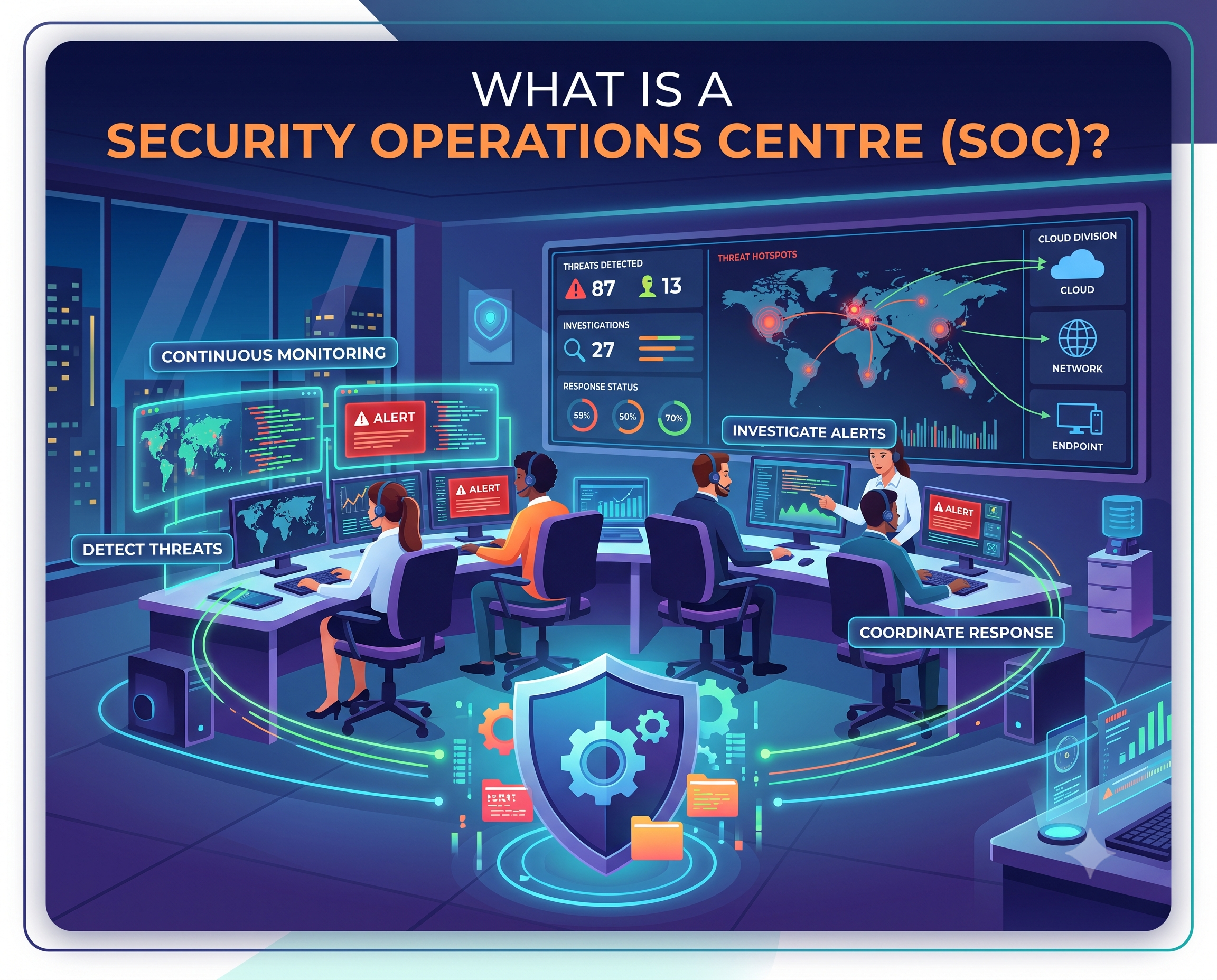
What Is a Security Operations Centre (SOC)?
A Security Operations Centre (SOC) is a centralized cybersecurity function responsible for continuously monitoring an organization's technology environment, detecting suspicious activity, investigating security alerts, and coordinating responses to cyber threats. A SOC brings together people, processes, and security technologies to provide ongoing visibility into an organization's security posture.
Unlike periodic security assessments that provide a point-in-time view, a SOC focuses on continuous security monitoring and operational response. Security analysts monitor alerts from endpoints, networks, applications, cloud environments, identity systems, and other security controls to identify potentially malicious activity.
A modern Security Operations Centre can operate as an internal team, an outsourced managed SOC service, or a hybrid model. The objective remains the same: detect threats early, determine their impact, contain incidents, and support recovery.
Why Is a Security Operations Centre Important?
Modern enterprises operate across cloud services, remote endpoints, mobile devices, applications, networks, and distributed users. This creates a large and constantly changing attack surface. Security events can occur at any time, and attackers may remain inside an environment for extended periods if suspicious activity is not detected.
A SOC provides a dedicated capability for monitoring these environments and turning large volumes of security telemetry into actionable security events.
- Continuous monitoring of security events
- Early detection of suspicious activity
- Centralized security alert management
- Threat investigation and analysis
- Incident triage and response coordination
- Security visibility across multiple environments
- Support for incident investigation and digital forensics
- Security reporting and operational metrics
- Improved readiness for cybersecurity incidents
The value of a SOC is not simply the number of alerts it processes. Its primary purpose is to identify meaningful security risks, prioritize them according to their potential impact, and help the organization respond before an incident causes significant damage.
How Does a SOC Work?
A SOC typically follows a continuous cycle of collecting security data, detecting suspicious activity, analyzing alerts, investigating potential incidents, responding to confirmed threats, and improving detection capabilities.
- Collect security telemetry from relevant systems and security controls
- Monitor events and identify suspicious patterns
- Generate and prioritize security alerts
- Triage alerts to determine their severity and legitimacy
- Investigate suspicious activity and establish the scope of the event
- Contain or escalate confirmed security incidents
- Coordinate remediation and recovery activities
- Document the incident and preserve relevant evidence
- Review the event and improve security controls and detection rules
This process allows a SOC to move from raw security data to actionable intelligence and coordinated response.
What Does a SOC Monitor?
A SOC can monitor a wide range of technology assets depending on the organization's environment, risk profile, and security requirements. The broader the environment, the more important centralized visibility and effective alert prioritization become.
- Endpoints and workstations
- Servers and operating systems
- Network traffic and network security devices
- Firewalls and intrusion detection systems
- Cloud infrastructure and cloud services
- Identity and access management systems
- Authentication activity
- Applications and APIs
- Email security systems
- Mobile devices and enterprise mobility environments
- Security and vulnerability management platforms
- Security logs and audit records
A mature SOC combines telemetry from multiple sources instead of relying on a single security product. Correlating information from different systems can help analysts understand whether apparently unrelated events are part of the same attack.
Key Components of a Security Operations Centre
People
People are one of the most important components of a SOC. Security analysts and incident responders investigate alerts, identify attack patterns, make risk-based decisions, and coordinate response activities.
- SOC analysts
- Security engineers
- Incident responders
- Threat intelligence analysts
- Security monitoring specialists
- Digital forensics specialists
- SOC managers and security leadership
Processes
A SOC needs clearly defined processes for monitoring, alert triage, incident escalation, investigation, containment, recovery, documentation, and continuous improvement. Without consistent processes, security teams can struggle to respond effectively when alert volumes increase.
Technology
SOC operations depend on security technologies that collect, process, correlate, and analyze security information. The exact technology stack depends on the organization's environment and security objectives.
- Security Information and Event Management systems
- Endpoint Detection and Response platforms
- Extended Detection and Response platforms
- Network security monitoring
- Threat intelligence platforms
- Security orchestration and automation
- Vulnerability management systems
- Identity and access monitoring
- Cloud security monitoring
- Digital forensics tools
What Is a SOC Analyst?
A SOC analyst is a cybersecurity professional responsible for monitoring security events, investigating alerts, identifying potential threats, and supporting incident response activities. SOC analysts often work with large volumes of security events and must determine which events require immediate investigation.
Common Responsibilities of a SOC Analyst
- Monitoring security dashboards and alerts
- Reviewing suspicious events
- Investigating potential security incidents
- Correlating events across multiple systems
- Validating whether an alert represents a genuine threat
- Classifying incidents according to severity
- Escalating high-risk incidents
- Supporting containment and remediation
- Documenting investigation findings
- Improving detection rules and monitoring processes
SOC analysts may operate at different levels depending on experience and responsibility. Junior analysts commonly focus on alert monitoring and initial triage, while more experienced analysts may perform complex investigations, threat hunting, incident response, and forensic analysis.
SOC Monitoring and Threat Detection
Threat detection is a core function of a Security Operations Centre. Detection systems generate alerts when security controls identify behavior that may indicate malicious activity, policy violations, compromised accounts, malware, unauthorized access, or other security risks.
Effective detection requires more than collecting alerts. Security teams must understand the context surrounding an event, determine whether the activity is expected, and identify relationships between events occurring across different systems.
Examples of Activities a SOC May Detect
- Repeated failed authentication attempts
- Suspicious administrator activity
- Malware execution
- Unauthorized software installation
- Unexpected network connections
- Command and control communication
- Abnormal user behavior
- Credential misuse
- Privilege escalation
- Suspicious data transfers
- Endpoint security control failures
- Unauthorized configuration changes
What Is SIEM and How Does It Relate to a SOC?
Security Information and Event Management (SIEM) is a technology used to collect, aggregate, correlate, and analyze security events and logs from multiple sources. A SIEM can be an important component of a SOC, but a SIEM is not the same thing as a SOC.
A SIEM provides technology for security visibility and event analysis, while a SOC represents the broader operational capability that includes people, processes, technology, investigation, response, and security governance.
A SOC may use SIEM technology as one of several security platforms within its overall monitoring and response architecture.
SOC vs Managed SOC
An internal SOC is operated by an organization's own cybersecurity team, while a Managed SOC is provided by an external cybersecurity service provider. The right approach depends on the organization's security requirements, internal expertise, budget, technology environment, and operational needs.
Internal SOC
- Security operations are managed internally
- Organization controls the SOC team and processes
- Greater customization of internal workflows
- Requires security personnel and infrastructure
- Requires ongoing investment in security technologies and expertise
Managed SOC
- Security monitoring is provided by an external security provider
- Access to specialized cybersecurity expertise
- Can provide continuous monitoring without building a large internal SOC
- Can help organizations scale security operations
- Can support alert triage, threat detection, investigation, and incident response
Organizations may also use a hybrid model in which internal security teams work together with an external SOC provider.
Benefits of a Security Operations Centre
A SOC can improve an organization's ability to identify, investigate, and respond to security threats. Its benefits extend beyond simple alert monitoring because a mature SOC creates an operational framework for continuous security visibility and response.
- Faster identification of security threats
- Centralized security monitoring
- Improved incident detection and triage
- Better visibility across distributed environments
- More consistent incident response
- Reduced burden on internal IT teams
- Improved security investigation capabilities
- Better use of security telemetry
- Support for security and compliance reporting
- Improved cybersecurity readiness
SOC and Incident Response
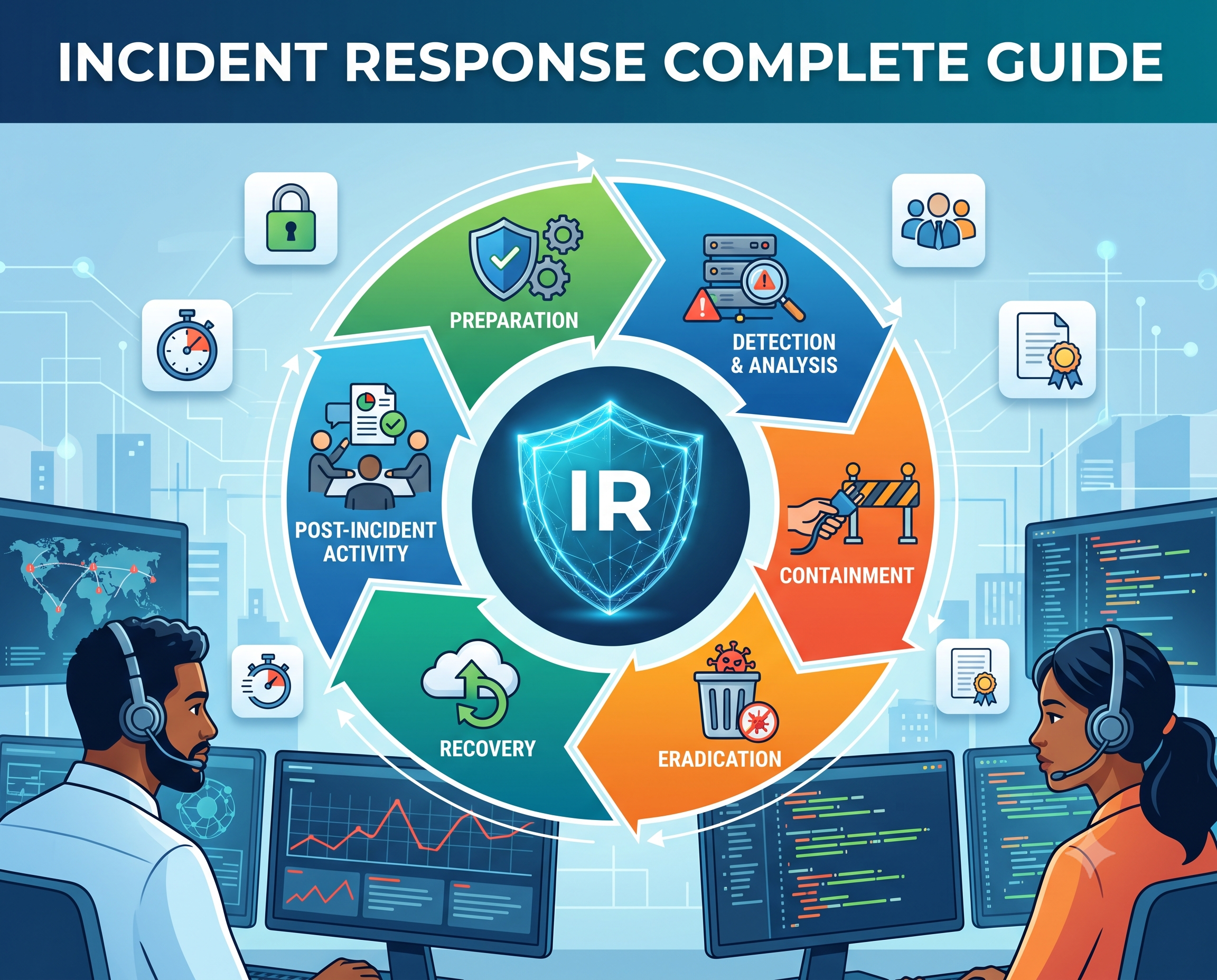
Security monitoring and incident response are closely connected. A SOC may identify suspicious activity, while the incident response function determines how the organization should contain, investigate, eradicate, and recover from a confirmed security incident.
For example, a SOC may detect suspicious authentication activity and escalate it after determining that the behavior is consistent with credential compromise. The incident response team can then investigate the affected account, identify related systems, contain the compromise, and coordinate recovery.
This relationship makes incident response an important part of a complete security operations capability.
SOC and Threat Intelligence
Threat intelligence can help SOC teams understand emerging threats, attacker techniques, malicious infrastructure, indicators of compromise, and known attack patterns. Security teams can use relevant intelligence to improve detection rules and prioritize investigations.
- Indicators of compromise
- Malicious IP addresses and domains
- Known malware information
- Threat actor techniques
- Attack patterns
- Vulnerability intelligence
- Industry-specific threat information
- Emerging cybersecurity risks
Threat intelligence becomes more useful when it is connected to the organization's own environment. A SOC can compare external threat information with internal security telemetry to determine whether a known threat may be relevant to the organization.
SOC and Digital Forensics
When a serious security incident occurs, security teams may need to determine what happened, how the attacker gained access, what systems were affected, and what actions were performed. Digital forensics can provide evidence that supports this investigation.
A SOC may preserve relevant logs and security telemetry and coordinate with incident response or forensic specialists when deeper investigation is required.
Forensic analysis can help organizations understand the timeline of an incident and identify evidence that can support remediation, security improvement, and appropriate reporting.
SOC Alert Triage and Prioritization
One of the biggest challenges in security operations is handling large numbers of alerts. Treating every alert as equally important can overwhelm security teams and delay the investigation of genuinely dangerous activity.
SOC teams therefore prioritize alerts based on factors such as severity, asset importance, user context, threat intelligence, attack behavior, and potential business impact.
Common Alert Priorities
- Informational events that require monitoring
- Low-risk events that may require investigation
- Medium-risk events requiring analyst review
- High-risk events requiring urgent investigation
- Critical incidents requiring immediate response and escalation
Effective alert triage helps security teams focus their time on the events most likely to represent genuine threats.
SOC Automation and Security Orchestration
Security operations can generate large volumes of repetitive tasks. Automation can help SOC teams perform certain actions more efficiently while allowing analysts to focus on complex investigations and decision-making.
- Automated alert enrichment
- Threat intelligence lookups
- Indicator searches
- Alert deduplication
- Automated ticket creation
- User or device isolation workflows
- Security notification workflows
- Automated evidence collection
- Incident workflow orchestration
Automation should complement human analysis rather than eliminate the need for security expertise. High-impact response actions should be governed by appropriate policies and approval processes.
SOC Metrics and Key Performance Indicators
Organizations need measurable indicators to understand whether their security operations are effective. SOC metrics should focus on detection quality, response performance, investigation efficiency, and security outcomes rather than simply measuring the number of alerts processed.
Common SOC Metrics
- Mean Time to Detect
- Mean Time to Respond
- Mean Time to Contain
- Number of confirmed security incidents
- Alert volume
- False positive rate
- Incident escalation rate
- Detection coverage
- Investigation time
- Security incidents by severity
- Incident response effectiveness
Metrics should be reviewed over time to identify trends and improve security operations.
Challenges of Running a Security Operations Centre
Operating a SOC can be complex because organizations generate large amounts of security data while attackers continuously change their techniques.
- High alert volumes
- False positives
- Shortage of cybersecurity expertise
- Complex technology environments
- Increasing attack sophistication
- Cloud and remote-work visibility challenges
- Integration between security tools
- Security data management
- Continuous staffing requirements
- Difficulty maintaining effective detection rules
Organizations should design SOC operations around their actual risk profile rather than simply deploying more security tools. Effective processes, skilled analysts, meaningful telemetry, and well-defined response procedures are essential.
How to Build an Effective SOC
- Define the organization's security objectives and risk profile
- Identify critical assets and systems that require monitoring
- Determine which security events and telemetry should be collected
- Select appropriate security monitoring and detection technologies
- Define alert severity and escalation procedures
- Establish incident response workflows
- Assign SOC roles and responsibilities
- Develop threat detection and investigation procedures
- Create security metrics and reporting processes
- Regularly test and improve SOC operations
SOC for Modern Enterprises
Modern enterprises operate across traditional data centers, cloud platforms, remote work environments, mobile devices, SaaS applications, and distributed networks. This makes centralized security visibility increasingly important.
A modern SOC should therefore be capable of monitoring different technology environments and correlating security events across them. Security operations should also work closely with vulnerability management, endpoint security, identity security, security compliance, and incident response functions.
Continuous monitoring can help organizations identify changes in their security environment between periodic audits and assessments.
SOC and Continuous Cybersecurity Monitoring
Continuous cybersecurity monitoring focuses on maintaining ongoing visibility into security conditions across an organization's environment. A SOC builds on this visibility by providing dedicated operational processes for detecting, investigating, and responding to security events.
This makes continuous monitoring an important source of information for SOC operations. At the same time, SOC findings can highlight security weaknesses that require improvements in security posture, endpoint configuration, vulnerability management, or access controls.
SOC Best Practices
- Monitor critical systems continuously
- Prioritize alerts according to risk and business impact
- Reduce unnecessary security alerts and false positives
- Maintain clear incident escalation procedures
- Integrate security telemetry from relevant systems
- Use threat intelligence to improve detection
- Automate repetitive security operations where appropriate
- Maintain reliable incident documentation
- Preserve evidence during serious incidents
- Regularly test incident response procedures
- Review and improve detection rules
- Measure SOC performance using meaningful metrics
- Keep security tools and detection capabilities updated
- Coordinate SOC operations with vulnerability management and compliance teams
Common SOC Mistakes to Avoid
- Collecting security data without a clear monitoring strategy
- Treating every alert as equally important
- Relying entirely on automated detection
- Ignoring false positive rates
- Failing to define escalation procedures
- Using disconnected security tools without proper integration
- Not preserving evidence during serious incidents
- Measuring success only by alert volume
- Failing to test incident response procedures
- Ignoring changes in the organization's technology environment
When Does an Organization Need a SOC?
Organizations should consider SOC capabilities when their technology environment becomes too complex for a small IT or security team to monitor effectively. The need is particularly relevant when an organization operates critical systems, handles sensitive information, manages large endpoint fleets, faces significant regulatory requirements, or requires continuous security visibility.
- Large or distributed technology environments
- Critical business applications and infrastructure
- Sensitive customer or organizational data
- Remote and hybrid work environments
- Multiple cloud and SaaS platforms
- Large endpoint or mobile device fleets
- Strict security or compliance requirements
- Frequent security incidents or alerts
- Limited internal security monitoring capacity
- Requirement for continuous security monitoring
Managed SOC Services
A Managed SOC can provide organizations with access to continuous security monitoring, threat detection, alert investigation, and incident response capabilities without requiring the organization to build and operate every SOC function internally.
Managed SOC services can be particularly useful for organizations that need continuous monitoring but do not have sufficient internal security personnel, specialized expertise, or resources to operate a full SOC.
The scope of a Managed SOC should be aligned with the organization's assets, risk profile, security objectives, escalation procedures, and incident response requirements.
Frequently Asked Questions About SOC
What does SOC stand for in cybersecurity?
SOC stands for Security Operations Centre. It is a cybersecurity function responsible for monitoring security events, detecting threats, investigating suspicious activity, and coordinating security response.
What is the main purpose of a SOC?
The main purpose of a SOC is to provide continuous security monitoring and help an organization detect, investigate, contain, and respond to cybersecurity threats.
Is a SOC a tool or a team?
A SOC is a broader operational function rather than a single security tool. It combines people, processes, and technologies to perform security monitoring and response.
What is the difference between SOC and SIEM?
A SIEM is a security technology used to collect and analyze security events. A SOC is the broader security operations function that uses technologies such as SIEM along with analysts, processes, investigation, and incident response.
What is a Managed SOC?
A Managed SOC is a SOC capability operated by an external cybersecurity service provider on behalf of an organization. It can provide services such as continuous monitoring, alert triage, threat detection, investigation, and incident response support.
Can a SOC prevent cyberattacks?
A SOC cannot guarantee that cyberattacks will never occur. Its role is to improve an organization's ability to detect suspicious activity early, investigate threats, and coordinate an effective response.
Is SOC monitoring required 24/7?
Organizations with significant security risks or critical systems may benefit from 24/7 monitoring because cybersecurity incidents can occur at any time. The required monitoring model should be based on the organization's risk profile and operational requirements.
Key Takeaways
- A Security Operations Centre provides centralized cybersecurity monitoring and response capabilities
- A SOC combines people, processes, and security technologies
- Continuous monitoring is a core SOC function
- SOC teams detect, investigate, prioritize, and escalate security events
- SIEM is a technology component that may be used by a SOC
- Incident response is closely connected to SOC operations
- Threat intelligence can improve detection and investigation
- Digital forensics can support deeper incident investigations
- Automation can improve SOC efficiency when appropriately governed
- Managed SOC services can provide continuous security operations without requiring a fully internal SOC
Conclusion
A Security Operations Centre is a critical component of modern cybersecurity operations. As organizations adopt cloud services, remote work, mobile devices, distributed infrastructure, and increasingly connected applications, security teams need continuous visibility into what is happening across their environments.
A mature SOC brings together security monitoring, threat detection, alert triage, investigation, threat intelligence, incident response, and continuous improvement. Whether operated internally, through a Managed SOC, or through a hybrid model, the goal is to identify threats early and help the organization respond effectively.
Organizations looking to strengthen their security operations should evaluate their monitoring requirements, critical assets, incident response capabilities, security telemetry, and internal expertise before selecting the right SOC operating model.
Recommended Solution
See how MOBISEC solves this in practice
Topics