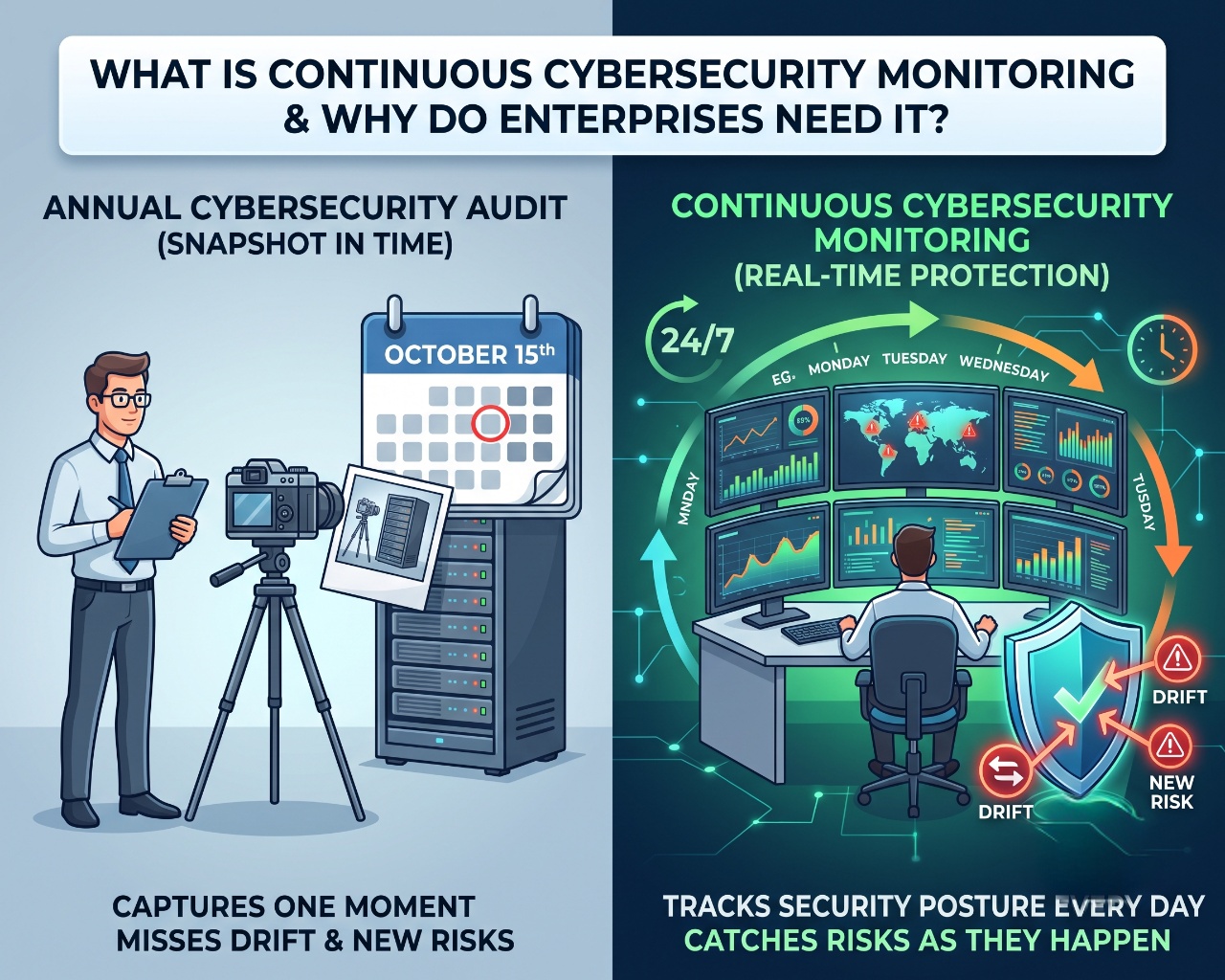
A cybersecurity audit tells you what your environment looked like on the day it was conducted. A single misconfiguration introduced the following week — a firewall rule changed, a patch skipped, an endpoint falling out of compliance — is invisible until the next audit cycle, which might be a year away. Continuous cybersecurity monitoring exists to close that gap.
What Is Continuous Cybersecurity Monitoring?
Continuous cybersecurity monitoring is the ongoing, automated collection and analysis of security-relevant data across an organization's endpoints, networks, and systems — as opposed to periodic, point-in-time assessments. Instead of asking "were we secure on audit day?", continuous monitoring asks "are we secure right now?" and keeps asking that question every hour of every day.
This typically covers endpoint configuration state, patch levels, user access and authentication events, network traffic patterns, and security control status (is the antivirus actually running? Is the firewall rule still in place?).
Why Point-in-Time Audits Aren't Enough Anymore
Traditional annual or quarterly security audits made sense when IT environments changed slowly. That's no longer true:
- Environments change constantly — new employees, new devices, new cloud services, and configuration changes happen daily, not annually.
- Configuration drift is the norm, not the exception. A server hardened correctly six months ago has very likely drifted from that baseline through routine patches, admin changes, or software installs.
- Attackers don't wait for your audit cycle. The gap between audits is exactly when undetected vulnerabilities are most valuable to an attacker.
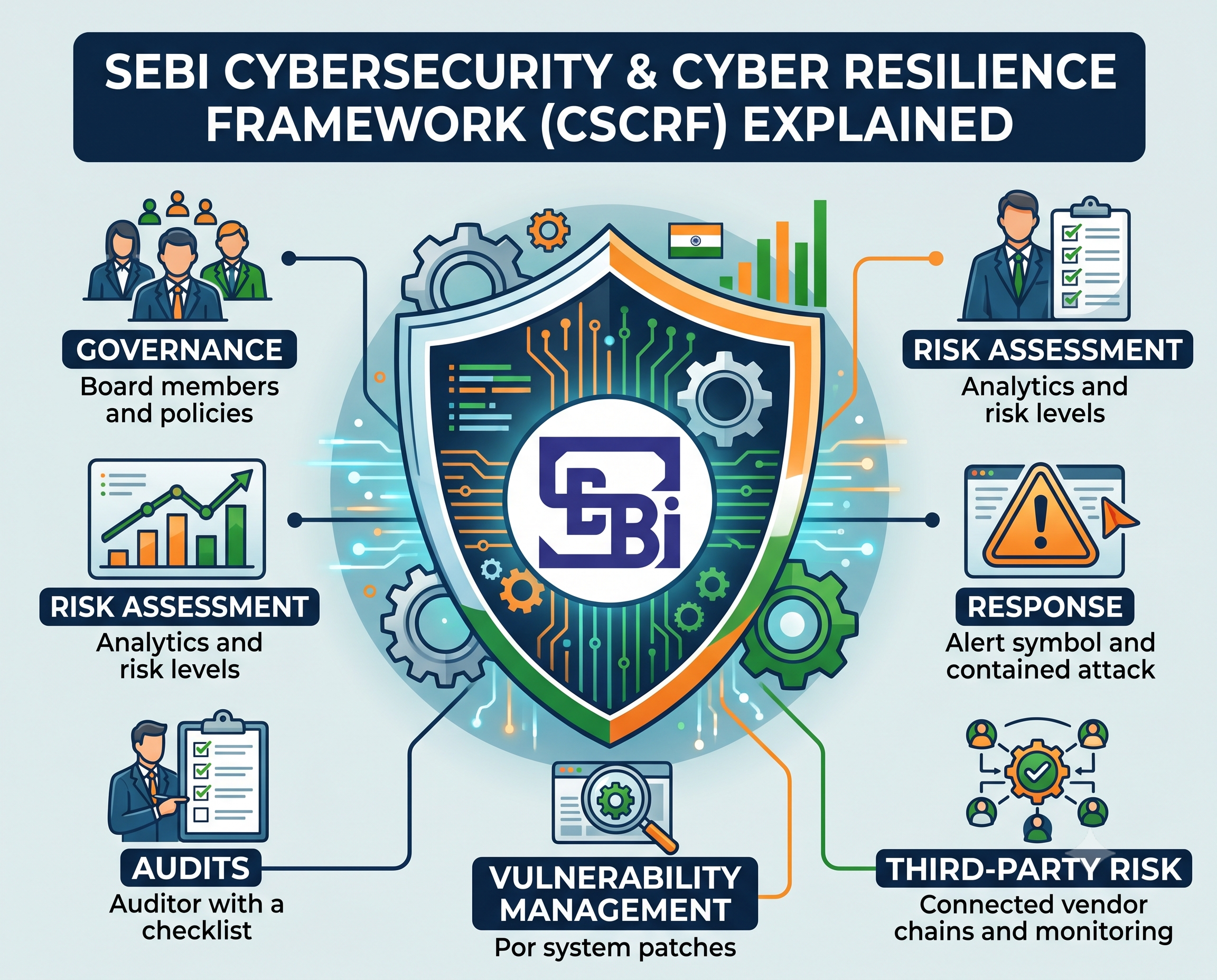
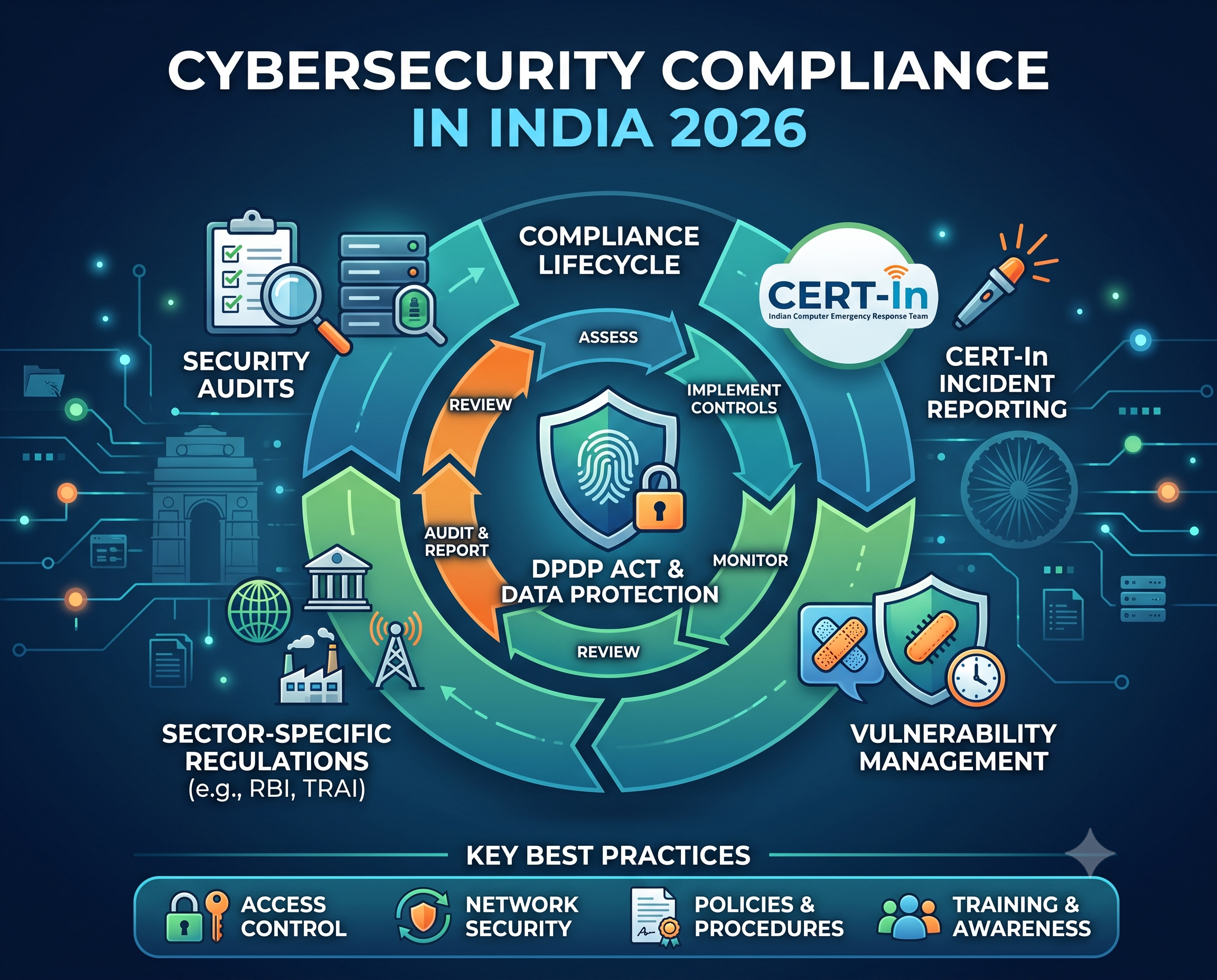
- Regulators are shifting expectations. Frameworks increasingly expect evidence of ongoing control effectiveness, not just an annual snapshot — a theme that runs through India's evolving CERT-In, RBI, and SEBI guidance.
What Continuous Monitoring Actually Tracks
Security Posture Score
A continuously updated score reflecting the overall health of the environment — device compliance rates, patch currency, control coverage — giving leadership a single number to track over time rather than a static report.
Configuration Drift
Detection of any deviation from an approved security baseline: a disabled security control, a changed firewall rule, a newly opened port, or a downgraded encryption setting.
Patch and Vulnerability State
Real-time visibility into which endpoints are missing critical patches, rather than discovering this during the next scheduled vulnerability scan.
Access and Authentication Anomalies
Unusual login patterns, privilege escalations, or access from unexpected locations, surfaced as they happen rather than during log review weeks later.
High-Risk Endpoint Settings
Continuous tracking of USB access, RDP/SSH exposure, Bluetooth state, and open ports — settings that are frequently the entry point for lateral movement during an incident.
Continuous Monitoring vs. a One-Time Audit
The two are complementary, not competing. A cybersecurity audit provides an independent, in-depth assessment — including manual review, interviews, and judgment calls that automated tools can't replace. Continuous monitoring keeps the environment on-track between audits, and critically, gives auditors a stream of historical evidence rather than a single snapshot, often shortening and strengthening the audit process itself.
Getting Started with Continuous Monitoring
Enterprises typically build continuous monitoring in stages:
- Establish a baseline — document the approved secure configuration for each device type and system.
- Deploy lightweight monitoring agents or use existing endpoint management tooling to collect posture data continuously.
- Define alert thresholds so drift is flagged before it becomes a real incident, without generating so much noise that alerts are ignored.
- Feed findings into a remediation workflow, closing the loop between detection and fix rather than leaving monitoring as a dashboard nobody acts on.
- Maintain audit-ready evidence continuously, rather than scrambling to reconstruct historical compliance state when an audit or regulatory inquiry arrives.
How MOBISEC Approaches Continuous Monitoring
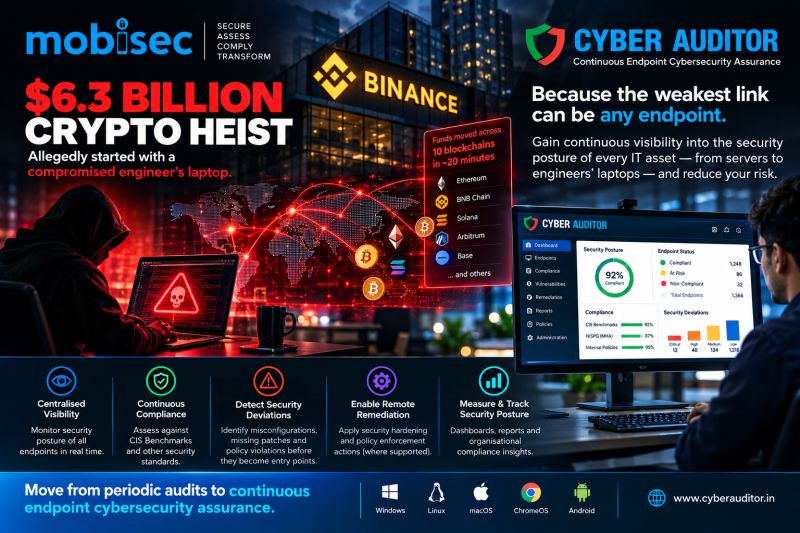
MOBISEC's Cyber Auditor platform continuously assesses device posture and policy compliance across your fleet, flags configuration drift the moment it occurs, and maintains audit-ready evidence automatically — so your next cybersecurity audit starts from a position of visibility, not guesswork.
Recommended Solution
See how MOBISEC solves this in practice
Topics