What Is VAPT?
VAPT stands for Vulnerability Assessment and Penetration Testing. It is a cybersecurity testing approach used to identify security vulnerabilities in systems, applications, networks, infrastructure, and other technology assets and assess the risk associated with those weaknesses.
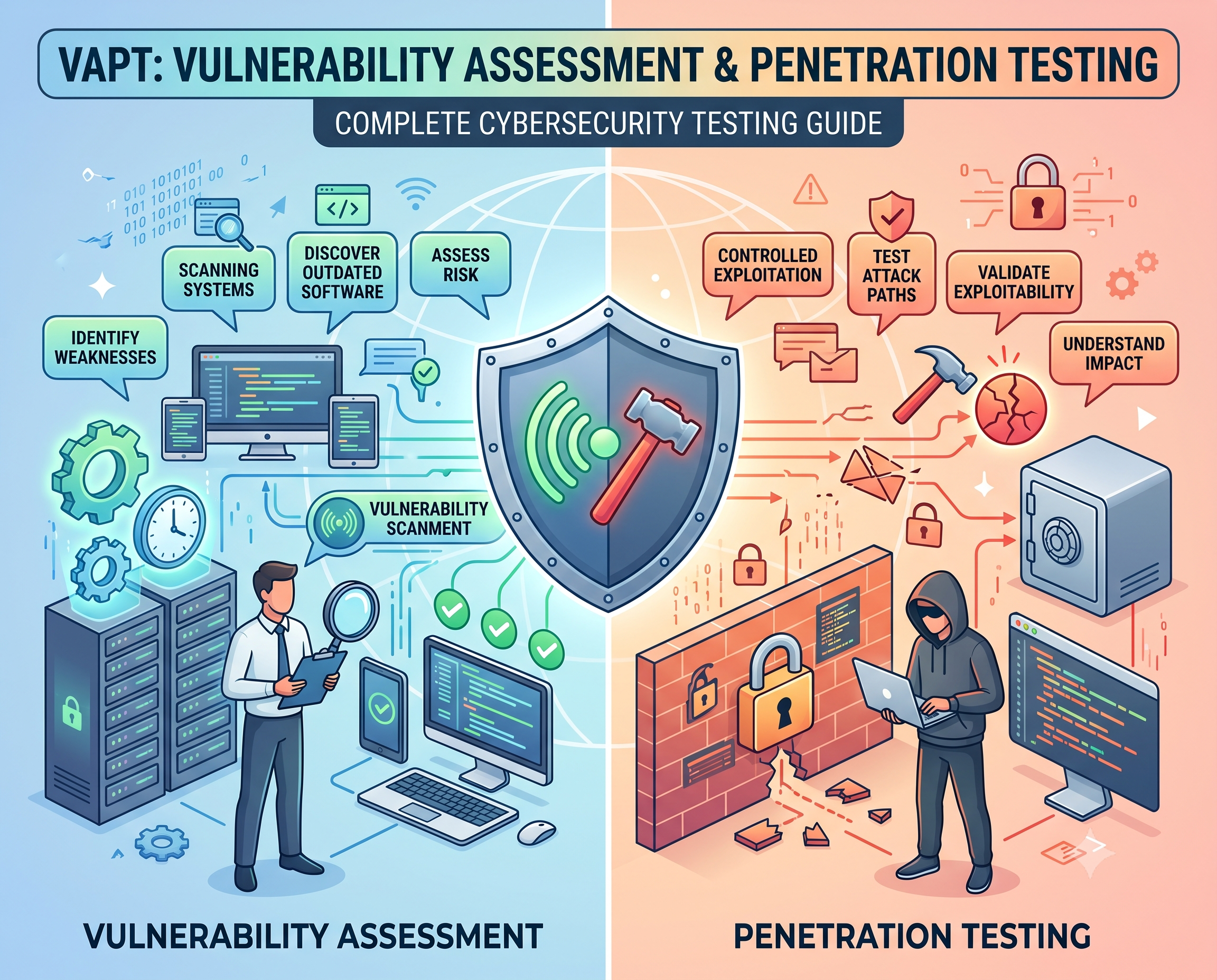
VAPT combines two related but different activities. Vulnerability assessment focuses on discovering and identifying security weaknesses, while penetration testing goes further by attempting to exploit selected vulnerabilities in a controlled and authorised manner.
Together, vulnerability assessment and penetration testing help organisations understand where technical weaknesses exist, how serious those weaknesses may be, and what actions should be taken to reduce security risk.
Why Is VAPT Important?
Modern organisations depend on applications, networks, cloud infrastructure, APIs, servers, endpoints, and other connected systems. Each technology asset can introduce potential security weaknesses that attackers may attempt to exploit.
VAPT provides organisations with a structured way to identify and validate technical security weaknesses before they are exploited by malicious actors.
- Identifies vulnerabilities in technology assets
- Helps discover weaknesses that may be exploited by attackers
- Provides technical evidence of security weaknesses
- Helps security teams prioritise remediation
- Improves visibility into the organisation’s attack surface
- Supports secure application and infrastructure development
- Helps validate security controls
- Supports risk management and security assurance
- Helps organisations improve their overall security posture
Vulnerability Assessment vs Penetration Testing
Although the terms are often used together, vulnerability assessment and penetration testing have different objectives.
What Is Vulnerability Assessment?
Vulnerability assessment is the process of identifying known or suspected security vulnerabilities in systems, applications, networks, software, and infrastructure.
The assessment typically uses automated scanning, security tools, configuration analysis, and manual validation to identify weaknesses that may expose an organisation to security risks.
- Discovers known vulnerabilities
- Identifies outdated software
- Detects vulnerable services
- Identifies security misconfigurations
- Finds exposed ports and services
- Maps affected systems
- Assigns vulnerability severity
- Provides remediation recommendations
What Is Penetration Testing?
Penetration testing is an authorised security testing activity in which testers attempt to exploit identified or suspected weaknesses in a controlled manner.
The objective is to determine whether a vulnerability can actually be exploited and to understand the potential impact of successful exploitation.
- Validates whether vulnerabilities are exploitable
- Tests real-world attack paths
- Evaluates potential business impact
- Identifies weaknesses that may allow unauthorised access
- Tests authentication and authorisation controls
- Provides technical evidence of exploitation
- Helps validate the effectiveness of security controls
How Vulnerability Assessment and Penetration Testing Work Together
Vulnerability assessment and penetration testing complement each other. Vulnerability assessment provides broad visibility into potential weaknesses, while penetration testing provides deeper validation of selected vulnerabilities and attack paths.
- Identify the assets and systems within the approved scope.
- Discover vulnerabilities across the defined environment.
- Analyse and validate identified vulnerabilities.
- Prioritise vulnerabilities based on severity and business risk.
- Select appropriate vulnerabilities or attack paths for penetration testing.
- Perform controlled and authorised exploitation.
- Assess the potential impact.
- Document findings and evidence.
- Recommend remediation actions.
- Retest relevant findings after remediation.
What Does VAPT Cover?
The scope of VAPT depends on the organisation’s technology environment and assessment objectives. A VAPT engagement can focus on networks, applications, APIs, cloud infrastructure, servers, or other technology assets.
- External network infrastructure
- Internal network infrastructure
- Web applications
- Mobile applications
- APIs
- Servers
- Cloud infrastructure
- Databases
- Network devices
- Authentication mechanisms
- Internet-facing services
- Operating systems
- Security configurations
Network VAPT
Network VAPT evaluates network infrastructure and services for vulnerabilities and security weaknesses. It can include external and internal network testing depending on the approved scope.
- Open ports
- Network services
- Exposed systems
- Weak configurations
- Outdated services
- Authentication weaknesses
- Network-level vulnerabilities
- Potential attack paths
Web Application VAPT
Web application VAPT evaluates applications for vulnerabilities that could allow attackers to access data, bypass security controls, manipulate application behaviour, or gain unauthorised access.
- Authentication weaknesses
- Authorisation issues
- Input validation weaknesses
- Injection vulnerabilities
- Session management weaknesses
- Access control issues
- Information disclosure
- Security misconfigurations
- Application logic weaknesses
API VAPT
API VAPT evaluates APIs for weaknesses in authentication, authorisation, input validation, data exposure, and other security controls.
- Broken authentication
- Broken authorisation
- Excessive data exposure
- Improper input validation
- Insecure API endpoints
- Weak access controls
- Rate-limiting weaknesses
- Sensitive information exposure
Mobile Application VAPT
Mobile application VAPT evaluates mobile applications and their supporting APIs for security weaknesses that could expose application data, credentials, communications, or backend functionality.
- Insecure data storage
- Weak authentication
- Weak authorisation
- Insecure communication
- Sensitive information exposure
- Insecure API usage
- Application configuration weaknesses
- Client-side security weaknesses
VAPT Process
A structured VAPT process helps organisations perform security testing in a controlled, measurable, and repeatable manner.
Step 1: Define the Scope
The first step is to define the systems, applications, networks, domains, IP addresses, APIs, or other assets that are authorised for testing.
The scope should clearly identify what can be tested, what is excluded, testing windows, and any operational restrictions.
Step 2: Information Gathering
Security testers gather information about the target environment to understand its attack surface and identify potential entry points.
- Domains
- IP addresses
- Network services
- Application technologies
- Subdomains
- Publicly exposed services
- System information
- Application endpoints
Step 3: Vulnerability Discovery
The next stage involves identifying potential vulnerabilities using automated tools, security scanners, configuration analysis, and manual security testing.
Identified vulnerabilities should be reviewed and validated to reduce false positives and improve the accuracy of the final results.
Step 4: Vulnerability Analysis
Security teams analyse identified vulnerabilities based on severity, exploitability, affected assets, exposure, business impact, and other relevant risk factors.
- Vulnerability severity
- Exploitability
- Affected assets
- Internet exposure
- Data sensitivity
- Potential business impact
- Attack complexity
- Availability of security controls
Step 5: Penetration Testing
Where penetration testing is included within the approved scope, testers attempt controlled exploitation of selected vulnerabilities to determine whether they can be used to compromise systems or security controls.
Penetration testing should always be performed within an authorised scope and according to agreed testing rules to avoid unnecessary disruption to production systems.
Step 6: Reporting
The findings are documented in a VAPT report containing technical details, affected assets, severity, evidence, potential impact, and remediation recommendations.
Step 7: Remediation and Retesting
After vulnerabilities are remediated, organisations may perform retesting to verify whether the identified weaknesses have been successfully addressed.
- Review the VAPT findings.
- Prioritise vulnerabilities.
- Assign remediation responsibilities.
- Apply security fixes or configuration changes.
- Validate the remediation.
- Perform retesting where required.
- Update the vulnerability status.
Common VAPT Findings
VAPT assessments can identify different types of vulnerabilities depending on the systems and applications being tested.
- Outdated software
- Known security vulnerabilities
- Weak passwords
- Weak authentication controls
- Broken access controls
- Insecure configurations
- Exposed network services
- Injection vulnerabilities
- Information disclosure
- Insecure APIs
- Weak encryption
- Session management weaknesses
- Unnecessary services
- Improper privilege controls
How Are VAPT Findings Classified?
VAPT findings are commonly prioritised according to the severity and potential impact of the vulnerability. The exact classification method can vary between assessments and organisations.
- Critical findings may indicate vulnerabilities with potentially severe security impact.
- High findings may represent significant security risks requiring prompt remediation.
- Medium findings may represent meaningful weaknesses that should be addressed according to risk.
- Low findings may represent lower-risk issues or weaknesses with limited impact.
- Informational findings may provide security observations or recommendations without representing a direct vulnerability.
Severity should not be considered in isolation. Organisations should also consider asset criticality, business impact, exposure, exploitability, data sensitivity, and compensating controls when prioritising remediation.
What Is Included in a VAPT Report?
A VAPT report provides the organisation with documented results of the security assessment. The exact structure varies depending on the testing scope and methodology.
- Executive summary
- Assessment scope
- Testing methodology
- Assets assessed
- Testing limitations
- Vulnerability summary
- Detailed vulnerability findings
- Severity ratings
- Technical evidence
- Affected assets
- Potential impact
- Remediation recommendations
- Retesting results where applicable
Executive Summary
The executive summary provides management with a high-level overview of the assessment, major findings, overall risk, and recommended priorities.
Technical Findings
Technical findings provide security teams with detailed information about identified vulnerabilities, affected assets, evidence, potential impact, and recommended remediation.
Remediation Recommendations
Remediation recommendations explain the actions that can be taken to reduce or eliminate the identified security weaknesses.
Benefits of VAPT
- Improves visibility into technical vulnerabilities
- Helps identify weaknesses before attackers exploit them
- Supports vulnerability prioritisation
- Provides technical evidence
- Helps validate security controls
- Improves application security
- Supports network security improvement
- Reduces exploitable attack surface
- Helps security teams focus remediation efforts
- Supports ongoing cybersecurity improvement
VAPT and Risk-Based Remediation
Finding vulnerabilities is only the first part of improving security. Organisations also need a structured remediation process to determine which vulnerabilities should be fixed first.
A risk-based approach considers both technical severity and business context.
- Critical business systems should receive higher priority.
- Internet-facing vulnerabilities may require faster remediation.
- Vulnerabilities affecting sensitive data should be prioritised.
- Exploitable vulnerabilities may require immediate attention.
- Vulnerabilities affecting privileged systems can create significant risk.
- Large-scale vulnerabilities affecting many assets should be evaluated carefully.
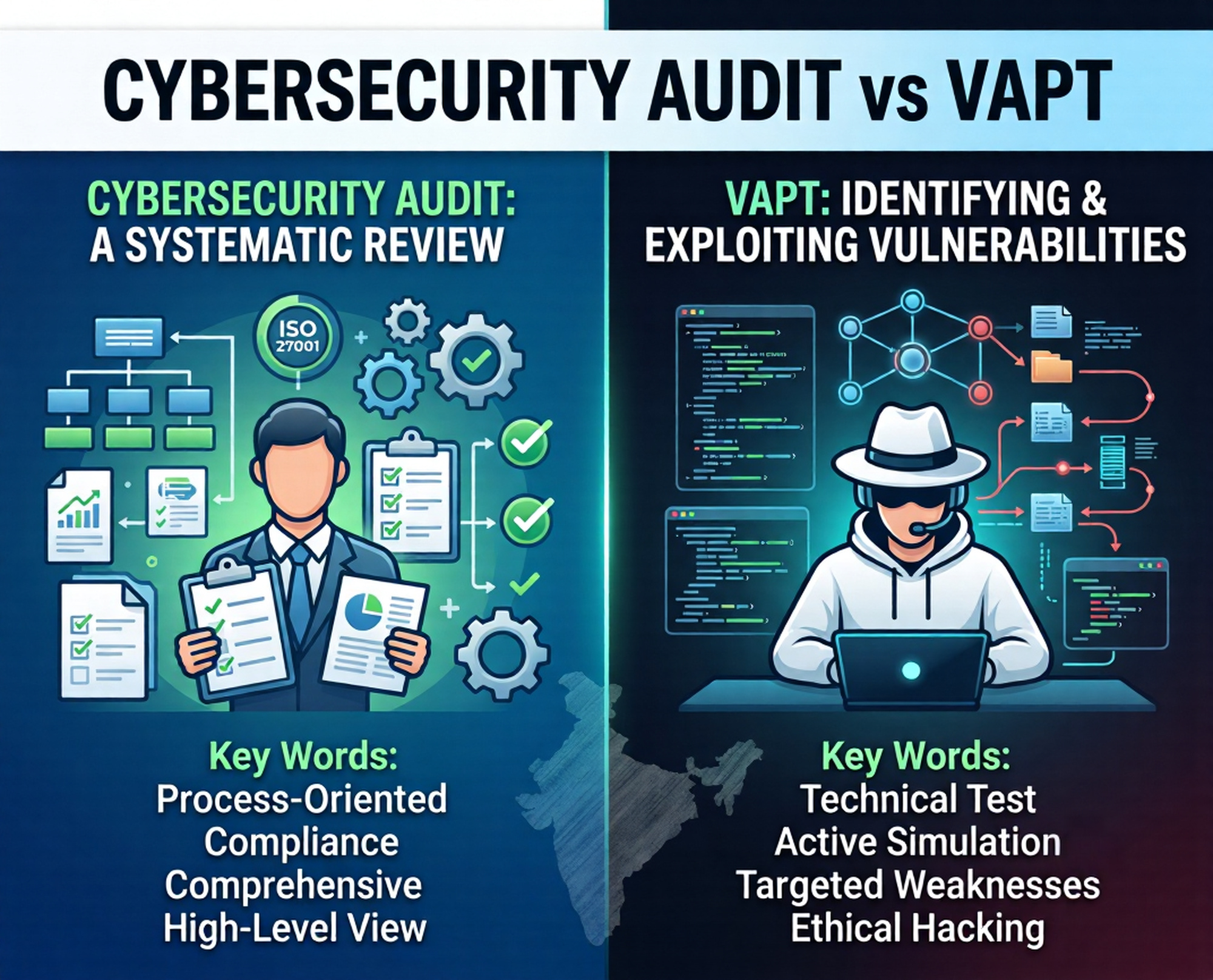
VAPT vs Cybersecurity Audit
VAPT and cybersecurity audits are complementary activities rather than replacements for each other.
VAPT focuses primarily on technical vulnerabilities and exploitability, while a cybersecurity audit evaluates broader security controls, governance, processes, evidence, and compliance requirements.
- VAPT focuses on technical security testing.
- Cybersecurity audits evaluate broader security controls.
- VAPT identifies and validates technical vulnerabilities.
- Audits can identify technical, procedural, governance, and compliance gaps.
- VAPT focuses on defined technical targets.
- Audits can evaluate organisation-wide security practices.
Organisations that need to understand the broader difference between these assessments should also review Cybersecurity Audit vs VAPT.
When Should Organisations Perform VAPT?
The appropriate timing and frequency of VAPT depends on business risk, technology changes, security objectives, exposure, and applicable requirements.
- Before launching a major application
- After significant application changes
- After major infrastructure changes
- When deploying internet-facing systems
- When introducing new APIs
- When assessing cloud infrastructure
- After significant security incidents
- When validating remediation
- As part of a broader security assessment program
- When required by contractual or organisational security requirements
VAPT for Indian Organisations
Indian organisations operate across diverse technology environments including cloud platforms, enterprise applications, mobile applications, network infrastructure, endpoints, and internet-facing services.
VAPT can help organisations identify technical weaknesses within these environments and improve their ability to reduce exploitable attack surfaces.
The scope and frequency of testing should be determined according to the organisation’s technology environment, business risk, applicable requirements, and security objectives.
VAPT Best Practices
- Define a clear testing scope before starting.
- Obtain appropriate authorisation for security testing.
- Maintain documented testing rules and restrictions.
- Use a combination of automated and manual testing.
- Validate important findings to reduce false positives.
- Prioritise vulnerabilities based on risk.
- Protect sensitive information discovered during testing.
- Avoid unnecessary disruption to production systems.
- Document technical evidence accurately.
- Provide practical remediation recommendations.
- Retest important vulnerabilities after remediation.
- Track unresolved vulnerabilities through the remediation lifecycle.
Common VAPT Mistakes
Testing Without a Clearly Defined Scope
Testing systems without a clearly defined and authorised scope can create operational and security risks. Organisations should identify approved targets and testing restrictions before the assessment begins.
Treating Scanner Results as Final Findings
Automated vulnerability scanners can identify potential weaknesses, but scan results may contain false positives. Important findings should be reviewed and validated before remediation decisions are made.
Focusing Only on Severity Scores
A severity score provides useful technical information, but it does not always represent the complete business risk. Asset criticality, exposure, data sensitivity, and business impact should also be considered.
Ignoring Remediation and Retesting
A VAPT assessment provides limited value if identified vulnerabilities remain unresolved. Organisations should track remediation and perform retesting where appropriate.
Performing VAPT Only Once
Security conditions change over time. New software versions, configuration changes, new vulnerabilities, new applications, and infrastructure changes can introduce new risks. VAPT should therefore be part of an ongoing security testing strategy rather than a one-time activity.
VAPT and Continuous Security Monitoring
VAPT provides a point-in-time view of technical security weaknesses within the defined testing scope. Continuous security monitoring provides visibility into security conditions as they change over time.
For example, an organisation may complete VAPT and remediate identified vulnerabilities, but later introduce a new service, configuration change, vulnerable software version, or exposed endpoint.
Continuous monitoring can help detect security changes between formal VAPT assessments, while periodic VAPT provides deeper technical testing and validation.
- VAPT provides periodic technical security testing.
- Continuous monitoring provides ongoing visibility.
- VAPT validates selected technical weaknesses.
- Continuous monitoring can detect changes and deviations.
- VAPT supports vulnerability discovery and validation.
- Continuous monitoring supports ongoing security assurance.
VAPT and Vulnerability Management
VAPT should be integrated into a broader vulnerability management process. Vulnerabilities identified through VAPT should be tracked from discovery through remediation and verification.
- Discover vulnerabilities.
- Validate the findings.
- Assess business and technical risk.
- Prioritise remediation.
- Assign ownership.
- Remediate the vulnerability.
- Retest the affected asset.
- Verify closure.
- Monitor for new or recurring weaknesses.
How VAPT Supports a Stronger Security Program
VAPT should not be viewed as an isolated security activity. Its findings can provide useful input to vulnerability management, patch management, application security, endpoint security, network security, security monitoring, and broader cybersecurity risk management.
- VAPT identifies technical weaknesses.
- Vulnerability management tracks and prioritises those weaknesses.
- Patch management addresses vulnerabilities that require software updates.
- Security hardening reduces unnecessary attack surfaces.
- Continuous monitoring identifies security changes.
- Incident response can use VAPT findings to improve defensive controls.
- Cybersecurity audits can use relevant technical evidence as part of broader control assessments.
Frequently Asked Questions
What does VAPT stand for?
VAPT stands for Vulnerability Assessment and Penetration Testing. It combines vulnerability assessment with controlled penetration testing to identify and validate technical security weaknesses.
What is the difference between vulnerability assessment and penetration testing?
Vulnerability assessment focuses on discovering and identifying security vulnerabilities. Penetration testing attempts to exploit selected vulnerabilities in a controlled and authorised manner to determine their potential impact.
Is VAPT the same as a cybersecurity audit?
No. VAPT primarily focuses on technical vulnerabilities and security testing, while a cybersecurity audit can evaluate broader security controls, governance, policies, processes, evidence, and compliance requirements.
What systems can be tested during VAPT?
Depending on the approved scope, VAPT can cover networks, web applications, mobile applications, APIs, servers, cloud infrastructure, databases, network devices, and other technology assets.
Does VAPT fix vulnerabilities?
VAPT identifies and validates vulnerabilities and provides remediation recommendations. The organisation’s security or technology teams are generally responsible for implementing and verifying the required fixes.
Why is retesting important after VAPT?
Retesting helps verify whether previously identified vulnerabilities have been successfully remediated. It provides additional assurance that the corrective action addressed the reported weakness.
Can VAPT be performed on production systems?
VAPT can be performed against production systems when it is appropriately authorised and planned, but testing restrictions, timing, safeguards, and operational risks should be clearly defined before testing begins.
Key Takeaways
- VAPT stands for Vulnerability Assessment and Penetration Testing.
- Vulnerability assessment focuses on discovering security weaknesses.
- Penetration testing focuses on validating whether selected weaknesses can be exploited.
- VAPT can cover networks, applications, APIs, mobile applications, servers, cloud infrastructure, and other technology assets.
- A structured VAPT process includes scoping, information gathering, vulnerability discovery, analysis, testing, reporting, remediation, and retesting.
- VAPT findings should be prioritised based on both technical severity and business risk.
- VAPT does not replace a broader cybersecurity audit.
- Continuous monitoring complements VAPT by providing ongoing visibility into security changes.
- VAPT should be integrated into vulnerability management and remediation processes.
- Regular security testing helps organisations continuously improve their technical security posture.
Conclusion
VAPT is an important component of an organisation’s cybersecurity strategy because it helps identify and validate technical security weaknesses before they can be exploited by attackers.
Vulnerability assessment provides broad visibility into potential weaknesses, while penetration testing provides deeper validation of selected vulnerabilities and attack paths. Together, they provide security teams with actionable information for improving applications, networks, infrastructure, and other technology assets.
The most effective VAPT programs do not stop at identifying vulnerabilities. Organisations should prioritise findings based on risk, implement remediation, verify fixes through retesting, and combine periodic security testing with vulnerability management and continuous security monitoring.
By making VAPT part of an ongoing cybersecurity program, organisations can reduce exploitable weaknesses, improve security assurance, and build a stronger and more resilient technology environment.
Recommended Solution
See how MOBISEC solves this in practice
Topics