Cybersecurity Audit vs VAPT: Understanding the Difference
Cybersecurity audits and Vulnerability Assessment and Penetration Testing (VAPT) are both important components of an organisation’s cybersecurity program. However, they are not the same activity and should not be treated as interchangeable.
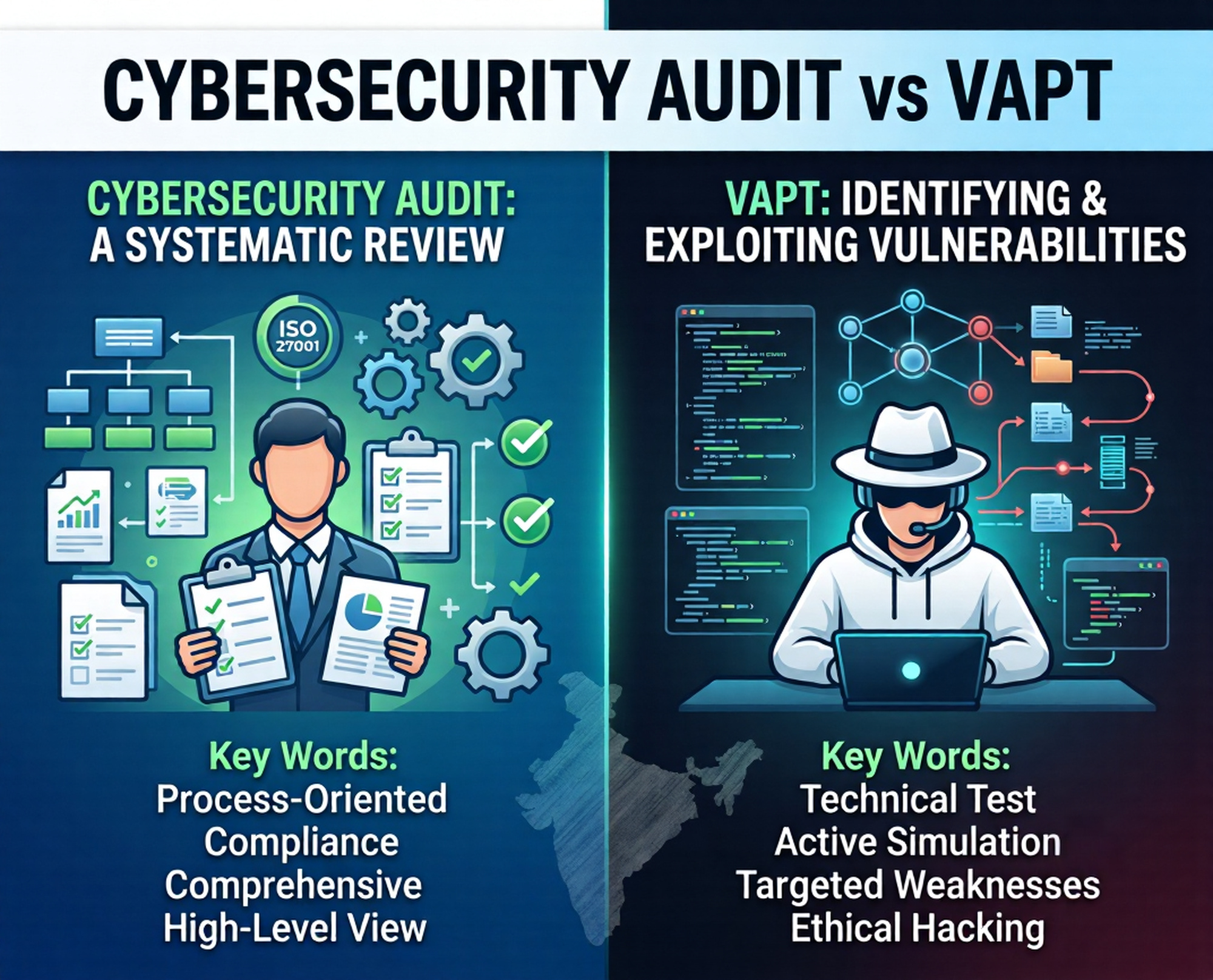
A cybersecurity audit evaluates whether an organisation has appropriate security controls, policies, processes, governance practices, and compliance measures in place. VAPT focuses more specifically on identifying technical vulnerabilities and testing whether those weaknesses can be exploited.
For Indian organisations, understanding the difference between a cybersecurity audit and VAPT is important when planning security assessments, preparing for compliance requirements, improving cyber resilience, and deciding where security testing should be applied.
What Is a Cybersecurity Audit?
A cybersecurity audit is a structured assessment of an organisation’s cybersecurity controls, processes, policies, technologies, and governance practices. Its purpose is to determine whether security measures are appropriately designed, implemented, maintained, and supported by sufficient evidence.
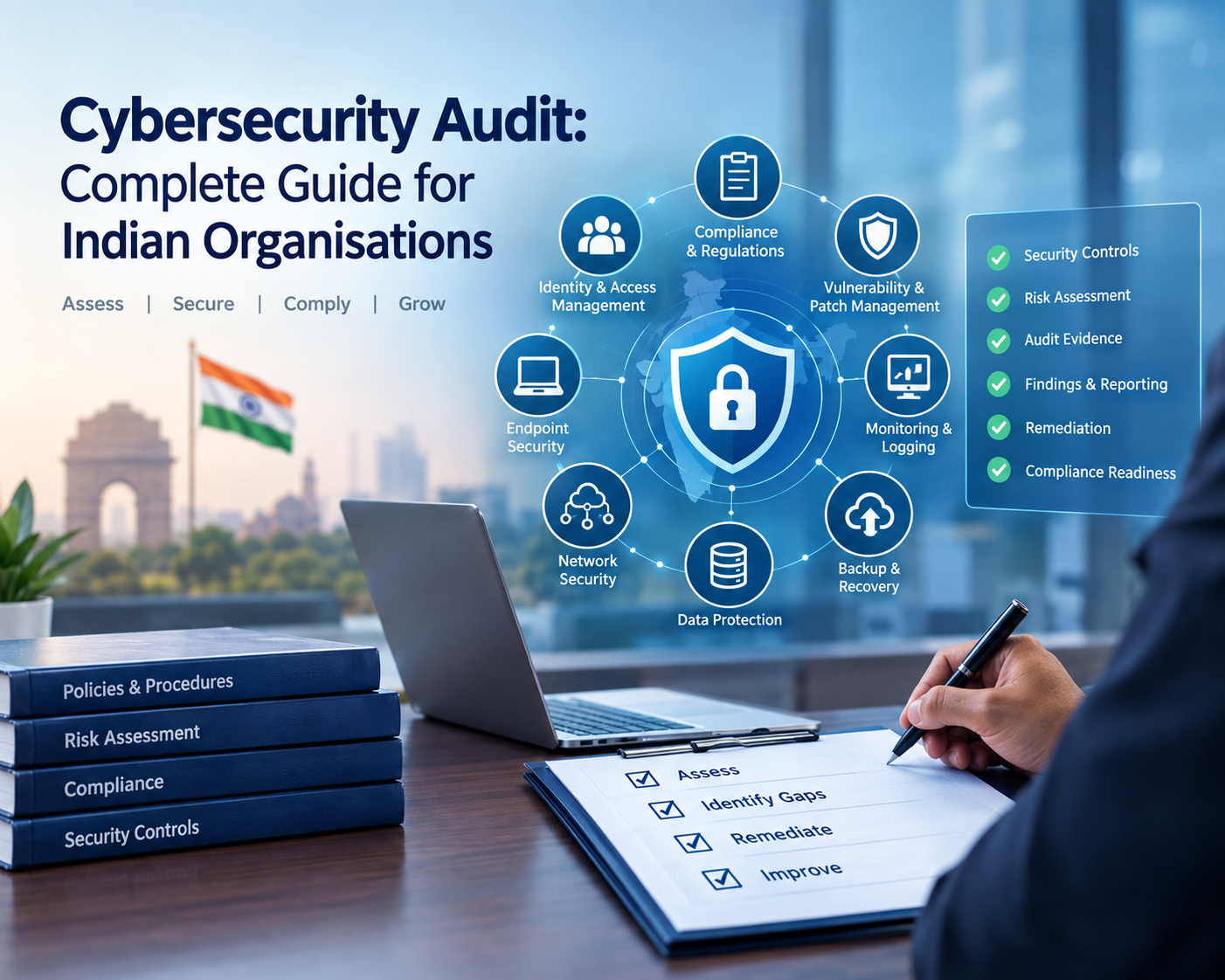
A cybersecurity audit can cover both technical and non-technical areas. Depending on the organisation and audit scope, it may examine identity and access management, endpoint security, network security, data protection, security monitoring, incident response, vulnerability management, backup and recovery, security policies, employee awareness, and compliance requirements.
What Does a Cybersecurity Audit Evaluate?
- Security policies and procedures
- Access control and identity management
- Endpoint and device security
- Network security controls
- Data protection and encryption practices
- Vulnerability and patch management
- Security monitoring and logging
- Incident response processes
- Backup and recovery controls
- Security awareness and organisational processes
- Compliance and governance requirements
- Audit evidence and control effectiveness
Main Objective of a Cybersecurity Audit
The primary objective of a cybersecurity audit is to understand the organisation’s overall security posture and determine whether its controls are operating as expected.
An audit may identify missing controls, ineffective processes, documentation gaps, configuration weaknesses, insufficient evidence, policy violations, or areas where the organisation does not meet an applicable security or compliance requirement.
What Is VAPT?
VAPT stands for Vulnerability Assessment and Penetration Testing. It is a security testing approach used to identify vulnerabilities in systems, applications, networks, infrastructure, and other technology assets and to assess the practical risk associated with those vulnerabilities.
Vulnerability assessment generally focuses on discovering and identifying known security weaknesses. Penetration testing goes further by attempting to exploit selected vulnerabilities in a controlled manner to determine whether they can actually be used to compromise systems, applications, accounts, or data.
What Does VAPT Typically Evaluate?
- Network vulnerabilities
- Web application vulnerabilities
- API vulnerabilities
- Operating system weaknesses
- Outdated or vulnerable software
- Misconfigured services
- Authentication and authorization weaknesses
- Exposed services and ports
- Known security vulnerabilities
- Potential attack paths
- Security control weaknesses that can be technically exploited
Main Objective of VAPT
The primary objective of VAPT is to identify technical vulnerabilities and determine how an attacker could potentially exploit them.
VAPT helps organisations understand which weaknesses are technically exploitable, what impact an exploit could have, and which vulnerabilities should be prioritised for remediation.
Cybersecurity Audit vs VAPT: Key Difference
The simplest way to understand the difference is that a cybersecurity audit evaluates the organisation’s overall security controls and governance, while VAPT focuses on discovering and validating technical vulnerabilities.
- Cybersecurity audit evaluates security controls, processes, governance, and compliance.
- VAPT evaluates technical vulnerabilities and potential attack paths.
- Cybersecurity audits can include technical and non-technical controls.
- VAPT is primarily focused on technical security testing.
- Audits assess whether controls are properly designed and implemented.
- VAPT tests whether technical weaknesses can be discovered or exploited.
- Audits produce findings related to controls, processes, evidence, and compliance.
- VAPT produces technical findings related to vulnerabilities and exploitation.
- An audit provides a broader view of cybersecurity maturity.
- VAPT provides deeper visibility into specific technical attack surfaces.
Cybersecurity Audit vs VAPT: Comparison
- Scope: Cybersecurity audits generally have a broader organisational scope, while VAPT focuses on defined technical assets and attack surfaces.
- Primary Goal: Audits evaluate security controls and governance, while VAPT identifies and validates technical vulnerabilities.
- Assessment Type: Audits involve control and evidence assessment, while VAPT involves security testing and technical analysis.
- Technical Testing: Audits may include technical control verification, while VAPT directly tests systems and applications for vulnerabilities.
- Compliance: Audits are commonly used to evaluate compliance and governance requirements, while VAPT can provide technical evidence supporting security requirements.
- Output: Audit reports generally contain control findings, observations, risks, and recommendations, while VAPT reports contain vulnerabilities, severity ratings, evidence, affected assets, and remediation guidance.
- Attack Simulation: A cybersecurity audit does not necessarily simulate an attacker, while penetration testing may attempt controlled exploitation.
- Frequency: Both activities can be performed periodically, but their frequency should depend on business risk, regulatory requirements, infrastructure changes, and security objectives.
Cybersecurity Audit vs VAPT: Scope
Cybersecurity Audit Scope
A cybersecurity audit can cover the organisation’s entire security environment or a defined subset of controls. The scope is normally based on business requirements, risk, compliance obligations, systems, locations, departments, and security objectives.
- Security governance
- Policies and procedures
- Asset management
- Identity and access management
- Endpoint security
- Network security
- Data security
- Vulnerability management
- Patch management
- Security monitoring
- Incident response
- Business continuity
- Backup and recovery
- Security awareness
- Third-party security
- Compliance controls
VAPT Scope
VAPT normally focuses on a clearly defined technical scope. The scope may include internal networks, external infrastructure, web applications, mobile applications, APIs, cloud environments, servers, endpoints, or specific systems.
- External network infrastructure
- Internal network infrastructure
- Web applications
- Mobile applications
- APIs
- Servers
- Cloud resources
- Databases
- Authentication mechanisms
- Network services
- Internet-facing systems
Cybersecurity Audit vs VAPT: Process
Typical Cybersecurity Audit Process
- Define the audit objectives and scope.
- Identify systems, processes, controls, and stakeholders included in the assessment.
- Collect relevant policies, procedures, configurations, records, and other evidence.
- Evaluate security controls against the defined requirements.
- Interview relevant teams and review operational processes.
- Perform technical verification where required.
- Identify control gaps, weaknesses, and areas of non-compliance.
- Assess the risk associated with identified findings.
- Document audit findings and supporting evidence.
- Prepare the audit report and remediation recommendations.
- Track corrective actions and verify remediation where required.
Typical VAPT Process
- Define the systems, applications, networks, or assets included in the testing scope.
- Confirm testing rules, authorised targets, and testing constraints.
- Perform reconnaissance and information gathering.
- Identify open ports, services, technologies, and potential attack surfaces.
- Perform vulnerability discovery and security testing.
- Validate identified vulnerabilities.
- Perform controlled exploitation where penetration testing is included.
- Assess the potential impact of successful exploitation.
- Document evidence and affected assets.
- Assign severity and prioritise vulnerabilities.
- Provide remediation recommendations.
- Perform retesting after remediation where required.
Cybersecurity Audit vs Vulnerability Assessment
A vulnerability assessment is one part of the broader VAPT process. It generally focuses on identifying known vulnerabilities across the systems included in the assessment.
A cybersecurity audit is broader because it does not only ask whether a vulnerability exists. It also evaluates whether the organisation has appropriate processes and controls for identifying, managing, monitoring, and remediating security weaknesses.
- Vulnerability assessment focuses on technical weaknesses.
- Cybersecurity audit evaluates broader security controls and processes.
- Vulnerability assessment may identify outdated software or known vulnerabilities.
- An audit may evaluate whether vulnerability management policies and remediation processes are properly implemented.
- Vulnerability assessment produces technical vulnerability findings.
- An audit can identify technical, procedural, governance, documentation, and compliance gaps.
Cybersecurity Audit vs Penetration Testing
Penetration testing is a component of security testing in which authorised testers attempt to exploit vulnerabilities in a controlled environment or against approved targets.
The goal is to demonstrate whether vulnerabilities can be exploited and determine their potential impact. A cybersecurity audit has a broader objective and evaluates whether security controls and processes are appropriately implemented.
- Penetration testing focuses on exploitability.
- Cybersecurity audits focus on control effectiveness.
- Penetration testing provides technical evidence.
- Audits can require technical and documentary evidence.
- Penetration testing typically targets defined systems or applications.
- Audits can cover organisation-wide security processes and controls.
Can a Cybersecurity Audit Include VAPT?
Yes. A cybersecurity audit can include VAPT as part of its technical assessment activities when the audit scope and objectives require it.
For example, an organisation may perform a cybersecurity audit to evaluate its overall security controls while using VAPT results as technical evidence for selected systems, applications, or infrastructure.
However, VAPT results alone do not represent a complete cybersecurity audit. A vulnerability report cannot by itself demonstrate that an organisation has effective security governance, access control processes, incident response procedures, security policies, monitoring practices, or adequate audit evidence.
Why Organisations Need Both Cybersecurity Audit and VAPT
Cybersecurity audits and VAPT answer different security questions. Using both provides a more complete view of an organisation’s security posture.
- The audit asks whether appropriate security controls and processes exist.
- VAPT asks whether technical weaknesses can be discovered or exploited.
- The audit evaluates governance and security practices.
- VAPT evaluates technical attack surfaces.
- The audit identifies control and compliance gaps.
- VAPT identifies technical vulnerabilities and exploitation risks.
- The audit supports security assurance and compliance activities.
- VAPT supports technical remediation and vulnerability reduction.
Example of Using Both Assessments
Consider an organisation with thousands of employee endpoints, servers, business applications, and cloud systems.
A cybersecurity audit may determine whether the organisation has an approved vulnerability management policy, defined patching responsibilities, appropriate access controls, security monitoring, incident response procedures, and documented evidence of control operation.
VAPT may then test selected applications, network services, or infrastructure to identify vulnerabilities that could be exploited by an attacker.
The two assessments therefore provide different but complementary perspectives.
Cybersecurity Audit Findings vs VAPT Findings
Typical Cybersecurity Audit Findings
- Missing or outdated security policies
- Inadequate access control procedures
- Insufficient security monitoring
- Weak vulnerability management processes
- Incomplete audit evidence
- Inconsistent security configurations
- Missing incident response documentation
- Insufficient backup and recovery controls
- Unaddressed compliance requirements
- Lack of documented security responsibilities
Typical VAPT Findings
- Critical or high-risk vulnerabilities
- Outdated software with known vulnerabilities
- Weak authentication mechanisms
- Insecure application configurations
- Exposed services
- Injection vulnerabilities
- Broken access control
- Security misconfigurations
- Information disclosure
- Weak encryption implementations
- Potential privilege escalation paths
How Findings Should Be Prioritised
Both cybersecurity audit and VAPT findings should be prioritised based on risk rather than simply the number of findings.
An organisation should consider the severity of the finding, affected assets, business impact, likelihood of exploitation, exposure to attackers, sensitivity of data, regulatory impact, and availability of compensating controls.
- Critical business impact
- High likelihood of exploitation
- Internet-facing exposure
- Sensitive or regulated data
- Privileged system access
- Large number of affected assets
- Lack of compensating controls
- Regulatory or contractual impact
Cybersecurity Audit and VAPT for Indian Organisations
Indian organisations operate in an environment where cybersecurity governance, incident preparedness, security controls, and technical security testing can all be important depending on the organisation, sector, systems, and applicable requirements.
A cybersecurity audit can help organisations evaluate their security governance, controls, evidence, processes, and compliance readiness. VAPT can provide deeper technical visibility into vulnerabilities affecting applications, infrastructure, networks, and other technology assets.
Organisations should determine the appropriate assessment scope based on their business risk, technology environment, contractual obligations, and applicable regulatory or sector-specific requirements.
When Should an Organisation Consider a Cybersecurity Audit?
- When evaluating overall cybersecurity maturity
- When preparing for a compliance or assurance assessment
- When reviewing security governance
- When assessing security controls across multiple departments
- When preparing audit evidence
- After major changes to security processes or infrastructure
- When management needs a broader view of cybersecurity posture
When Should an Organisation Consider VAPT?
- When testing internet-facing applications
- When assessing web or mobile applications
- When evaluating APIs
- When testing network infrastructure
- When validating the security of newly deployed systems
- After major application or infrastructure changes
- When investigating technical security weaknesses
- When validating remediation of previously identified vulnerabilities
How Cybersecurity Audit and VAPT Work Together
The strongest security assessment strategy does not treat cybersecurity audit and VAPT as competing activities. Instead, organisations can use them together to evaluate both the effectiveness of security controls and the technical security of their systems.
- Start with a defined cybersecurity risk and assessment scope.
- Evaluate the organisation’s security policies, processes, and controls.
- Identify areas requiring deeper technical validation.
- Perform VAPT against approved systems and applications.
- Map relevant technical findings to broader security controls.
- Prioritise remediation based on business and security risk.
- Remediate identified vulnerabilities and control gaps.
- Retest technical findings where required.
- Collect updated evidence.
- Maintain ongoing monitoring and security assurance.
Cybersecurity Audit vs VAPT: Which One Should You Choose?
The answer depends on the security objective.
If the primary objective is to evaluate the organisation’s overall security controls, governance, processes, evidence, and compliance readiness, a cybersecurity audit is the more appropriate assessment.
If the objective is to identify and validate technical vulnerabilities in applications, infrastructure, networks, or other systems, VAPT is more appropriate.
For organisations seeking stronger overall security assurance, using both approaches can provide broader and deeper visibility.
- Choose a cybersecurity audit for broader security control and governance assessment.
- Choose VAPT for technical vulnerability discovery and exploitation testing.
- Use both when you need broader security assurance combined with technical validation.
Common Misconceptions About Cybersecurity Audit and VAPT
VAPT Is the Same as a Cybersecurity Audit
VAPT is not the same as a cybersecurity audit. VAPT focuses on technical security testing, while an audit evaluates a wider set of security controls, processes, governance practices, and evidence.
A Clean VAPT Report Means the Organisation Is Fully Secure
A VAPT report with no significant vulnerabilities does not automatically mean that the organisation has mature cybersecurity controls. Security governance, access management, monitoring, incident response, policies, compliance, and operational processes may still contain weaknesses.
A Cybersecurity Audit Finds Every Technical Vulnerability
A cybersecurity audit may identify technical weaknesses, but it is not necessarily designed to perform the same depth of technical testing as a dedicated VAPT engagement.
Only Large Enterprises Need These Assessments
Organisations of different sizes can benefit from cybersecurity audits and VAPT. The appropriate scope and depth should be based on business risk, technology exposure, data sensitivity, and applicable requirements.
How Continuous Monitoring Complements Audit and VAPT
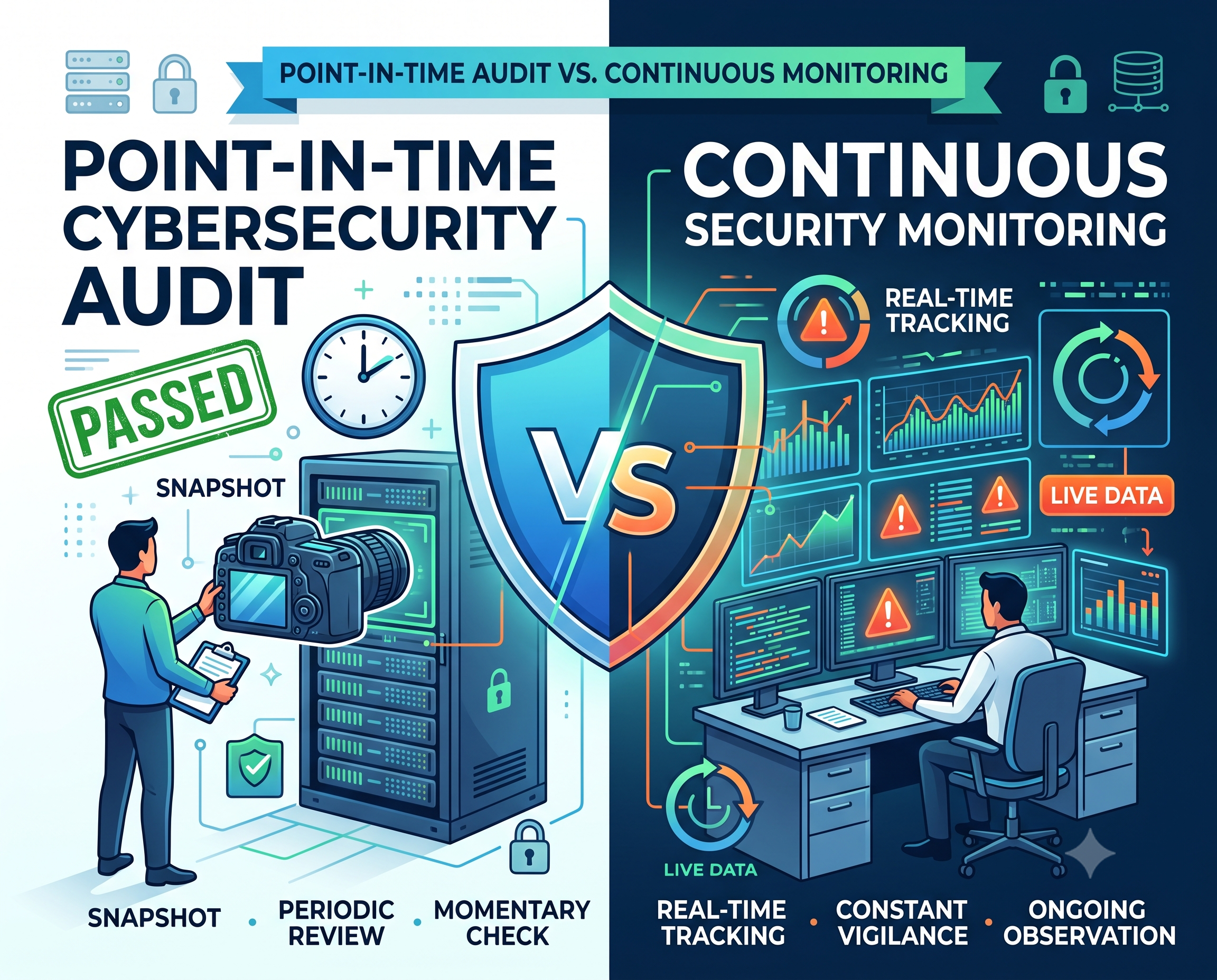
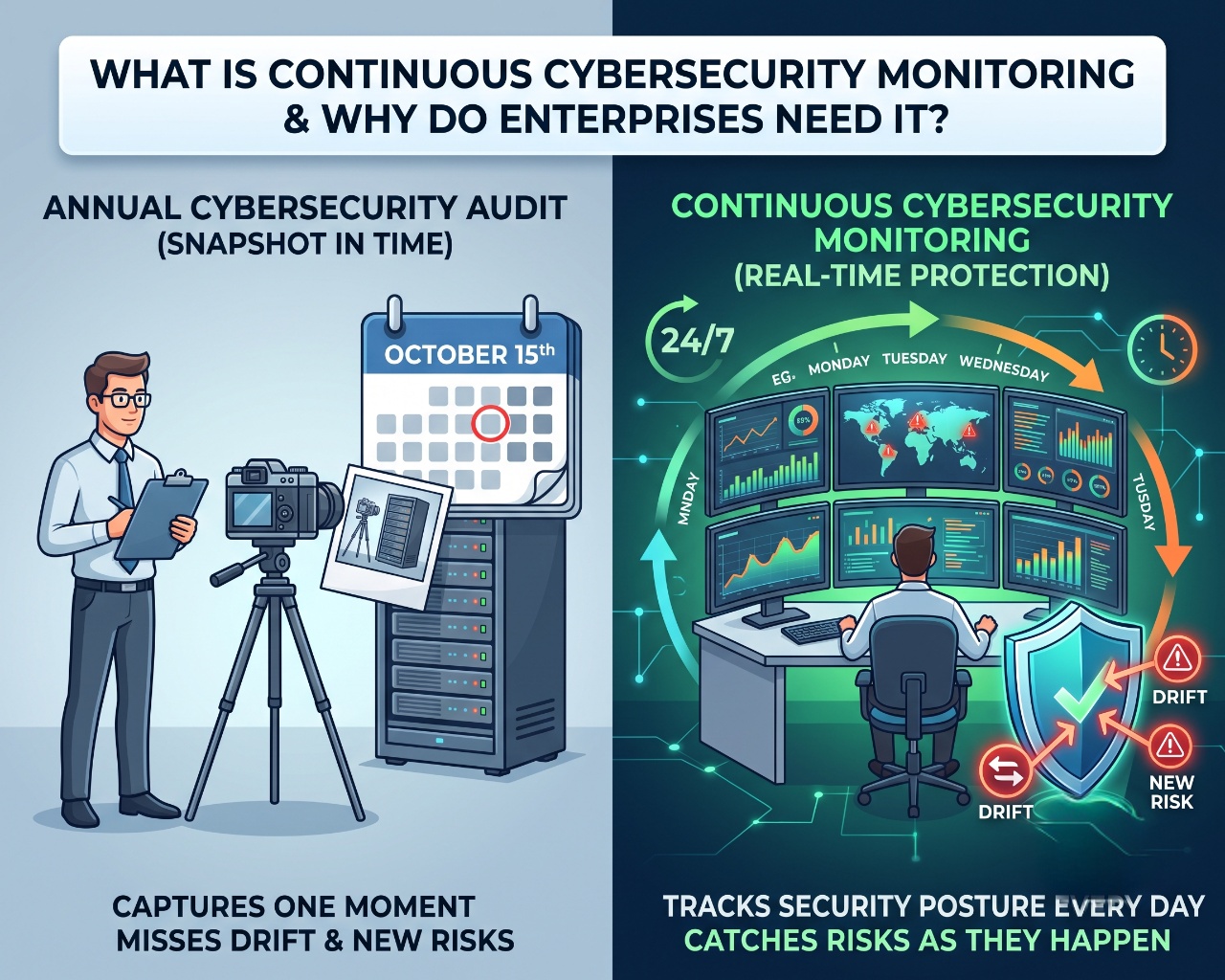
Cybersecurity audits and VAPT are valuable assessment activities, but they generally provide visibility during a defined assessment period. Security conditions can change after the assessment because of new vulnerabilities, configuration changes, software updates, new devices, access changes, or infrastructure modifications.
Continuous security monitoring helps organisations identify changes and security deviations between formal assessments. This can improve visibility into configuration drift, control effectiveness, endpoint security, and audit readiness.
Organisations can therefore use periodic cybersecurity audits and VAPT together with continuous monitoring to build a stronger security assurance program.
Key Takeaways
- Cybersecurity audit and VAPT are complementary but different security activities.
- A cybersecurity audit evaluates broader security controls, processes, governance, and evidence.
- VAPT focuses on discovering and validating technical vulnerabilities.
- Vulnerability assessment identifies security weaknesses, while penetration testing validates exploitability where authorised.
- VAPT can support a cybersecurity audit but does not replace a complete audit.
- Cybersecurity audits can identify technical, procedural, governance, documentation, and compliance gaps.
- VAPT provides deeper technical visibility into defined attack surfaces.
- Organisations should prioritise findings according to business and security risk.
- Using audits, VAPT, and continuous monitoring together can provide stronger security assurance.
Frequently Asked Questions
Is VAPT part of a cybersecurity audit?
VAPT can be included within a cybersecurity audit when technical testing is required by the defined audit scope. However, VAPT alone does not constitute a complete cybersecurity audit because an audit can cover governance, policies, processes, controls, evidence, and compliance requirements.
What is the main difference between cybersecurity audit and VAPT?
The main difference is scope and objective. A cybersecurity audit evaluates broader security controls and organisational practices, while VAPT focuses on identifying and validating technical vulnerabilities.
Which is better, cybersecurity audit or VAPT?
Neither is universally better. They address different objectives. A cybersecurity audit is appropriate for broader security control and compliance assessment, while VAPT is appropriate for technical vulnerability assessment and penetration testing.
Can VAPT replace a cybersecurity audit?
No. VAPT cannot replace a cybersecurity audit when the objective is to evaluate broader cybersecurity governance, controls, processes, evidence, or compliance requirements.
How often should an organisation perform VAPT?
The appropriate frequency depends on the organisation’s risk profile, technology changes, exposure, applicable requirements, and security program. VAPT should also be considered after significant changes to applications, infrastructure, or network architecture.
How does continuous monitoring help after an audit or VAPT?
Continuous monitoring helps organisations identify security changes and control deviations after a formal assessment. It can help detect configuration drift, newly introduced weaknesses, and changes that may affect security posture or audit readiness.
Conclusion
Cybersecurity audit and VAPT serve different purposes but work best as complementary security activities. A cybersecurity audit provides a broader view of an organisation’s security controls, governance, processes, evidence, and compliance readiness, while VAPT provides deeper technical insight into vulnerabilities and potential exploitation paths.
For organisations that want stronger cybersecurity assurance, the objective should not be to choose one assessment permanently. Instead, security teams should determine where each assessment provides value and combine cybersecurity audits, VAPT, remediation, and continuous monitoring according to business risk.
A structured approach helps organisations move beyond identifying individual vulnerabilities toward building measurable, continuously improving cybersecurity resilience.
Recommended Solution
See how MOBISEC solves this in practice
Topics