What Is a Cybersecurity Audit?
A cybersecurity audit is a structured review of an organisation’s cybersecurity controls, policies, processes, systems, and security practices. The purpose is to determine whether security controls are properly designed, implemented, maintained, and capable of reducing cybersecurity risk.
A cybersecurity audit can identify weaknesses such as insecure configurations, excessive user privileges, missing security controls, outdated systems, insufficient monitoring, weak security policies, and gaps in compliance evidence.
For Indian organisations, cybersecurity audits are becoming an important part of cybersecurity governance because businesses increasingly depend on cloud services, endpoints, applications, networks, remote access, and third-party platforms.
Why Is a Cybersecurity Audit Important for Indian Organisations?
Indian organisations manage business information, customer information, employee data, financial information, intellectual property, and critical operational systems. A weakness in any part of this environment can increase the risk of data breaches, malware, ransomware, unauthorised access, service disruption, and other cyber incidents.
A cybersecurity audit provides management and security teams with a structured view of how effectively security controls are operating and where improvements are required.
- Identify cybersecurity weaknesses before they become serious incidents
- Evaluate the effectiveness of security controls
- Identify insecure system and endpoint configurations
- Review user access and privileged permissions
- Identify gaps in cybersecurity policies and procedures
- Improve cybersecurity risk management
- Support compliance and governance activities
- Improve audit readiness
- Strengthen incident preparedness
- Provide management with visibility into security risks
What Does a Cybersecurity Audit Cover?
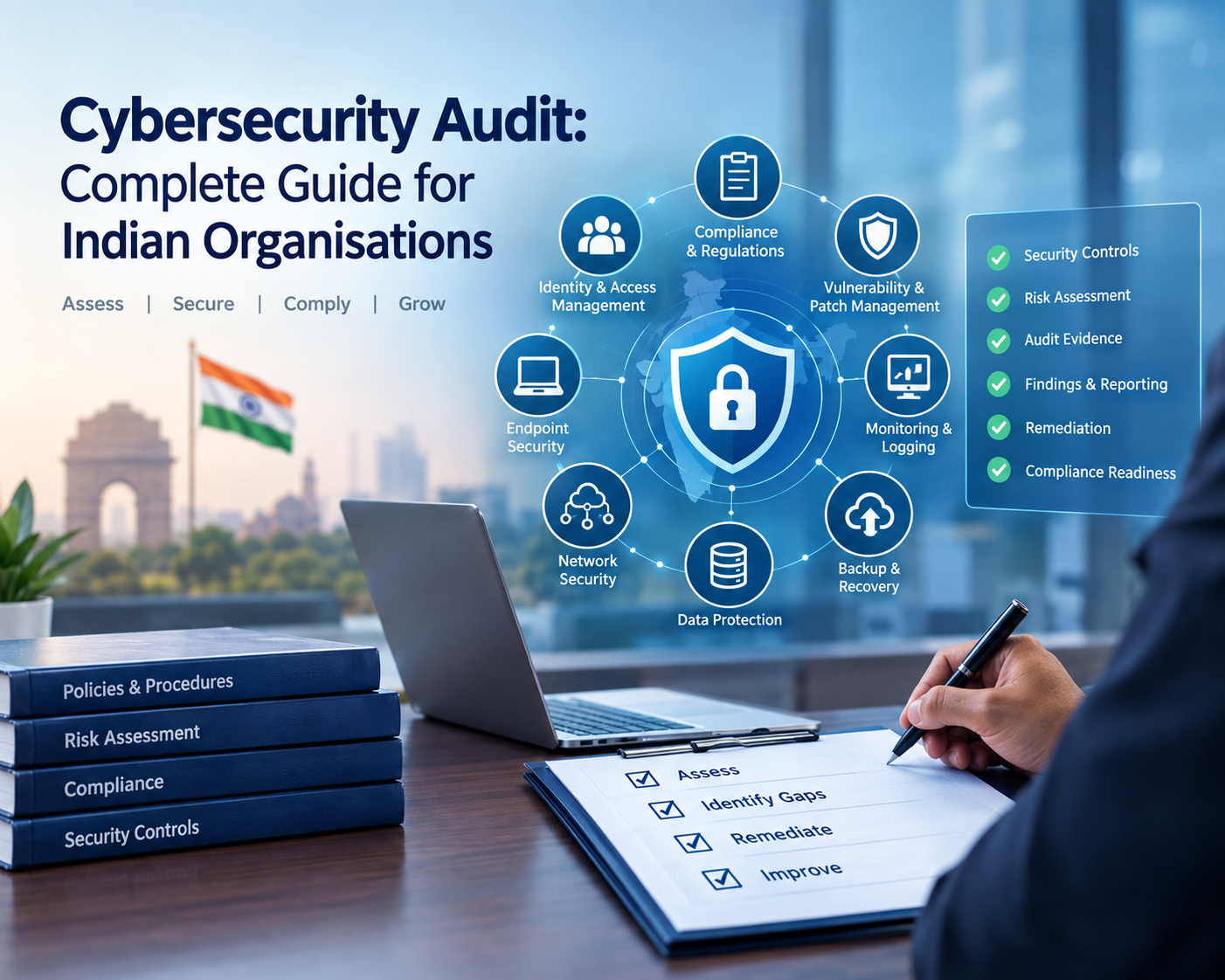
The scope of a cybersecurity audit depends on the organisation, industry, technology environment, business requirements, and audit objectives. A comprehensive audit can cover both technical security controls and organisational processes.
- Identity and access management
- User and administrator accounts
- Privileged access
- Endpoint security
- Operating system security
- Network security
- Firewall controls
- Application security
- Cloud security
- Data protection
- Vulnerability management
- Patch management
- Security logging
- Security monitoring
- Backup and recovery
- Incident response
- Security policies
- Security awareness
- Third-party security
- Compliance controls
Cybersecurity Audit Objectives
Before starting an audit, the organisation should define clear objectives. These objectives determine what will be assessed and what evidence will be required.
- Determine whether security controls are implemented
- Identify weaknesses in security controls
- Evaluate cybersecurity risk
- Verify compliance with internal requirements
- Evaluate security policies and procedures
- Assess access control effectiveness
- Review endpoint and infrastructure security
- Evaluate vulnerability and patch management
- Assess security monitoring capabilities
- Review incident response readiness
- Identify remediation requirements
- Improve overall security posture
Cybersecurity Audit vs Security Assessment
A cybersecurity audit and a security assessment are closely related but have different objectives. A security assessment generally focuses on identifying risks and weaknesses, while an audit evaluates security controls against defined requirements, policies, standards, or compliance expectations.
- Security assessments focus strongly on identifying security risks
- Cybersecurity audits evaluate controls against defined requirements
- Security assessments can be highly technical
- Audits commonly require documented evidence
- Audits can support governance and compliance activities
- Both activities can identify security weaknesses
- Both can contribute to cybersecurity improvement
Key Areas of a Cybersecurity Audit
Identity and Access Management
Identity and access management is one of the most important areas of a cybersecurity audit. Excessive permissions, inactive accounts, weak authentication, and unmanaged administrator accounts can increase the impact of a compromised identity.
- User account management
- Privileged account management
- Role-based access control
- Least-privilege access
- Password policies
- Multi-factor authentication
- Inactive account management
- Access reviews
- Administrator account monitoring
- Joiner, mover, and leaver processes
Endpoint Security
Endpoints such as laptops, desktops, workstations, and servers are common targets for malware, ransomware, credential theft, and unauthorised access. An audit should determine whether endpoints have appropriate security controls and secure configurations.
- Endpoint protection
- Operating system security configuration
- Security software
- Host firewall
- Application control
- Device encryption
- USB and removable media controls
- Local administrator privileges
- Endpoint logging
- Security updates
- Security configuration compliance
Network Security
Network security controls help prevent unauthorised access and reduce the ability of attackers to move between systems after gaining access to the environment.
- Firewall configuration
- Network segmentation
- Network access control
- Secure remote access
- VPN security
- Wireless security
- Intrusion detection
- Intrusion prevention
- Network monitoring
- Administrative access controls
Vulnerability and Patch Management
Unpatched vulnerabilities can provide attackers with opportunities to compromise systems and applications. A cybersecurity audit should evaluate whether vulnerabilities are identified, prioritised, remediated, and tracked.
- Vulnerability scanning
- Risk-based vulnerability prioritisation
- Security patch management
- Critical vulnerability remediation
- Patch testing
- Patch exceptions
- Remediation tracking
- Vulnerability reporting
- Periodic vulnerability assessment
- Verification of remediation
Security Monitoring and Logging
Security monitoring helps organisations identify suspicious activities and investigate security incidents. An audit should verify whether important systems generate appropriate security logs and whether those logs are monitored and retained.
- Authentication logging
- Endpoint logging
- Administrative activity logging
- Security event monitoring
- Centralised log collection
- Security alerting
- Log retention
- Time synchronisation
- Monitoring of critical systems
- Monitoring of security controls
Data Protection
Data protection controls help prevent unauthorised access, disclosure, modification, and loss of sensitive information.
- Data classification
- Access restrictions
- Encryption
- Secure data transmission
- Data retention
- Data backup
- Data disposal
- Database security
- Sensitive data protection
- Data access monitoring
Backup and Recovery
Backup and recovery controls are important because organisations need to recover critical systems and information after ransomware, cyber incidents, hardware failures, or other disruptions.
- Backup policies
- Backup schedules
- Backup access controls
- Backup protection
- Isolated or protected backups
- Recovery testing
- Disaster recovery procedures
- Business continuity planning
- Recovery responsibilities
- Backup monitoring
Cybersecurity Audit Process
A structured cybersecurity audit process helps organisations evaluate security controls consistently and produce useful findings and remediation plans.
- Define the audit objectives
- Define the audit scope
- Identify systems and assets within scope
- Identify applicable security requirements
- Define the controls to be evaluated
- Collect cybersecurity evidence
- Review policies and procedures
- Evaluate technical and operational controls
- Identify security gaps
- Classify findings according to risk
- Prepare the audit report
- Define remediation actions
- Assign remediation owners
- Track remediation progress
- Validate completed remediation
Step 1: Define the Audit Scope
The audit scope determines which systems, applications, infrastructure, endpoints, processes, users, and data will be evaluated. A clearly defined scope prevents important assets from being unintentionally excluded.
- Business applications
- Endpoints
- Servers
- Cloud environments
- Network infrastructure
- Databases
- Data repositories
- Remote access systems
- Critical business processes
- Third-party services
- Security management systems
Step 2: Identify Applicable Security Requirements
Once the scope has been defined, the organisation should identify the security requirements against which controls will be evaluated.
These requirements may come from internal security policies, organisational standards, customer contracts, industry requirements, regulatory expectations, or other obligations applicable to the organisation.
The audit criteria should be documented clearly so that every finding can be connected to a specific security requirement or expected control.
Step 3: Collect Cybersecurity Audit Evidence
Audit evidence allows auditors and security teams to verify whether controls are actually implemented and maintained.
- Security policies
- Security procedures
- Asset inventories
- User access reports
- Privileged access reports
- Endpoint security reports
- Configuration reports
- Vulnerability reports
- Patch reports
- Firewall configurations
- Security logs
- Monitoring reports
- Backup reports
- Incident records
- Risk assessments
- Previous audit reports
- Remediation records
Step 4: Evaluate Security Controls
During control evaluation, auditors determine whether required controls are implemented and whether they operate effectively.
A security control may exist in a written policy but still be ineffective if it is not consistently implemented or monitored. Therefore, cybersecurity audits should evaluate both documented processes and actual technical or operational evidence.
Step 5: Identify Cybersecurity Audit Findings
Audit findings describe weaknesses, gaps, or areas where existing controls do not meet the defined requirements.
Findings should be documented clearly so that security teams understand what is wrong, why it matters, what assets are affected, and what action is required.
How Are Cybersecurity Audit Findings Classified?
Organisations should use a consistent risk-based approach when classifying audit findings. Risk classification helps security teams prioritise remediation.
- Critical
- High
- Medium
- Low
- Observation
- Improvement opportunity
The severity of a finding can depend on factors such as business impact, affected assets, exposure, exploitability, data sensitivity, number of affected systems, and existing compensating controls.
Common Cybersecurity Audit Findings
Many organisations encounter similar security weaknesses during cybersecurity audits. Identifying these issues early can help security teams improve controls before formal assessments.
- Excessive user privileges
- Unmanaged administrator accounts
- Inactive accounts that remain enabled
- Weak authentication controls
- Missing multi-factor authentication
- Unsupported operating systems
- Missing security patches
- Critical vulnerabilities without remediation
- Inconsistent endpoint configurations
- Unnecessary services
- Weak firewall controls
- Poor network segmentation
- Insufficient security logging
- Inadequate log retention
- Unprotected sensitive information
- Weak backup controls
- Outdated security policies
- Incomplete incident response procedures
- Insufficient security monitoring
- Unresolved previous audit findings
Cybersecurity Audit Checklist
A cybersecurity audit checklist helps security teams systematically review important controls and collect the evidence needed to support the assessment.
- Review the organisation’s asset inventory
- Review user accounts
- Review privileged accounts
- Verify least-privilege access
- Verify multi-factor authentication
- Review endpoint security
- Check operating system security configurations
- Review patch levels
- Review vulnerability remediation
- Check firewall configurations
- Review network segmentation
- Review remote access controls
- Verify encryption controls
- Review security logs
- Review monitoring coverage
- Review backup controls
- Test recovery procedures
- Review incident response procedures
- Review security policies
- Review third-party security controls
- Review previous audit findings
- Verify remediation status
Cybersecurity Audit and Indian Compliance
Cybersecurity audits can help Indian organisations evaluate whether their security practices align with applicable legal, regulatory, contractual, and industry requirements.
The specific requirements applicable to an organisation depend on factors such as its industry, services, data handled, technology environment, and regulatory obligations.
Organisations should identify the requirements that apply specifically to their business and maintain appropriate evidence showing how relevant security controls are implemented.
CERT-In and Cybersecurity Audit Readiness
CERT-In requirements are an important consideration for organisations operating in India. Security teams should understand the requirements applicable to their organisation and ensure that relevant security processes, records, logging, and incident response capabilities are appropriately maintained.
Cybersecurity audit programmes can help organisations identify gaps in these areas and establish documented remediation actions.
SEBI Cybersecurity Requirements and Audits
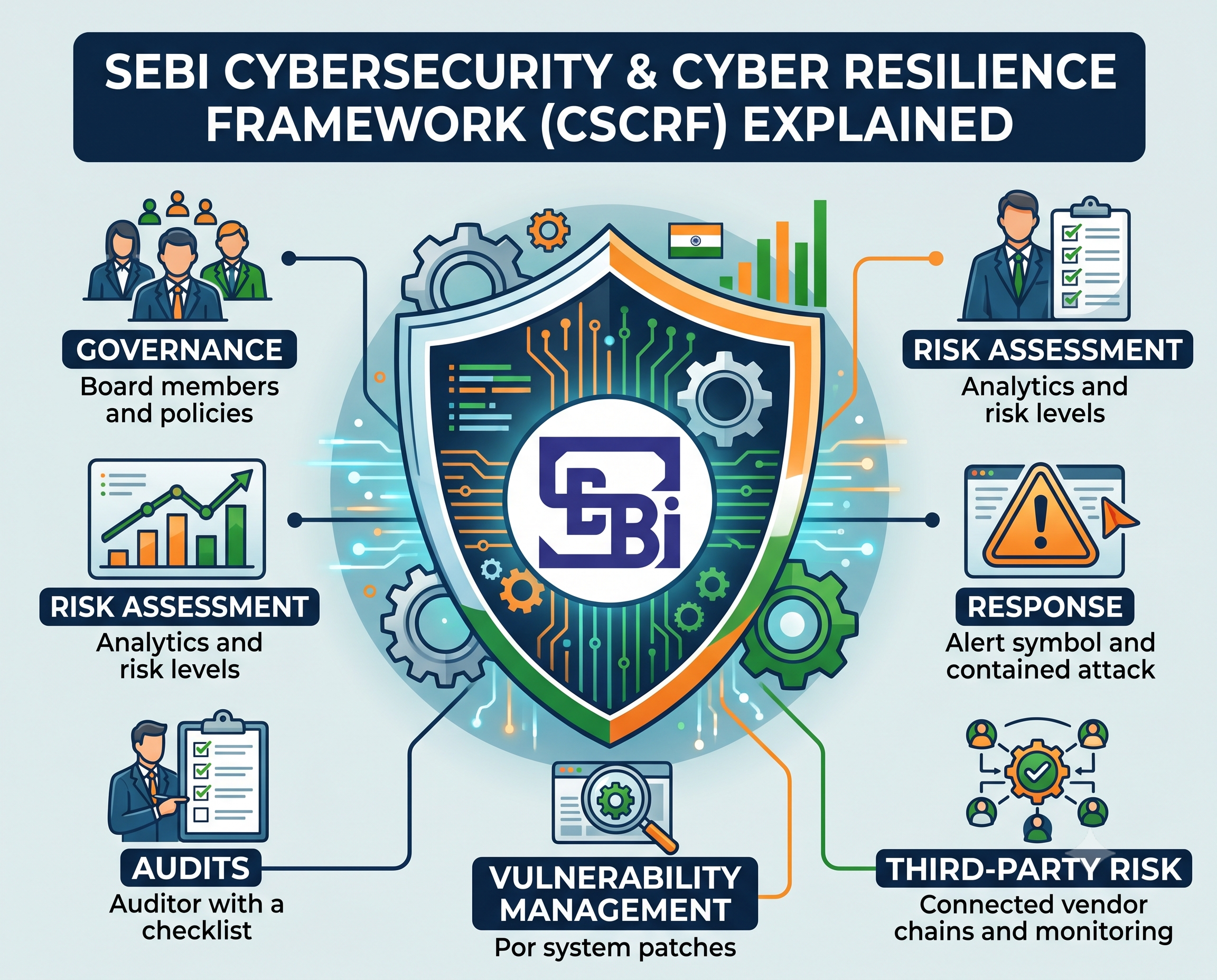
Organisations operating within the securities market ecosystem may need to consider cybersecurity requirements and frameworks applicable to their role and regulatory environment.
A cybersecurity audit can help organisations evaluate relevant security controls, document evidence, identify gaps, and track remediation activities.
RBI Cybersecurity and IT Governance Requirements
Financial institutions and other organisations subject to RBI requirements need strong cybersecurity and IT governance processes appropriate to their regulatory environment.
Cybersecurity audits can support the review of access controls, security configurations, monitoring, vulnerability management, incident response, data protection, and other relevant security controls.
MHA NISPG and Cybersecurity Practices
Organisations may also need to consider relevant cybersecurity guidance and requirements associated with national information security practices.
Audit and compliance teams should identify the requirements applicable to their organisation and map them to documented security controls and evidence.
Cybersecurity Audit Evidence and Documentation
Strong documentation makes cybersecurity audits more efficient and helps demonstrate that security controls are implemented and maintained.
- Security policies
- Standard operating procedures
- Asset inventories
- Access review reports
- Endpoint compliance reports
- Configuration reports
- Vulnerability reports
- Patch reports
- Firewall rules
- Network diagrams
- Security monitoring reports
- Incident response records
- Backup verification records
- Risk registers
- Remediation plans
- Previous audit reports
- Security control evidence
Why Continuous Monitoring Improves Cybersecurity Audits
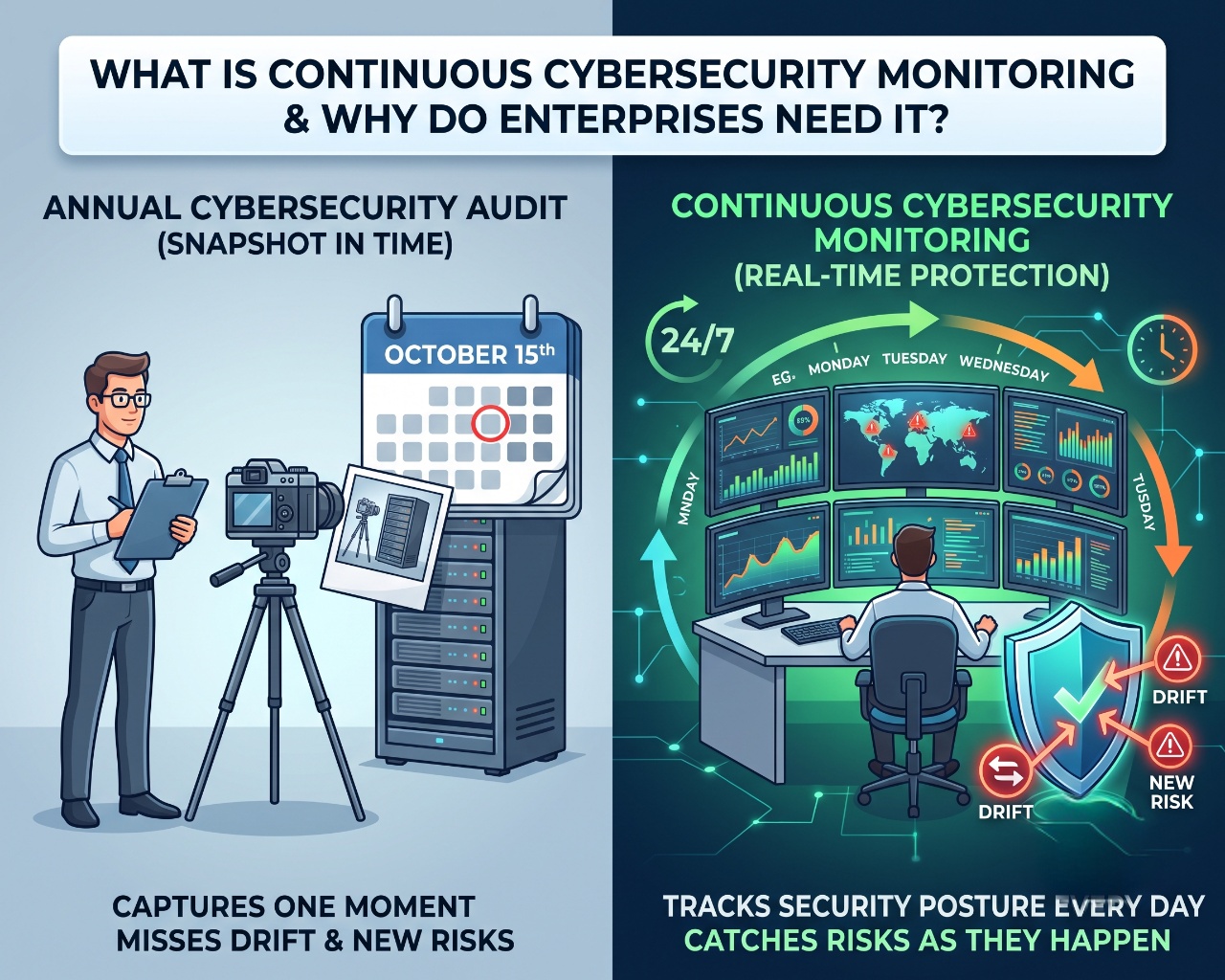
A traditional cybersecurity audit provides a view of security controls during a defined audit period. Enterprise environments, however, change continuously as users, devices, applications, configurations, vulnerabilities, and security controls change.
Continuous cybersecurity monitoring helps organisations identify changes between formal audits and provides better visibility into whether security controls remain compliant over time.
- Detect configuration changes
- Identify security control failures
- Monitor endpoint security posture
- Track vulnerabilities and patches
- Identify configuration drift
- Monitor security baselines
- Generate ongoing security evidence
- Improve audit readiness
- Reduce the gap between formal audits
Cybersecurity Audit and Configuration Drift
Configuration drift occurs when systems gradually move away from an approved or secure configuration.
An endpoint may meet the organisation’s security baseline during an audit but become non-compliant later because of software installation, configuration changes, administrator actions, policy changes, or other system modifications.
Continuous monitoring can help detect these changes and provide security teams with evidence that can be used for investigation and remediation.
Cybersecurity Audit and Endpoint Security
Endpoint security should be an important part of an enterprise cybersecurity audit because endpoints are distributed across users, offices, remote locations, and business environments.
- Operating system configuration
- Security baseline compliance
- Endpoint protection
- Local administrator access
- Firewall status
- Application control
- USB controls
- Security updates
- Vulnerability status
- Endpoint monitoring
- Configuration changes
How to Prepare for a Cybersecurity Audit
Organisations should prepare for cybersecurity audits continuously rather than attempting to resolve all security gaps immediately before an audit.
- Maintain an accurate asset inventory
- Document cybersecurity policies
- Define security configuration baselines
- Review user and administrator access
- Maintain vulnerability management processes
- Maintain patch management processes
- Monitor endpoint security controls
- Maintain security logs
- Test backup and recovery procedures
- Review incident response plans
- Track previous audit findings
- Maintain remediation records
- Continuously monitor critical security controls
Cybersecurity Audit Reporting
A cybersecurity audit report should communicate the audit scope, assessment results, security findings, risk levels, and recommended corrective actions in a clear format.
- Executive summary
- Audit objectives
- Audit scope
- Assessment methodology
- Systems reviewed
- Security controls reviewed
- Evidence evaluated
- Key findings
- Risk ratings
- Business impact
- Recommended corrective actions
- Remediation owners
- Target remediation dates
- Overall security observations
How to Prioritise Cybersecurity Audit Findings
Organisations should prioritise audit findings according to their potential impact and risk rather than treating every finding equally.
- Critical business systems should receive higher priority
- Internet-facing weaknesses should be assessed quickly
- Known exploitable vulnerabilities should receive urgent attention
- Privileged access weaknesses should be prioritised
- Sensitive data exposure should receive high priority
- Repeated audit findings should be investigated
- Issues affecting large numbers of endpoints should be assessed at scale
- Findings with weak or missing compensating controls should receive higher priority
Cybersecurity Audit Remediation Process
A cybersecurity audit should lead to measurable improvements. Each finding should have a clear remediation action, responsible owner, target date, and validation method.
- Document the finding
- Identify the root cause
- Assess the business and security impact
- Assign a remediation owner
- Define the corrective action
- Set a target completion date
- Implement the corrective control
- Validate the remediation
- Update the audit evidence
- Close the finding
Cybersecurity Audit vs VAPT
A cybersecurity audit and vulnerability assessment and penetration testing have different purposes. A cybersecurity audit evaluates security controls, processes, policies, and evidence against defined requirements, while VAPT focuses on identifying and validating technical vulnerabilities and potential attack paths.
- Cybersecurity audits evaluate security governance and controls
- Vulnerability assessments identify technical vulnerabilities
- Penetration testing validates whether vulnerabilities can be exploited
- Audits commonly require documented evidence
- VAPT provides technical security findings
- Both activities can complement each other
- VAPT can form one component of a broader cybersecurity assurance programme
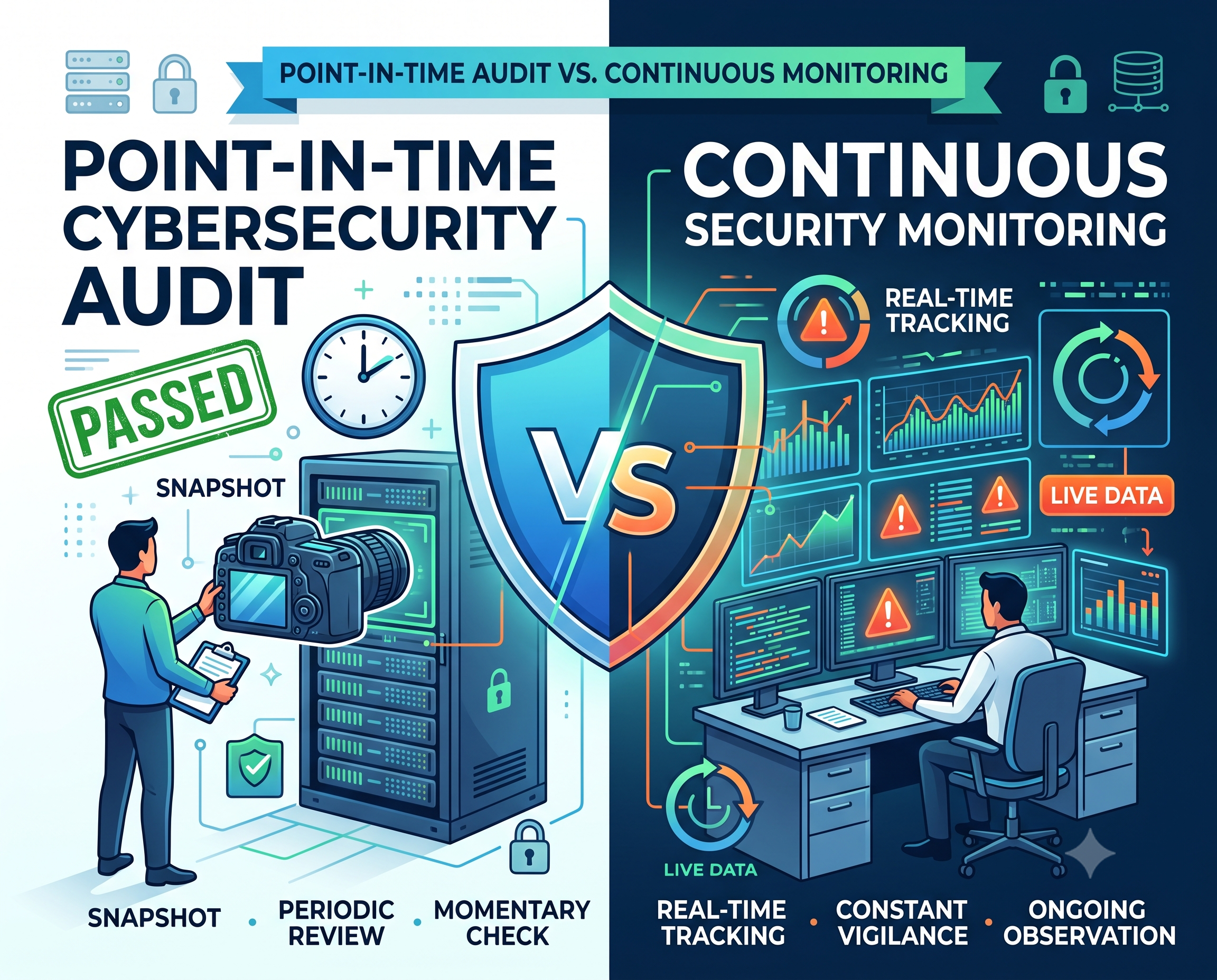
Cybersecurity Audit vs Continuous Security Monitoring
A cybersecurity audit evaluates security controls during a defined assessment period, while continuous security monitoring provides ongoing visibility into security controls and changes.
Organisations can benefit from both approaches. Audits provide structured assurance, while continuous monitoring helps identify security changes between formal assessments.
Benefits of a Mature Cybersecurity Audit Programme
- Better visibility into cybersecurity risk
- Improved security control effectiveness
- Earlier identification of security weaknesses
- Improved compliance readiness
- Stronger audit evidence
- Better remediation tracking
- Reduced configuration drift
- Improved security governance
- Greater accountability
- Improved incident preparedness
- Better management visibility
Common Cybersecurity Audit Mistakes
- Treating cybersecurity audits as a one-time compliance exercise
- Focusing only on documentation
- Ignoring endpoint configurations
- Failing to monitor configuration changes
- Not tracking remediation
- Using outdated asset inventories
- Ignoring privileged accounts
- Failing to validate security controls
- Collecting insufficient evidence
- Ignoring recurring audit findings
- Failing to define remediation ownership
- Not monitoring security controls between audits
Best Practices for Cybersecurity Audits
- Define a clear audit scope
- Use risk-based control prioritisation
- Maintain an accurate asset inventory
- Document security policies and procedures
- Establish secure configuration baselines
- Regularly review privileged access
- Maintain vulnerability and patch management
- Monitor critical security controls
- Maintain reliable audit evidence
- Track findings through remediation
- Validate corrective actions
- Investigate recurring findings
- Use continuous monitoring between formal audits
- Review and update the audit programme regularly
How Cyber Auditor Can Support Cybersecurity Assurance
Cybersecurity audit activities become more effective when organisations have continuous visibility into endpoint security controls, configurations, vulnerabilities, and security posture.
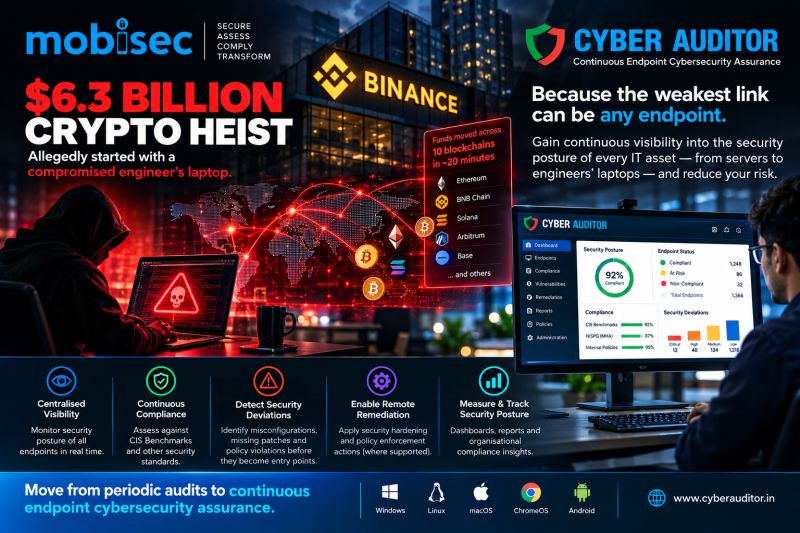
A platform such as Cyber Auditor can support organisations by providing visibility into security controls and helping security teams identify configuration and compliance gaps that require attention.
The goal is not to replace the organisation’s audit process, but to improve visibility, evidence collection, monitoring, and remediation across the environment.
Frequently Asked Questions About Cybersecurity Audits
What is a cybersecurity audit?
A cybersecurity audit is a structured evaluation of an organisation’s cybersecurity controls, policies, processes, systems, and evidence to determine whether security requirements are being met and cybersecurity risks are being appropriately managed.
Why do Indian organisations need cybersecurity audits?
Cybersecurity audits help Indian organisations identify security weaknesses, evaluate security controls, improve governance, support compliance activities, and maintain evidence demonstrating that security practices are implemented and maintained.
What is included in a cybersecurity audit?
A cybersecurity audit can include identity and access management, endpoint security, network security, vulnerability and patch management, application security, data protection, logging, monitoring, backup and recovery, incident response, security policies, and compliance controls.
Is a cybersecurity audit the same as penetration testing?
No. A cybersecurity audit evaluates security controls and processes against defined requirements, while penetration testing focuses on identifying and validating exploitable technical weaknesses. Both can be used together as part of a broader cybersecurity programme.
How often should a cybersecurity audit be performed?
The appropriate frequency depends on the organisation’s risk profile, industry, regulatory requirements, contractual obligations, technology environment, and internal governance requirements. Organisations should also use continuous monitoring to maintain visibility between formal audit cycles.
What evidence is required for a cybersecurity audit?
Typical evidence includes security policies, access reviews, asset inventories, configuration reports, vulnerability reports, patch records, security logs, monitoring reports, backup records, incident records, risk assessments, and remediation evidence.
Can continuous monitoring replace a cybersecurity audit?
Continuous monitoring does not necessarily replace a formal cybersecurity audit. Monitoring provides ongoing visibility into security controls and system changes, while an audit provides structured assurance against defined requirements.
What happens after a cybersecurity audit?
After an audit, organisations should prioritise findings, assign remediation owners, define corrective actions, set target dates, implement fixes, validate remediation, and maintain evidence showing that identified weaknesses have been addressed.
Conclusion
A cybersecurity audit provides Indian organisations with a structured way to evaluate security controls, identify weaknesses, improve cybersecurity governance, and prepare for applicable compliance requirements.
However, cybersecurity should not be treated as a once-a-year compliance exercise. Enterprise environments continuously change, and security controls can become ineffective when systems, users, applications, configurations, and vulnerabilities change.
Combining regular cybersecurity audits with continuous security monitoring, vulnerability management, patch management, endpoint hardening, and structured remediation helps organisations maintain stronger security controls and improve their overall cyber resilience.
A mature cybersecurity programme should therefore connect audit findings with continuous monitoring and remediation so that security teams can move from simply identifying problems to continuously improving the organisation’s security posture.
Recommended Solution
See how MOBISEC solves this in practice
Topics