SOC vs SIEM vs MDR vs XDR: What's the Difference?
SOC, SIEM, MDR, and XDR are different components or approaches used in modern cybersecurity operations. They are often discussed together because they can work together to improve an organization's ability to monitor systems, detect threats, investigate suspicious activity, and respond to security incidents.
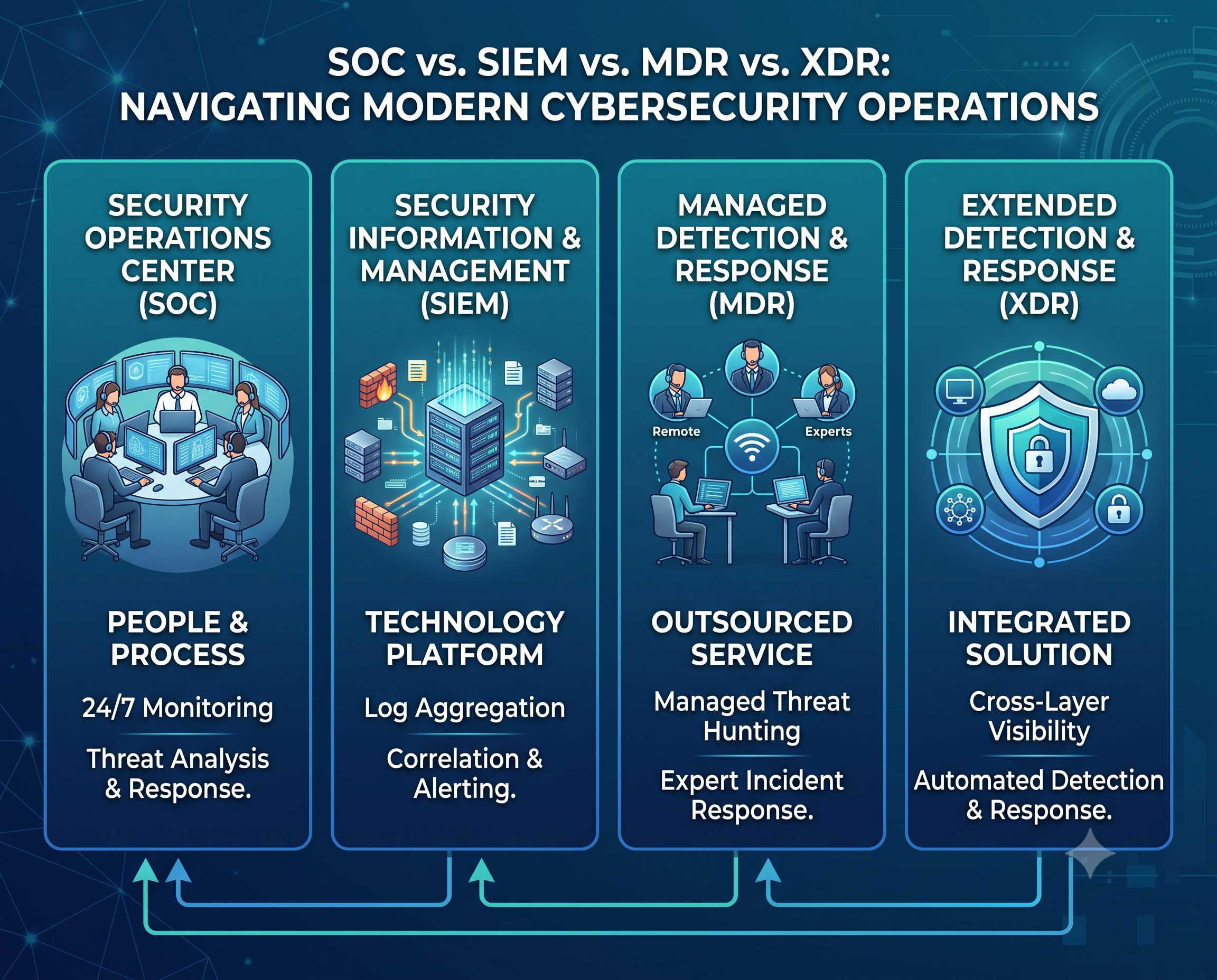
However, they are not interchangeable. A Security Operations Centre is an operational security function that combines people, processes, and technologies. SIEM is a technology platform for collecting and analyzing security events. MDR is a managed cybersecurity service focused on threat detection and response. XDR is a security technology approach that correlates detection and response capabilities across multiple security layers.
Understanding these differences helps organizations select the right security capabilities instead of treating SOC, SIEM, MDR, and XDR as competing products.
What Is a SOC?
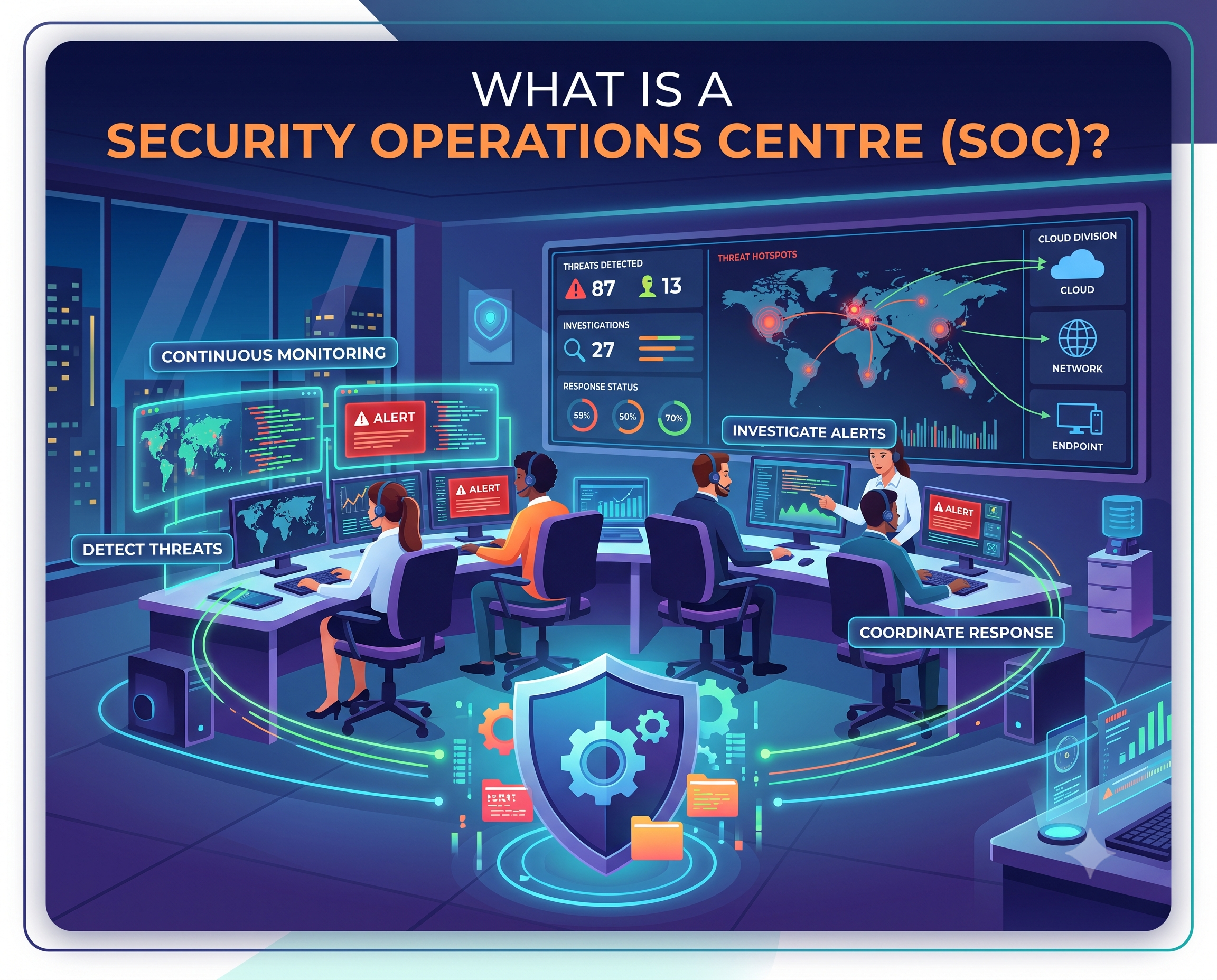
A Security Operations Centre (SOC) is a centralized cybersecurity function responsible for continuously monitoring an organization's technology environment, investigating security alerts, detecting threats, and coordinating incident response.
A SOC combines three major elements: people, processes, and technology. Security analysts use monitoring and detection technologies to identify suspicious activity, investigate security events, prioritize incidents, and coordinate response activities.
- Security monitoring
- Threat detection
- Alert triage
- Security investigation
- Incident response
- Threat intelligence
- Security reporting
- Security operations management
A SOC can be operated internally by an organization's security team, provided through a Managed SOC service, or operated through a hybrid model.
What Is SIEM?
SIEM stands for Security Information and Event Management. A SIEM platform collects security logs and events from multiple systems and provides capabilities for event correlation, analysis, alerting, investigation, and security visibility.
SIEM can collect information from endpoints, servers, applications, networks, authentication systems, firewalls, cloud environments, and other security controls.
What Does SIEM Do?
- Collects security logs and events
- Centralizes security information
- Correlates events from different sources
- Generates security alerts
- Supports security investigations
- Provides dashboards and reporting
- Helps security teams search historical events
- Supports detection and monitoring workflows
A SIEM is therefore a technology component that can support SOC operations. A SIEM by itself does not represent the complete SOC function because it does not replace the people and operational processes required for investigation and response.
What Is MDR?
MDR stands for Managed Detection and Response. MDR is a managed cybersecurity service in which a security provider helps organizations detect, investigate, and respond to threats.
MDR services are designed to provide organizations with security expertise and operational capabilities without requiring them to build every detection and response function internally.
What Does MDR Typically Provide?
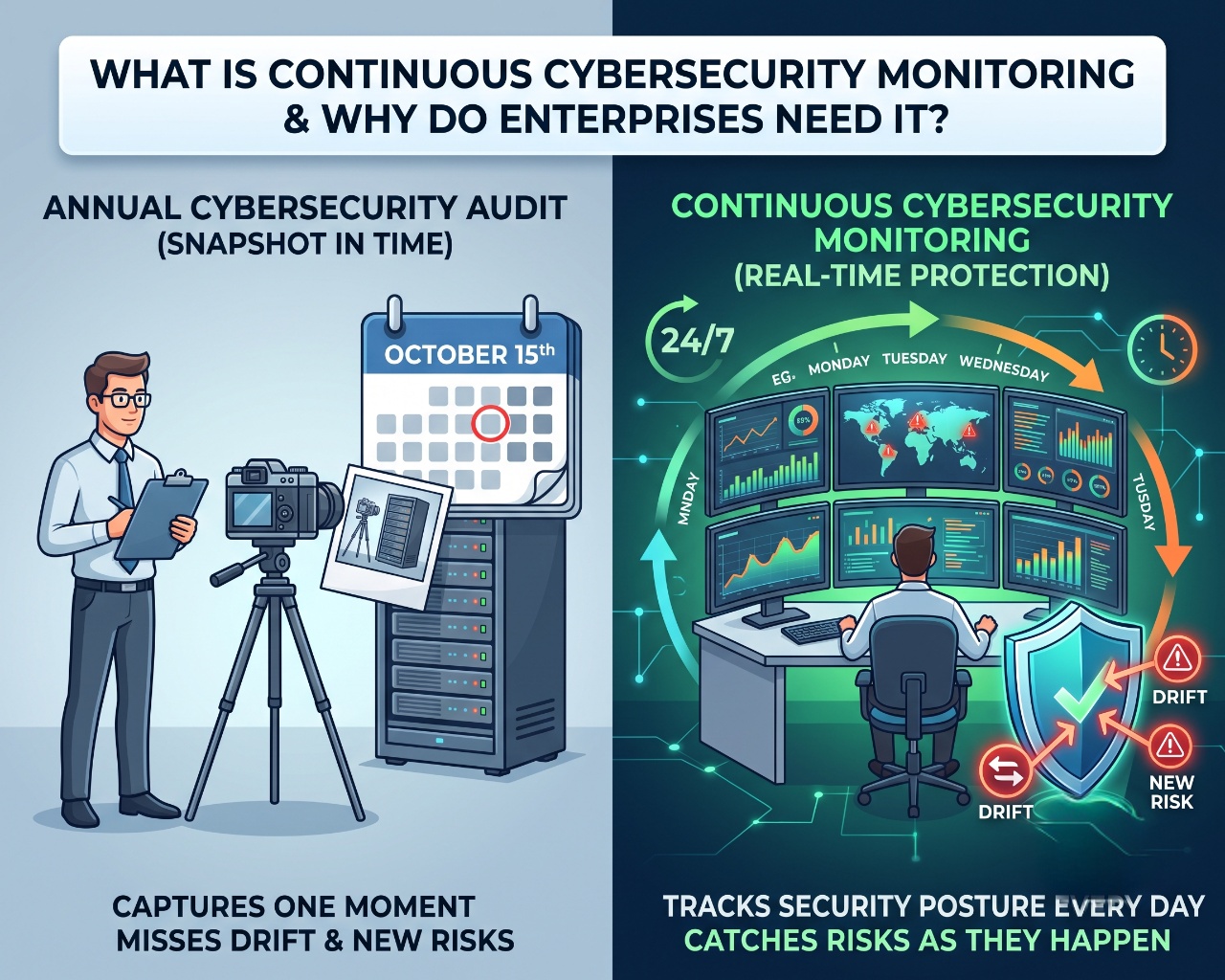
- Continuous security monitoring
- Threat detection
- Alert investigation
- Threat analysis
- Incident triage
- Incident response support
- Threat hunting
- Security expertise
- Incident escalation
- Security recommendations
The exact capabilities of an MDR service vary by provider. Organizations should evaluate the monitoring coverage, detection capabilities, response procedures, technologies, service-level agreements, and escalation model before selecting an MDR provider.
What Is XDR?
XDR stands for Extended Detection and Response. XDR is a security technology approach designed to improve threat detection and investigation by correlating security signals across multiple security layers.
Instead of analyzing endpoint, network, email, identity, and cloud security events separately, XDR can connect related signals to provide a broader view of potential attack activity.
Security Layers XDR Can Connect
- Endpoint security
- Network security
- Email security
- Identity security
- Cloud security
- Application security
- Server security
By connecting signals across security layers, XDR can help security teams understand attack activity that may not be obvious when each security event is analyzed independently.
SOC vs SIEM
SOC and SIEM are related but represent different things. A SOC is an operational security function, while SIEM is a technology platform that can be used by a SOC.
- SOC combines people, processes, and technology
- SIEM is primarily a security event management technology
- SOC analysts investigate and respond to security events
- SIEM collects and correlates security events
- SOC defines operational procedures and escalation processes
- SIEM provides security visibility and event analysis capabilities
A SOC can use SIEM as one of its core monitoring technologies, but a SIEM does not automatically create a complete SOC.
SOC vs MDR
SOC and MDR are also different concepts. A SOC describes the security operations function, while MDR describes a managed service focused on detection and response.
- SOC can be internal, external, or hybrid
- MDR is generally delivered as a managed cybersecurity service
- SOC includes broader operational processes
- MDR focuses strongly on managed detection and response
- Internal SOCs require dedicated personnel and infrastructure
- MDR can provide access to external security expertise
An organization can use an MDR provider as part of its broader security operations strategy.
SOC vs XDR
A SOC is a security operations function, while XDR is a technology approach that can help security teams correlate and investigate threats across multiple security layers.
- SOC provides people, processes, and security operations
- XDR provides cross-layer detection and response capabilities
- SOC analysts investigate security incidents
- XDR correlates signals across security environments
- SOC manages escalation and response workflows
- XDR can provide contextual security visibility
XDR can therefore become an important technology component within a modern SOC.
SIEM vs MDR
SIEM and MDR are not direct equivalents. SIEM is a technology platform, while MDR is a managed service that can include detection, investigation, and response capabilities.
An organization may deploy a SIEM internally and operate its own security monitoring team. Alternatively, it may use a managed service provider to monitor security events and investigate threats.
Key Differences
- SIEM is a security technology
- MDR is a managed security service
- SIEM focuses heavily on event collection and analysis
- MDR focuses on managed detection and response
- SIEM typically requires security personnel to investigate alerts
- MDR provides access to security analysts and operational expertise
SIEM vs XDR
SIEM and XDR can both provide security detection and investigation capabilities, but they approach security visibility differently.
SIEM traditionally focuses on collecting and correlating security events from many sources. XDR focuses on connecting detection and response signals across multiple security layers to provide broader attack context.
- SIEM centralizes security events and logs
- XDR correlates security signals across security layers
- SIEM can support broad log management and investigation
- XDR can provide integrated detection and response workflows
- Both can support security monitoring and threat investigation
The right technology depends on the organization's environment, security architecture, data requirements, detection strategy, and operational capabilities.
MDR vs XDR
MDR and XDR are also different because one primarily describes a service model while the other describes a technology approach.
- MDR is a managed detection and response service
- XDR is a technology approach for extended detection and response
- MDR provides security expertise and operational monitoring
- XDR provides cross-layer security visibility and detection capabilities
- MDR can use XDR as part of its technology stack
- XDR can be operated by an internal security team
Organizations can therefore use XDR technology internally or as part of an MDR service.
SOC vs SIEM vs MDR vs XDR: Simple Comparison
The simplest way to understand these four concepts is to look at what each one represents.
- SOC — Security operations function involving people, processes, and technology
- SIEM — Technology for collecting, correlating, and analyzing security events
- MDR — Managed service providing threat detection and response capabilities
- XDR — Technology approach for correlating detection and response across multiple security layers
How SOC, SIEM, MDR, and XDR Work Together
These capabilities do not necessarily compete with each other. In many enterprise security environments, they can work together as different layers of the security operations architecture.
- Security technologies generate security events and telemetry
- SIEM and other security platforms collect and analyze relevant events
- XDR can correlate signals across multiple security layers
- SOC analysts review and investigate security alerts
- MDR providers can perform managed detection and response activities
- Confirmed incidents are escalated according to defined response procedures
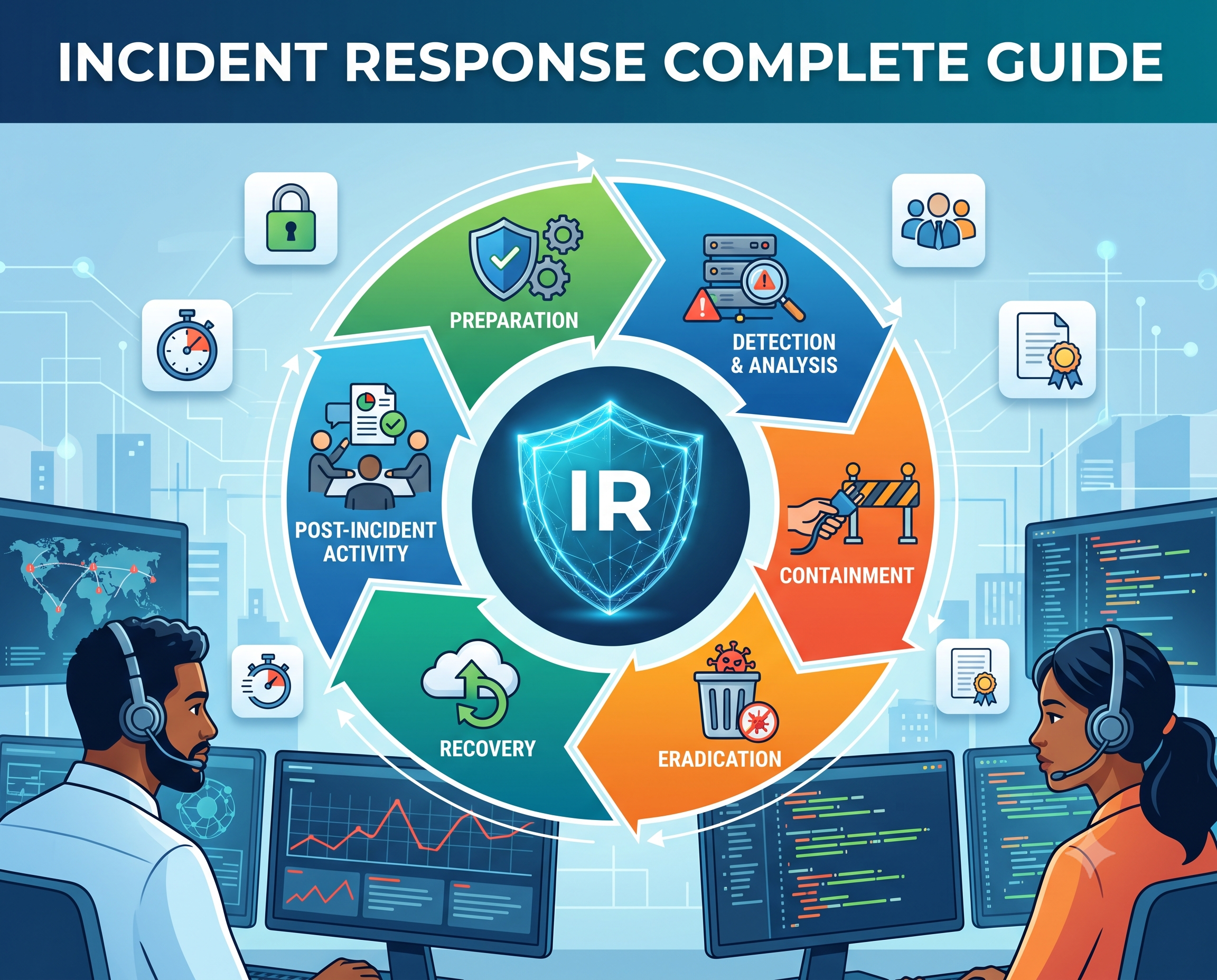
- Incident response teams contain, investigate, remediate, and recover from serious incidents
- Security teams review incidents and improve detection and response capabilities
For example, an endpoint may generate a suspicious process alert. XDR may correlate the endpoint event with suspicious identity or network activity. SIEM may provide additional historical event information. A SOC analyst can investigate the combined evidence and determine whether the activity represents a genuine security incident. If the organization uses MDR, the managed security team may perform or support this investigation and response.
Which Is More Important: SOC, SIEM, MDR, or XDR?
There is no single technology or service that is universally more important. Each addresses a different part of the security operations problem.
Organizations should first identify their security objectives, technology environment, internal expertise, monitoring requirements, and incident response capabilities before deciding which combination is appropriate.
Organizations Building an Internal Security Operation
- May need a dedicated SOC function
- May use SIEM for centralized security event management
- May use XDR for cross-layer detection
- May integrate additional endpoint, network, identity, and cloud security technologies
- Need trained security personnel and defined response processes
Organizations With Limited Internal Security Expertise
- May benefit from MDR services
- Can use managed security analysts for detection and investigation
- Can reduce the need to build every security operations capability internally
- Can combine managed services with existing security technologies
When Should an Organization Consider SIEM?
SIEM can be useful when an organization needs centralized collection, correlation, search, analysis, and reporting of security events across multiple systems.
- Large volumes of security logs
- Multiple security technologies
- Complex IT environments
- Centralized security monitoring requirements
- Security investigation requirements
- Compliance and security reporting requirements
- Need for historical event analysis
When Should an Organization Consider MDR?
MDR can be useful when an organization needs managed threat detection and response capabilities but does not have sufficient internal resources or expertise to operate these functions continuously.
- Limited internal security staff
- Need for continuous monitoring
- High security alert volumes
- Need for specialized threat detection expertise
- Requirement for security investigation support
- Need for incident response assistance
- Growing or distributed technology environments
When Should an Organization Consider XDR?
XDR can be useful when organizations want to correlate security signals across multiple security layers and improve their ability to investigate complex attacks.
- Multiple endpoint security controls
- Cloud and SaaS environments
- Identity and access systems
- Network security infrastructure
- Email security controls
- Need for cross-layer threat correlation
- Need for improved investigation context
Common Misconceptions About SOC, SIEM, MDR, and XDR
A SIEM Is a SOC
A SIEM is a technology platform. A SOC is the broader security operations function involving people, processes, and technologies.
MDR and SOC Mean the Same Thing
MDR is a managed detection and response service, while SOC describes a security operations function. An MDR provider can deliver capabilities that support an organization's SOC operations.
XDR Replaces the SOC
XDR can improve detection and response capabilities, but security operations still require appropriate processes, investigation, decision-making, and response coordination.
More Security Alerts Mean Better Security
A large number of alerts does not necessarily indicate effective security operations. Security teams need meaningful, prioritized alerts that help identify genuine threats.
How to Choose the Right Security Operations Approach
- Identify critical business assets and technology environments
- Determine security monitoring requirements
- Assess internal cybersecurity expertise
- Identify current detection and response gaps
- Evaluate existing security technologies
- Determine whether centralized event management is required
- Assess the need for cross-layer threat detection
- Determine whether managed security expertise is required
- Define incident escalation and response requirements
- Evaluate security service coverage and operational requirements
SOC, SIEM, MDR, and XDR in a Modern Cybersecurity Strategy
Modern organizations rarely depend on a single security capability. Effective security operations often combine endpoint security, identity security, network security, cloud security, vulnerability management, security monitoring, threat intelligence, and incident response.
SOC provides the operational framework. SIEM can provide centralized security event visibility. XDR can improve cross-layer threat detection and investigation. MDR can provide managed security expertise and operational support.
The combination should be designed around the organization's risk profile rather than simply adopting every available security technology.
Frequently Asked Questions
Is SOC the same as SIEM?
No. A SOC is a security operations function involving people, processes, and technologies. SIEM is a technology platform used to collect, correlate, and analyze security events.
Is MDR the same as a SOC?
No. MDR is a managed detection and response service, while a SOC is the broader security operations function. MDR can provide capabilities that support or extend an organization's SOC.
Does XDR replace SIEM?
XDR and SIEM address overlapping but different security operations needs. XDR focuses on correlating detection and response signals across security layers, while SIEM provides centralized event collection, correlation, analysis, and historical visibility.
Can an organization use SIEM and XDR together?
Yes. SIEM and XDR can provide complementary security capabilities. An organization can use SIEM for centralized security event management and XDR for cross-layer threat detection and response.
Can MDR work with an internal SOC?
Yes. Organizations can use MDR to extend internal security operations, provide additional monitoring and investigation expertise, or support specific detection and response requirements.
Which is best for an enterprise: SOC, SIEM, MDR, or XDR?
There is no universal choice. The appropriate combination depends on the organization's technology environment, security requirements, internal expertise, risk profile, monitoring needs, and incident response capabilities.
Key Takeaways
- SOC is a security operations function combining people, processes, and technology
- SIEM is a technology platform for centralized security event collection and analysis
- MDR is a managed service focused on threat detection and response
- XDR is a technology approach for correlating detection and response across security layers
- These capabilities can complement rather than replace each other
- SOC teams can use SIEM and XDR as part of their security technology stack
- MDR can extend security operations with managed expertise
- Organizations should select security capabilities according to their risk and operational requirements
Conclusion
SOC, SIEM, MDR, and XDR represent different layers of modern cybersecurity operations. A SOC provides the operational function, SIEM provides security event management capabilities, MDR provides managed detection and response, and XDR provides broader cross-layer detection and response capabilities.
Understanding the difference between these technologies and services helps organizations build a more effective security operations strategy. Rather than treating them as competing solutions, organizations should evaluate how each capability can address a specific security requirement.
For organizations that need continuous security monitoring, threat detection, investigation, and response but do not want to build every capability internally, a Managed SOC or MDR approach can provide additional security expertise and operational support.
Recommended Solution
See how MOBISEC solves this in practice
Topics