What Are RBI Cybersecurity and IT Governance Requirements?
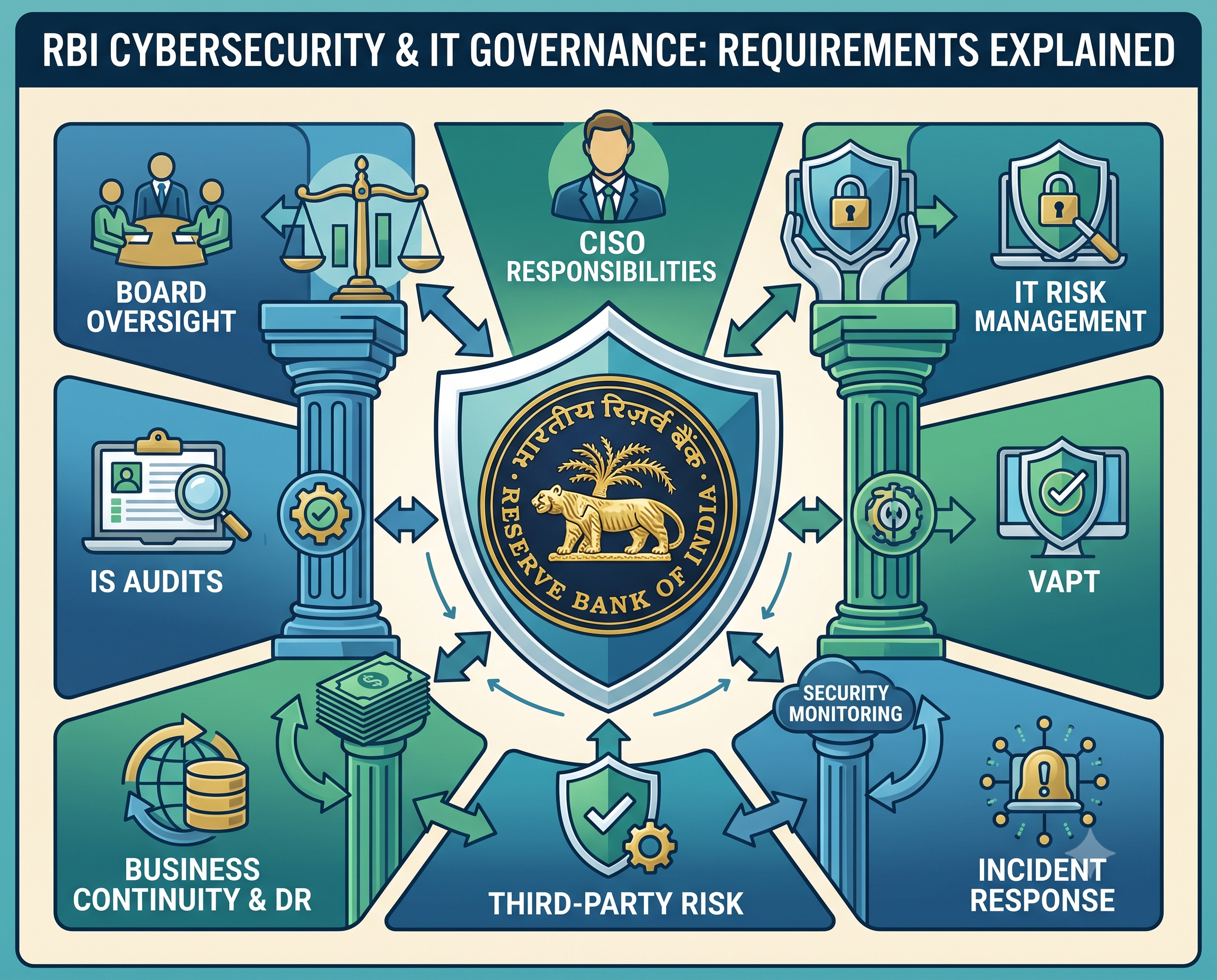
RBI cybersecurity and IT governance requirements establish a structured approach for managing technology risk, information security, cyber risk, operational resilience and technology-enabled business operations within regulated entities.
The Reserve Bank of India has progressively strengthened its expectations around information technology governance and cybersecurity as financial institutions increasingly depend on digital banking, internet-facing applications, mobile applications, cloud services, payment infrastructure, APIs, data platforms and third-party technology providers.
The RBI framework is not limited to deploying security tools. It places significant emphasis on governance, accountability, risk management, security policies, independent assurance, vulnerability management, incident response, business continuity and continuous improvement.
For regulated entities, cybersecurity therefore needs to be treated as an enterprise risk and governance responsibility rather than only an IT department responsibility.
Why RBI Cybersecurity Requirements Matter
Financial institutions operate systems that process sensitive customer information, financial transactions, authentication data and business-critical services. A disruption or compromise can affect customers, financial operations, regulatory obligations and the reputation of the institution.
RBI's cybersecurity expectations are designed to improve the resilience of regulated entities against cyberattacks, technology failures, operational disruptions and other events that could affect critical services.
- Protect customer and financial information
- Reduce technology and cybersecurity risks
- Strengthen operational resilience
- Improve detection and response to cyber incidents
- Establish clear accountability for technology and security
- Protect critical information systems
- Improve third-party and supply-chain security
- Support business continuity and disaster recovery
- Provide evidence through audits, logs and assurance activities
- Create a continuous cybersecurity improvement process
Who Needs to Consider RBI IT Governance Requirements?
RBI requirements apply according to the regulated entity and the specific directions, circulars and regulatory instructions applicable to that entity.
Banks, non-banking financial companies and other RBI-regulated entities may have different regulatory obligations depending on their category, size, technology environment, services and applicable RBI directions.
Organisations should therefore avoid treating RBI cybersecurity compliance as a single checklist that applies identically to every financial institution. The applicable regulatory framework should first be identified for the specific regulated entity.
RBI IT Governance Starts With Board-Level Oversight
A major principle of RBI's IT governance framework is that technology and cybersecurity cannot be delegated entirely to technical teams. Senior management and the Board must provide appropriate oversight of IT strategy, cybersecurity risk and operational resilience.
The RBI directions require the regulated entity to have an effective IT strategic planning process and ensure that IT strategy aligns with overall business objectives.
Governance should also establish clear accountability, appropriate resources, defined responsibilities and effective oversight of IT and information security.
- Board-level oversight of technology and cyber risk
- Alignment between business strategy and IT strategy
- Defined IT governance responsibilities
- Defined information security responsibilities
- Appropriate cybersecurity budgets and resources
- Periodic review of cybersecurity risks
- Oversight of business continuity and disaster recovery
- Review of major IT and security issues
- Monitoring of regulatory and legal requirements
IT Steering Committee and Senior Management Responsibilities
RBI's IT governance framework expects regulated entities to establish appropriate governance structures for overseeing IT activities. An IT Steering Committee should include representation from senior management, IT and business functions.
The committee is expected to contribute to strategic IT planning, oversee IT performance, support alignment with business requirements and monitor business continuity and disaster recovery arrangements.
The IT Steering Committee also has an important role in ensuring that the organisation's IT architecture supports statutory and regulatory requirements.
- Align IT initiatives with business requirements
- Review IT performance and major technology risks
- Oversee business continuity and disaster recovery processes
- Monitor implementation of IT strategy
- Review important technology and cybersecurity issues
- Support regulatory and security compliance
- Ensure appropriate escalation of material technology risks
Role of the Chief Information Security Officer
The Chief Information Security Officer, or CISO, plays a central role in RBI's cybersecurity governance framework.
The CISO is responsible for driving cybersecurity strategy, supporting regulatory compliance, coordinating information security activities and helping ensure that security controls operate effectively.
RBI's directions also establish expectations around the independence, expertise, staffing and reporting structure of the CISO function.
- Drive cybersecurity strategy
- Support compliance with regulatory and statutory requirements
- Coordinate cybersecurity activities across the organisation
- Oversee security operations and security projects
- Monitor the effectiveness of security solutions
- Coordinate incident response activities
- Report cybersecurity risks and preparedness to senior governance bodies
- Support cybersecurity awareness initiatives
- Maintain appropriate cybersecurity resources and expertise
Information Security Policy and Cybersecurity Policy
A regulated entity should maintain formal information security and cybersecurity policies that define how technology and security risks are governed.
The policy framework should clearly establish ownership, responsibilities, scope, security objectives, exception handling, compliance monitoring and consequences for policy violations.
RBI's framework also requires regulated entities to maintain a Cyber Crisis Management Plan that addresses how the organisation will detect, contain, respond to and recover from cyber incidents.
IT and Information Security Risk Management
IT risk management is a core component of RBI's cybersecurity expectations. Regulated entities should identify technology and information security risks, assess their potential impact and implement controls appropriate to those risks.
The risk management framework should identify critical information systems and define controls for protecting the confidentiality, integrity and availability of information.
- Identify critical information assets
- Classify information according to sensitivity and criticality
- Assess cybersecurity and technology risks
- Identify control gaps
- Define risk ownership
- Implement risk treatment measures
- Monitor residual risk
- Review risks periodically
- Update controls as threats and technology change
Critical Information Systems and Asset Classification
An effective cybersecurity programme starts with knowing which systems, applications, databases, networks and services are critical to the organisation.
RBI's IT governance framework expects regulated entities to identify and classify information assets based on confidentiality, integrity and availability requirements and their importance to business operations.
Without an accurate asset inventory and classification process, it becomes difficult to determine where stronger controls, monitoring, testing and recovery capabilities are required.
- Maintain an updated IT asset inventory
- Identify critical applications
- Identify critical databases
- Identify customer-facing systems
- Identify sensitive information
- Map dependencies between systems
- Classify assets according to business criticality
- Document owners and responsible teams
Access Control and Privileged Access Management
Access to information assets should be based on legitimate business requirements. Access controls should be documented, reviewed and updated as roles and responsibilities change.
Privileged accounts require stronger controls because compromise of administrative credentials can provide attackers with extensive access to critical systems.
- Apply need-based access
- Use role-based access controls
- Review privileged accounts regularly
- Monitor privileged-user activity
- Log administrative activities
- Apply multi-factor authentication where required
- Remove unnecessary accounts
- Disable access when users leave or change roles
- Review access after major organisational changes
Multi-Factor Authentication and Remote Access Security
Remote access introduces additional security risks because users and devices may connect to critical systems from outside controlled corporate environments.
RBI's framework includes expectations around securing remote access and using multi-factor authentication for enterprise access to critical systems.
Organisations should combine identity controls with device security, network controls, monitoring and appropriate access policies.
Vulnerability Assessment and Penetration Testing
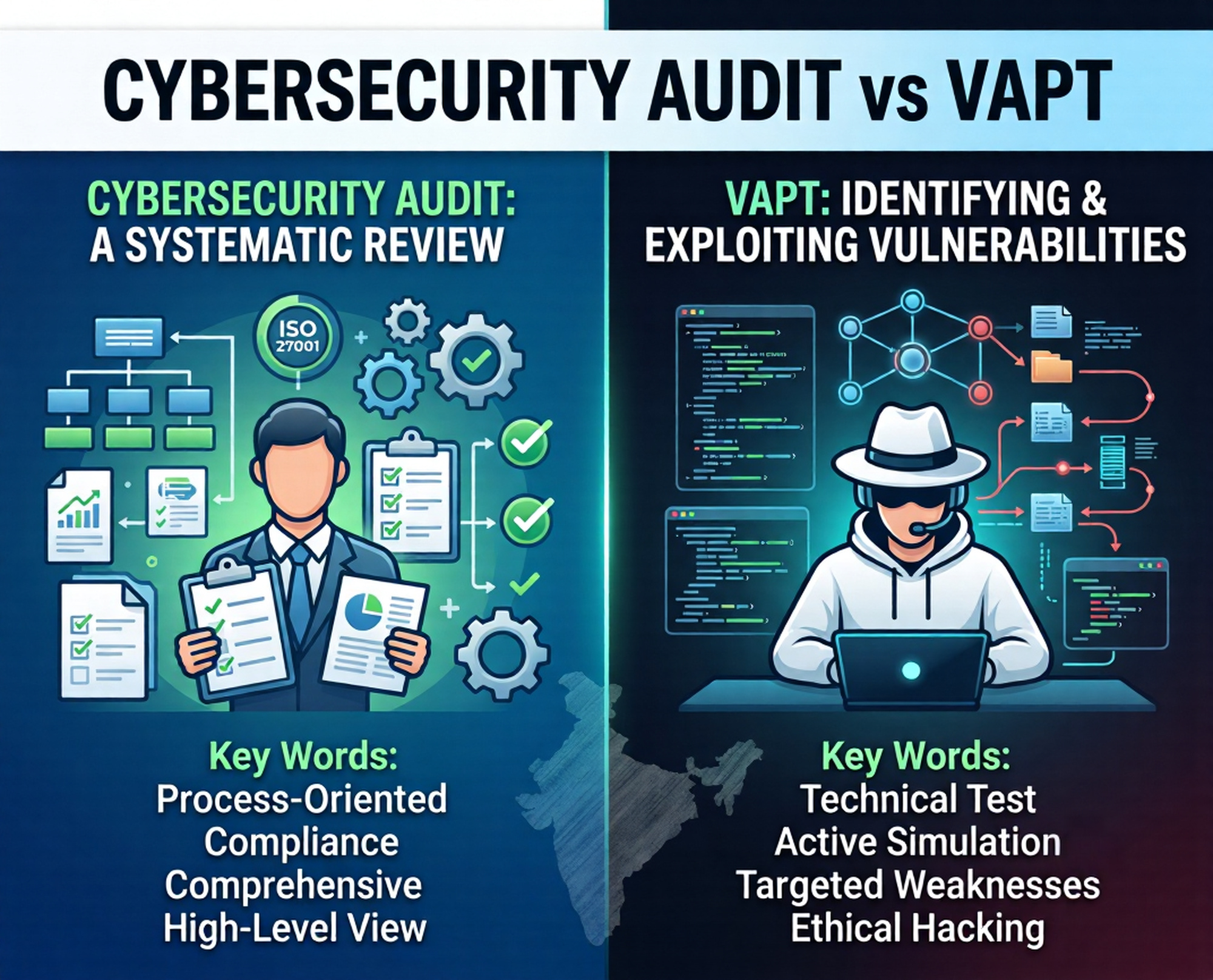
Vulnerability Assessment and Penetration Testing, commonly known as VA and PT or VAPT, is an important part of RBI's cybersecurity framework.
For critical information systems and certain customer-facing systems in the DMZ, RBI's directions specify vulnerability assessment at least every six months and penetration testing at least every twelve months. VAPT should also be performed through the system lifecycle, including before implementation, after implementation and after major changes.
- Identify critical systems requiring testing
- Perform vulnerability assessments at required intervals
- Perform penetration testing according to applicable requirements
- Test systems after major changes
- Include internet-facing systems in the security assessment scope
- Use appropriately trained and independent security professionals
- Document vulnerabilities and risk ratings
- Track remediation activities
- Retest corrected vulnerabilities
- Maintain evidence of testing and remediation
Vulnerability Remediation and Patch Management
Finding vulnerabilities is only the first step. RBI's IT governance framework also expects regulated entities to address identified vulnerabilities and associated risks in a time-bound manner.
Patch and change management should be formally documented so that security updates are assessed, approved, implemented and validated without introducing unnecessary operational risk.
- Maintain a vulnerability register
- Prioritise vulnerabilities based on risk
- Define remediation timelines
- Track overdue vulnerabilities
- Test security patches before deployment where appropriate
- Document patch approvals
- Monitor unsupported software
- Maintain technology refresh plans
- Retest critical vulnerabilities after remediation
Security Monitoring and Security Operations Centre
Continuous monitoring is essential because cyber threats can occur outside normal business hours and may remain undetected if systems are not actively monitored.
RBI's earlier Cyber Security Framework for banks specifically emphasised the importance of Security Operations Centres and continuous surveillance. The current IT governance directions also place responsibility on the CISO function for managing and monitoring the SOC where applicable.
A modern SOC can combine security logs, endpoint telemetry, network events, identity signals, threat intelligence and automated alerts to identify suspicious activity.
- Collect security logs
- Monitor critical systems
- Monitor privileged activity
- Detect suspicious authentication
- Monitor network activity
- Correlate security events
- Investigate alerts
- Maintain incident records
- Integrate threat intelligence
- Escalate significant incidents
Audit Trails and Security Logging
RBI's IT governance directions require IT applications that can access or affect critical or sensitive information to have appropriate audit and system logging capabilities.
Audit trails should be detailed enough to support audits, forensic investigations, dispute resolution and other regulatory or operational requirements. Logs should also be monitored regularly to identify unauthorised activity.
- Authentication logs
- Administrative activity logs
- Access logs
- Security event logs
- Application logs
- Database activity logs
- Configuration-change logs
- Incident-related logs
- Log monitoring and alerting
- Appropriate log retention
Incident Response and Cyber Incident Management
Cybersecurity controls cannot guarantee that incidents will never occur. RBI therefore places importance on incident response and recovery capabilities.
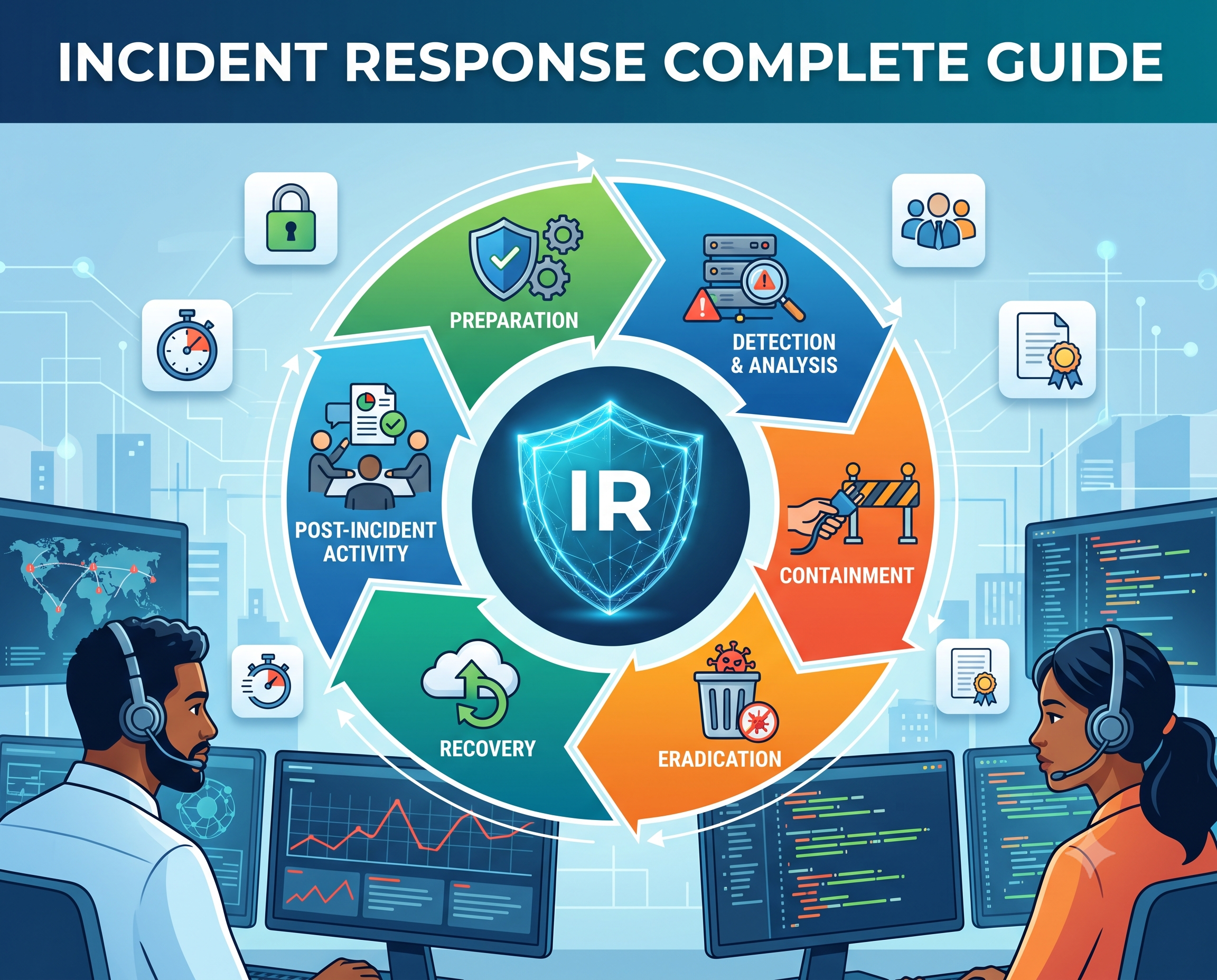
Regulated entities should have written procedures for classifying, investigating, containing and recovering from cyber incidents.
Incident response should include clear responsibilities, escalation procedures, communication plans, forensic investigation where necessary and corrective actions.
- Detect and identify the incident
- Classify the incident based on severity and impact
- Activate the appropriate response process
- Contain the threat
- Investigate the root cause
- Eradicate malicious activity
- Recover affected systems
- Validate security before returning to normal operations
- Complete regulatory and internal reporting
- Document lessons learned
- Implement corrective and preventive measures
RBI Cyber Incident Reporting
Cyber incidents affecting regulated entities may trigger reporting obligations under applicable RBI directions and other regulatory requirements.
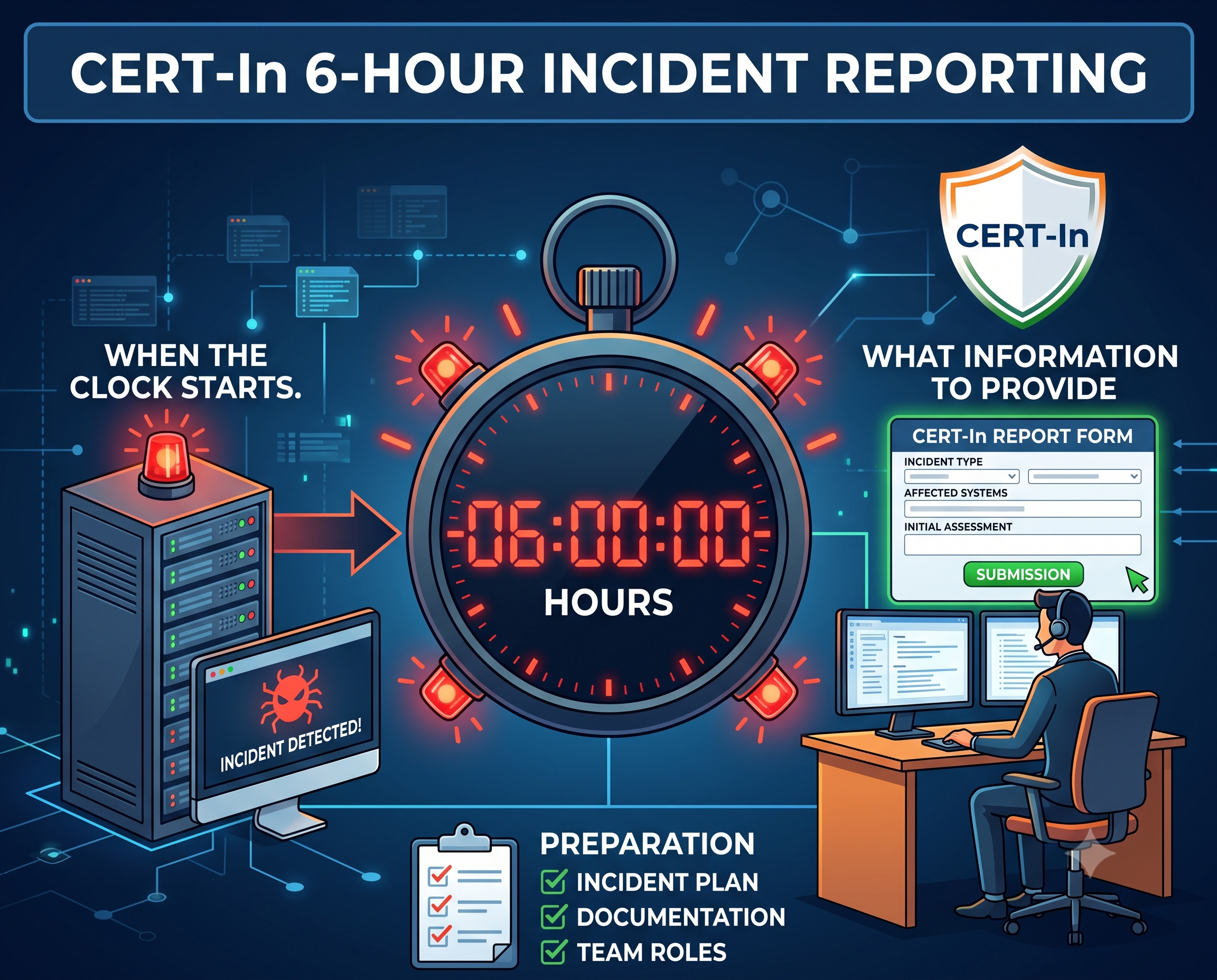
RBI's IT governance directions state that regulated entities should proactively notify CERT-In and RBI regarding incidents as required by applicable regulations. Organisations should therefore maintain an incident reporting process that identifies which incidents must be reported, who is responsible for reporting and what information needs to be prepared.
Incident reporting should be integrated into the organisation's broader incident response process rather than treated as a separate activity performed only after technical recovery.
Business Continuity and Disaster Recovery
Cybersecurity and operational resilience are closely connected. A ransomware attack, data corruption event, infrastructure failure or major technology outage can disrupt critical financial services even when data confidentiality has not been compromised.
RBI's framework requires regulated entities to maintain business continuity and disaster recovery capabilities appropriate to their critical operations.
For critical information systems, the RBI directions specify disaster recovery drills at least half-yearly, while other systems can follow a risk-based approach. DR testing should demonstrate the ability to switch operations to the alternate site and support business operations for an appropriate period.
- Define critical business services
- Establish recovery priorities
- Define Recovery Time Objectives
- Define Recovery Point Objectives
- Maintain disaster recovery infrastructure
- Test backup restoration
- Protect backup data
- Conduct DR drills
- Document DR test results
- Remediate identified gaps
- Test interconnected vendor systems where applicable
Backup and Recovery Security
Backups are a critical component of cyber resilience. However, simply having backup copies does not guarantee recoverability after a cyberattack.
Organisations should periodically restore backups to verify usability and should protect backup integrity and access controls.
- Maintain backups for critical systems
- Protect backups from unauthorised access
- Test restoration regularly
- Monitor backup failures
- Protect backup credentials
- Maintain appropriate backup retention
- Document restoration procedures
- Test recovery after ransomware scenarios
- Verify backup integrity
Third-Party and Vendor Risk Management
Financial institutions rely heavily on technology vendors, cloud providers, software providers, managed security providers and other third parties.
Third-party relationships can introduce risks such as concentration risk, supply-chain compromise, data exposure, service disruption and dependency on a single provider.
RBI's IT governance framework requires appropriate vendor risk assessment and controls for applicable third-party technology and cybersecurity arrangements, with controls proportionate to risk and materiality.
- Perform vendor risk assessments
- Classify vendors according to criticality
- Assess access to sensitive information
- Review vendor security controls
- Define contractual security requirements
- Monitor vendor performance
- Manage concentration risk
- Address single points of failure
- Review supply-chain risks
- Plan for vendor exit or service disruption
Cloud Security and RBI IT Governance
Cloud adoption can improve scalability and operational efficiency, but it also changes the technology risk environment.
Regulated entities should understand where critical systems and information are hosted, how access is controlled, how logs are collected, how incidents are handled and how services can be recovered if a cloud provider becomes unavailable.
Cloud-hosted systems should remain within the organisation's overall IT risk management, security testing, monitoring and business continuity frameworks.
Data Security and Protection
RBI cybersecurity requirements place significant importance on protecting information assets and customer information.
Security controls should protect information throughout its lifecycle, including storage, processing and transmission.
- Classify sensitive information
- Restrict access to authorised users
- Encrypt sensitive data where appropriate
- Secure data transmission
- Monitor access to sensitive information
- Protect databases
- Maintain audit trails
- Control data transfers
- Secure backup copies
- Manage third-party access to information
Cryptographic and Encryption Controls
Cryptographic controls are important for protecting sensitive information and secure communications.
RBI's IT governance directions require regulated entities to use strong key lengths, algorithms, cipher suites and applicable protocols and to avoid standards that have been deprecated or demonstrated to be insecure.
Organisations should therefore maintain standards for encryption, certificate management, key management and secure communication protocols.
Change and Patch Management
Uncontrolled changes can introduce security vulnerabilities and operational failures. RBI's framework expects regulated entities to maintain documented change and patch management procedures.
- Assess the business impact of a proposed change
- Assess security implications
- Obtain appropriate approvals
- Implement the change securely
- Maintain change records
- Monitor the result
- Validate the change
- Maintain rollback or recovery mechanisms
- Review failed changes
- Document emergency changes
IT Project and Application Security
Technology projects should incorporate security and risk considerations from the beginning rather than treating security as a final-stage activity.
RBI's directions require a formally defined IT project management approach and expect appropriate consideration of enterprise architecture, security, vendor support and application risks.
Critical applications should receive additional assurance, including appropriate source-code, vulnerability and quality controls.
Business Continuity and Cyber Resilience
Business continuity planning should consider cyber incidents in addition to traditional operational disruptions.
A resilient organisation should be able to continue critical services, contain security incidents, recover affected technology and securely resume operations.
- Cyber incident scenarios
- Ransomware
- Data corruption
- System compromise
- Credential compromise
- Network outage
- Cloud service disruption
- Third-party failure
- Data centre failure
- Major application failure
- Critical infrastructure outage
Information Systems Audit
Information Systems Audit provides independent assurance that technology controls, security processes and governance mechanisms are working effectively.
RBI's IT governance directions require regulated entities to establish an IS Audit Policy and ensure appropriate oversight through the Audit Committee of the Board.
IS audit should follow a risk-based approach, with critical systems receiving appropriate attention and more frequent assurance where necessary.
- Define the IS audit universe
- Identify critical systems
- Assess technology risks
- Review security controls
- Review access management
- Review vulnerability management
- Review logging and monitoring
- Review incident management
- Review backup and recovery
- Review third-party controls
- Track audit findings
- Verify remediation
Cybersecurity Awareness and Cyber Hygiene
Technology controls can be weakened by human error, phishing, credential theft, insecure practices and poor security awareness.
RBI's cybersecurity framework recognises the importance of cybersecurity awareness across employees, management, the Board and relevant stakeholders.
Security awareness should therefore be treated as an ongoing programme rather than a one-time training exercise.
- Phishing awareness
- Password and credential security
- MFA awareness
- Safe use of email
- Secure remote working
- Data handling practices
- Incident reporting awareness
- Social engineering awareness
- Executive cybersecurity awareness
- Vendor security awareness
Cybersecurity Metrics and Risk Reporting
Cybersecurity governance requires measurable indicators. Management should be able to understand whether security controls are improving risk posture or whether significant gaps remain.
Useful cybersecurity metrics can cover vulnerabilities, incidents, detection, response, recovery, access control, patching, audit findings and security testing.
- Critical vulnerabilities outstanding
- Patch compliance
- Mean Time to Detect
- Mean Time to Respond
- Security incidents by severity
- Privileged-access reviews completed
- VAPT findings closed
- Security audit findings overdue
- Backup restoration success rate
- DR drill performance
- Security awareness completion
- Third-party risk assessments completed
How RBI Compliance Connects With CERT-In Requirements
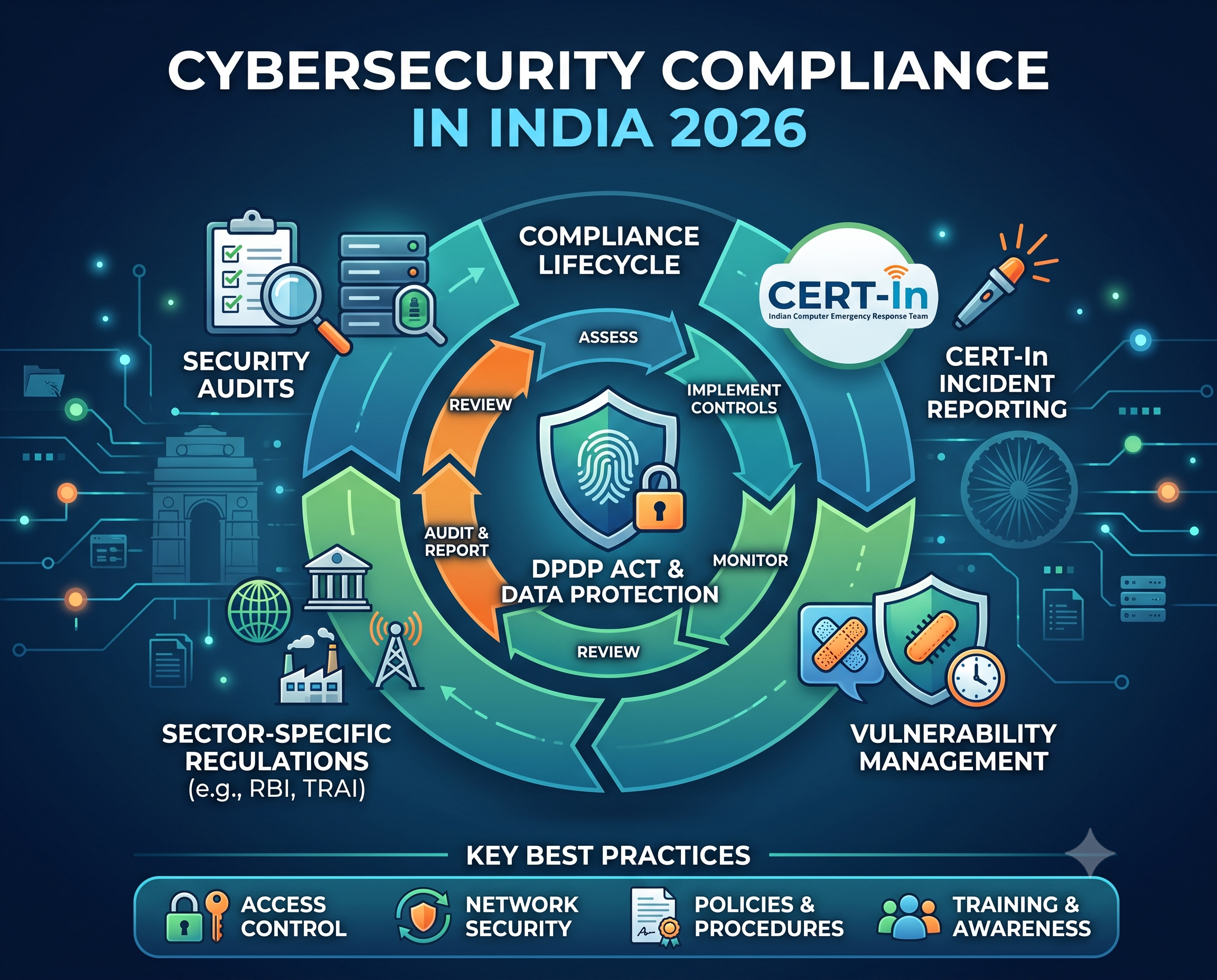
RBI cybersecurity compliance should not be considered in isolation. Regulated entities may also have obligations under CERT-In directions, data protection requirements and other sector-specific regulatory frameworks.
For example, incident response processes should be designed to identify regulatory reporting obligations and coordinate reporting within the applicable timelines.
A mature compliance programme maps overlapping requirements instead of creating separate disconnected processes for every regulator.
RBI Cybersecurity Compliance Checklist
- Board-approved IT and cybersecurity governance framework
- Defined IT strategy and governance structure
- IT Steering Committee
- Information Security Committee
- Qualified CISO and security team
- IT and cybersecurity risk management framework
- Critical information asset inventory
- Access control framework
- Privileged access management
- Multi-factor authentication
- Vulnerability management
- Periodic VAPT
- Security patch management
- Security logging and audit trails
- Security monitoring
- SOC capabilities where applicable
- Cyber incident response plan
- Cyber Crisis Management Plan
- Business continuity plan
- Disaster recovery plan
- Regular DR testing
- Backup and restoration testing
- Third-party risk management
- Cloud security controls
- Security awareness programme
- Information Systems Audit
- Risk and compliance reporting
- Documented remediation tracking
How to Implement RBI Cybersecurity Requirements
RBI compliance should be implemented as a continuous risk management programme rather than as a one-time audit exercise.
- Identify the applicable RBI directions
- Map regulatory requirements to business processes
- Create a complete IT and information asset inventory
- Classify critical systems and information
- Perform an enterprise IT and cybersecurity risk assessment
- Review governance roles and responsibilities
- Assess the CISO and security organisation
- Evaluate existing security controls
- Perform vulnerability assessment and penetration testing
- Review logging and security monitoring
- Test incident response capabilities
- Review business continuity and disaster recovery
- Assess third-party and cloud risks
- Conduct an Information Systems Audit
- Document compliance gaps
- Prioritise remediation based on risk
- Track corrective actions
- Report material risks to appropriate governance bodies
- Repeat assessments periodically
Common RBI Cybersecurity Compliance Gaps
Organisations can have security products in place and still have significant governance and compliance gaps.
- Incomplete asset inventory
- Unsupported software
- Weak privileged-access controls
- Insufficient MFA coverage
- Infrequent vulnerability remediation
- Unresolved VAPT findings
- Poor log monitoring
- Insufficient incident response testing
- Outdated disaster recovery plans
- Unverified backups
- Weak third-party risk assessments
- Incomplete security documentation
- Lack of evidence for implemented controls
- Overdue audit findings
- Limited Board-level cybersecurity reporting
- Insufficient security awareness
RBI Compliance vs Cybersecurity Best Practice
Regulatory compliance provides an important baseline, but organisations should not interpret compliance as the maximum level of security required.
A system can technically satisfy a control requirement while still remaining vulnerable to a sophisticated attack. Effective cybersecurity combines regulatory compliance with threat intelligence, continuous monitoring, secure architecture, strong identity controls, vulnerability management, detection engineering and incident response.
The objective should be to build a resilient security programme that remains effective as threats, technology and business operations change.
How Cybersecurity Audits Support RBI Compliance
A cybersecurity audit can help an organisation determine whether its security governance, controls and processes are operating as intended.
An effective audit should evaluate both technical and governance controls and produce evidence-based findings that can be tracked through remediation.
- Governance assessment
- Policy review
- Risk assessment review
- Asset inventory review
- Access control assessment
- Vulnerability management review
- VAPT review
- Security monitoring review
- Incident response assessment
- BCP and DR assessment
- Third-party security assessment
- IS audit review
- Compliance evidence review
- Remediation tracking
Frequently Asked Questions
What is RBI cybersecurity compliance?
RBI cybersecurity compliance refers to meeting the applicable Reserve Bank of India requirements governing information technology, cybersecurity, information security, operational resilience, risk management and related controls for regulated entities.
Does RBI cybersecurity compliance apply to every company?
No. RBI requirements apply to entities regulated by RBI and depend on the specific regulatory framework applicable to the entity. Organisations should identify the relevant RBI directions rather than assuming that one cybersecurity checklist applies to every financial institution.
What is the role of a CISO under RBI requirements?
The CISO is responsible for driving cybersecurity strategy, supporting regulatory compliance, coordinating cybersecurity activities, overseeing security capabilities and reporting significant cybersecurity risks and preparedness through the appropriate governance structure.
Does RBI require VAPT?
Yes, RBI's IT governance directions contain vulnerability assessment and penetration testing requirements. For specified critical and customer-facing systems, the directions establish minimum testing frequencies and also require testing across relevant stages of the system lifecycle.
How often should critical systems undergo vulnerability assessment?
For critical information systems and certain DMZ systems with customer interfaces, RBI's directions specify vulnerability assessment at least once every six months. The applicable requirements should always be reviewed for the specific regulated entity and system.
How often should penetration testing be performed?
For the specified critical and customer-facing systems covered by the RBI directions, penetration testing is required at least once every twelve months, with additional testing during relevant lifecycle events such as major changes.
Does RBI require security monitoring?
Security monitoring is an important component of RBI's cybersecurity expectations. Earlier RBI guidance for banks specifically emphasised Security Operations Centres and continuous surveillance, while current IT governance requirements place monitoring responsibilities within the security governance framework.
Does RBI require disaster recovery testing?
Yes. RBI's IT governance directions establish disaster recovery testing expectations, including at least half-yearly DR drills for critical information systems, while other systems can follow a risk-based approach.
Why are audit trails important for RBI compliance?
Audit trails provide evidence of system and user activity, support security monitoring, help investigate incidents and can provide forensic evidence during audits or investigations.
How can an organisation prepare for an RBI cybersecurity audit?
Start by identifying applicable RBI requirements, mapping them to controls, reviewing technology and cybersecurity risks, validating evidence, conducting security testing, checking incident response and recovery capabilities, and tracking all identified gaps through documented remediation.
Key Takeaways
- RBI cybersecurity is an enterprise governance responsibility, not only an IT responsibility
- Board and senior management oversight are critical
- A qualified and appropriately positioned CISO is an important component of cybersecurity governance
- IT and cybersecurity risks should be formally identified and managed
- Critical information systems require stronger security controls
- VAPT and vulnerability remediation should be performed systematically
- Security logs and audit trails should support monitoring and investigation
- Incident response and recovery capabilities should be tested
- Business continuity and disaster recovery should be regularly validated
- Third-party technology risks must be assessed and managed
- Information Systems Audit provides independent assurance
- Cybersecurity compliance should be continuously reviewed and improved
Conclusion
RBI cybersecurity and IT governance requirements provide a structured foundation for protecting financial institutions against technology risks, cyber threats and operational disruptions.
Effective compliance requires much more than implementing firewalls, antivirus software or security monitoring tools. Organisations need governance, accountable leadership, risk management, secure technology architecture, vulnerability management, incident response, business continuity, third-party risk management and independent assurance.
The strongest approach is to integrate RBI requirements into the organisation's overall cybersecurity programme so that compliance activities continuously improve security and operational resilience.
As cyber threats and technology environments evolve, regulated entities should periodically reassess their controls, update policies, test their resilience and maintain evidence demonstrating that cybersecurity risks are actively managed.
Recommended Solution
See how MOBISEC solves this in practice
Topics