CIS Controls vs CIS Benchmarks: An Overview
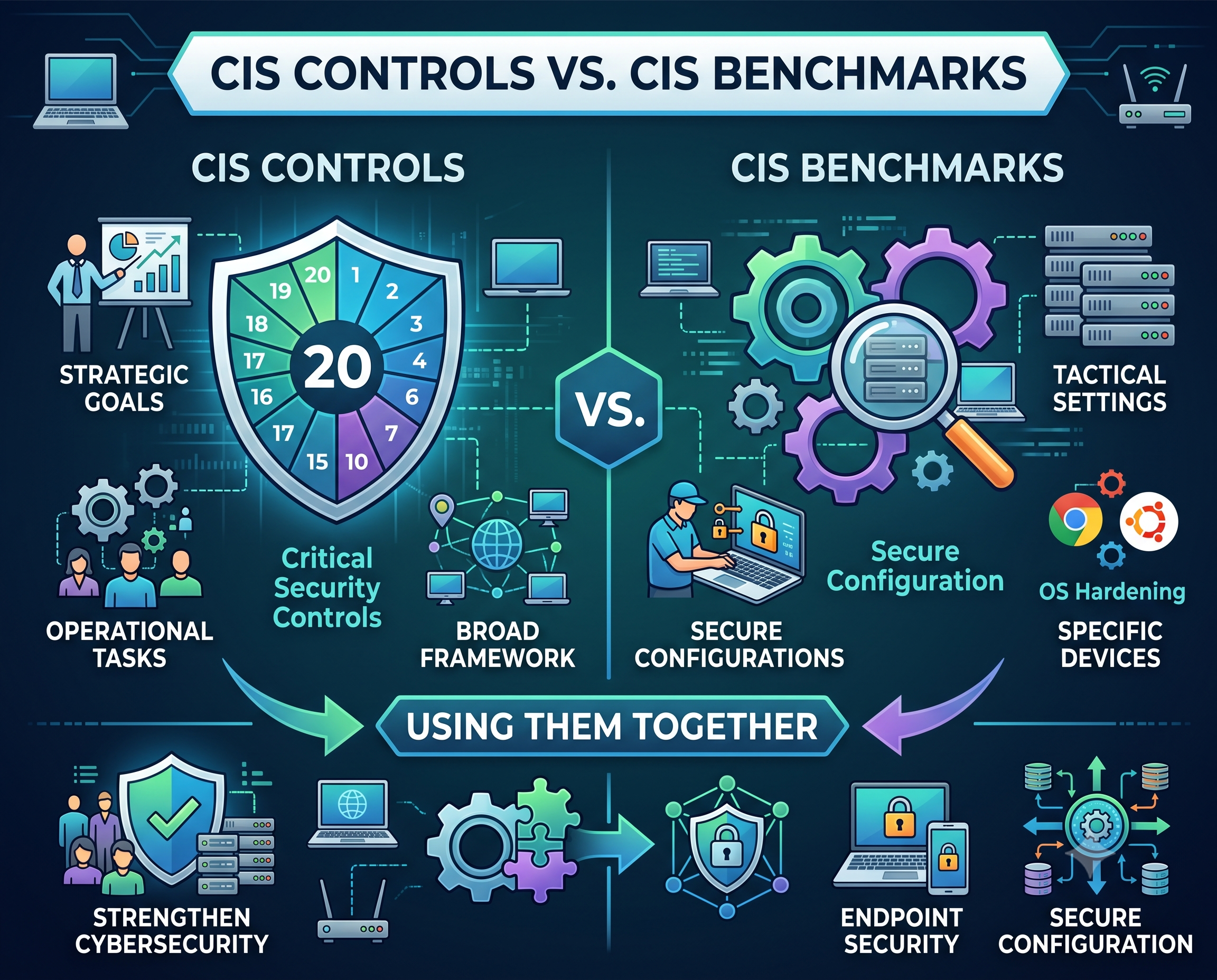
CIS Controls and CIS Benchmarks are both important resources from the Center for Internet Security, but they address different parts of cybersecurity.
CIS Controls provide a prioritised set of cybersecurity safeguards that organisations can use to improve their overall security programme.
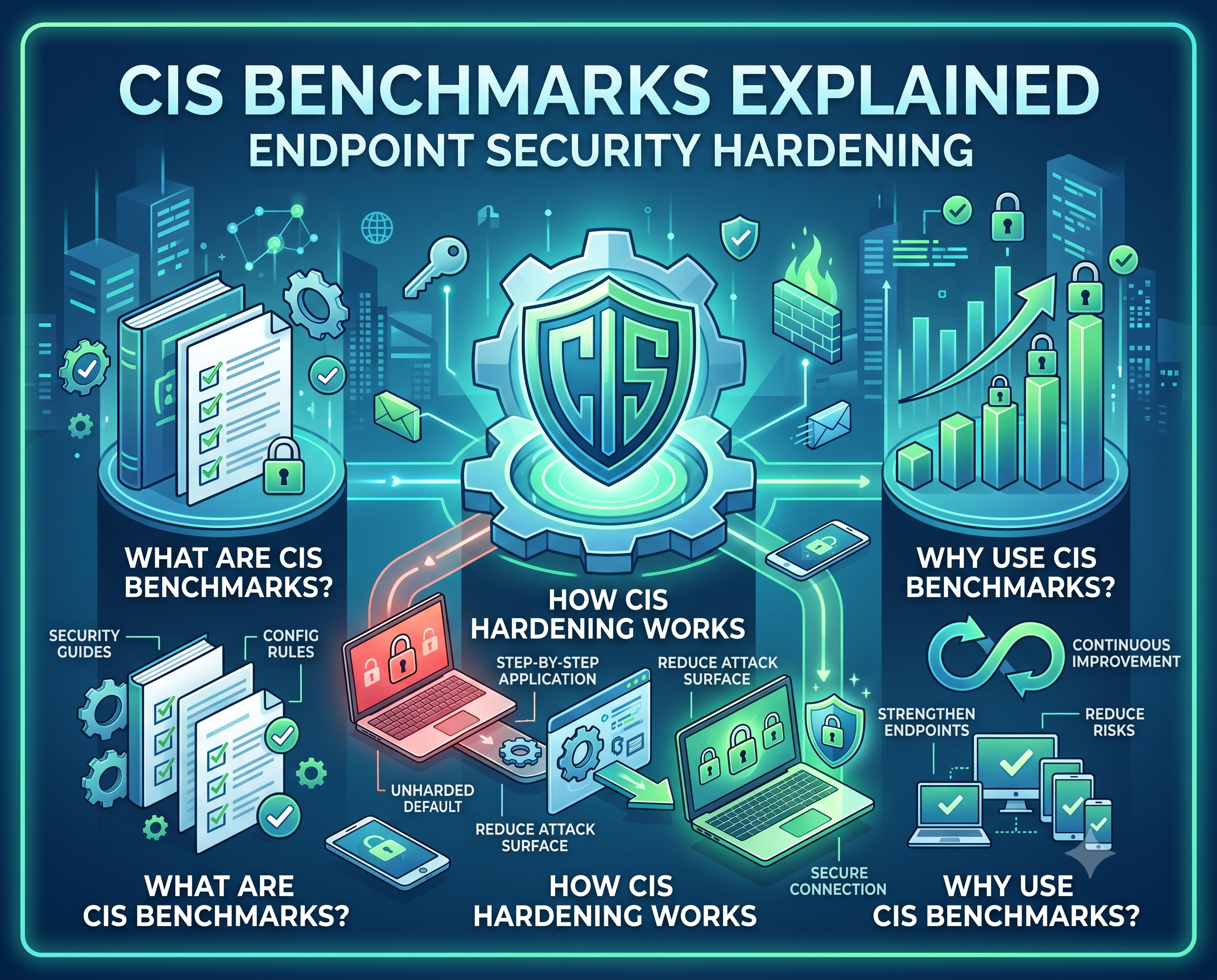
CIS Benchmarks provide detailed security configuration recommendations for specific technologies such as operating systems, applications, cloud platforms, network devices, and other systems.
The simplest way to understand the difference is that CIS Controls help organisations determine what types of cybersecurity safeguards they should implement, while CIS Benchmarks provide detailed guidance for securely configuring specific technologies.
- CIS Controls focus on broader cybersecurity safeguards.
- CIS Benchmarks focus on technology-specific secure configurations.
- CIS Controls help define security priorities.
- CIS Benchmarks help implement secure technical configurations.
- CIS Controls operate at a broader security-programme level.
- CIS Benchmarks operate at a detailed configuration level.
- Both can be used together to strengthen an organisation's security posture.
What Are CIS Controls?
CIS Controls are a prioritised set of cybersecurity safeguards designed to help organisations defend against common and significant cyber threats.
They provide a structured way for security teams to identify important security activities and organise cybersecurity improvements according to organisational needs and risk.
Rather than prescribing every technical configuration for a particular operating system or application, CIS Controls provide a broader view of the safeguards an organisation should establish.
Focus of CIS Controls
CIS Controls focus on cybersecurity practices and safeguards that organisations can implement across their environments.
- Asset and software inventory.
- Data protection.
- Account and access management.
- Security awareness.
- Vulnerability management.
- Audit log management.
- Email and web browser protections.
- Malware defences.
- Network infrastructure management.
- Incident response.
- Application security.
- Security monitoring.
The exact implementation of a control depends on the organisation's technology environment, risk profile, business requirements, and security architecture.
What Are CIS Benchmarks?
CIS Benchmarks are detailed security configuration recommendations for specific technologies.
A benchmark provides technical guidance that can help administrators and security teams evaluate whether systems are configured according to a defined security baseline.
Benchmarks are available for a wide range of technologies and are designed to address configuration-related security risks.
Focus of CIS Benchmarks
CIS Benchmarks focus on the technical configuration of a particular technology or platform.
- Operating-system security settings.
- Authentication configuration.
- Account and privilege settings.
- Network configuration.
- Firewall settings.
- Logging and auditing.
- File and directory permissions.
- Services and components.
- Application configuration.
- Platform-specific security settings.
The exact recommendations depend on the technology and benchmark version being used.
CIS Controls vs CIS Benchmarks: The Main Difference
The primary difference between CIS Controls and CIS Benchmarks is their level of focus.
CIS Controls provide a broader cybersecurity safeguard framework, while CIS Benchmarks provide detailed technical configuration guidance.
- CIS Controls answer: What security safeguards should we implement?
- CIS Benchmarks answer: How should a specific technology be securely configured?
- CIS Controls help establish security priorities.
- CIS Benchmarks help establish secure technical configurations.
- CIS Controls cover broader security practices.
- CIS Benchmarks focus on specific technologies.
CIS Controls vs CIS Benchmarks Comparison
Although the two resources are related, they should not be treated as interchangeable.
Purpose
CIS Controls help organisations prioritise and organise cybersecurity safeguards.
CIS Benchmarks help organisations securely configure specific technologies.
Scope
CIS Controls address broader cybersecurity activities across an organisation.
CIS Benchmarks address configuration settings within particular technologies or platforms.
Level of Detail
CIS Controls provide higher-level security safeguards.
CIS Benchmarks provide more detailed technical recommendations that can be assessed against actual system configurations.
Primary Users
CIS Controls can be useful for security leaders, governance teams, security architects, IT teams, and security practitioners.
CIS Benchmarks are particularly useful for system administrators, endpoint-security teams, security engineers, configuration-management teams, and auditors.
Implementation
CIS Controls can influence security policies, processes, technologies, and operational practices.
CIS Benchmarks can directly influence the configuration of operating systems, applications, and infrastructure.
Why CIS Controls and CIS Benchmarks Are Often Confused
The confusion exists because both are published by the Center for Internet Security and both are intended to improve cybersecurity.
They also overlap conceptually. For example, a broader safeguard may require secure configuration or vulnerability management, while a CIS Benchmark can provide detailed configuration guidance for implementing secure settings on a specific platform.
However, the two resources operate at different levels and solve different problems.
How CIS Controls and CIS Benchmarks Work Together
CIS Controls and CIS Benchmarks become more useful when they are treated as complementary resources rather than competing frameworks.
An organisation can use CIS Controls to identify and prioritise the security capabilities it needs and then use CIS Benchmarks to establish secure configurations for the technologies supporting those capabilities.
- Identify the organisation's important security objectives.
- Map relevant security safeguards to those objectives.
- Identify the technologies that support the safeguards.
- Select appropriate CIS Benchmarks for those technologies.
- Assess current configurations.
- Define an approved security baseline.
- Implement required configuration changes.
- Monitor systems for configuration deviations.
- Remediate significant deviations.
- Measure and report security improvement.
Example: Using CIS Controls and CIS Benchmarks for Endpoint Security
Consider an organisation managing hundreds of Windows laptops used by employees to access corporate applications and sensitive information.
The organisation may use CIS Controls to establish broader security requirements around asset inventory, vulnerability management, secure configuration, account management, logging, and other safeguards.
The security team can then use the applicable CIS Benchmark for the supported Windows environment to identify specific configuration settings that should be reviewed and hardened.
The two resources therefore work at different levels.
- CIS Controls define broader security safeguards.
- CIS Benchmarks provide detailed configuration recommendations.
- Endpoint-management tools can help deploy approved configurations.
- Configuration assessment can identify deviations.
- Continuous monitoring can identify configuration drift.
- Remediation can restore approved settings.
CIS Controls Provide the Security Direction
CIS Controls can help organisations decide which cybersecurity activities deserve attention and how security improvements should be prioritised.
They can provide a useful structure for developing a security programme because they address multiple areas of cybersecurity rather than focusing only on operating-system configuration.
This broader perspective helps prevent organisations from treating endpoint hardening as their entire cybersecurity strategy.
CIS Benchmarks Provide Technical Configuration Guidance
Once an organisation determines that secure configuration is an important security requirement, CIS Benchmarks can provide technology-specific guidance for implementing that objective.
For example, an organisation may have a broader requirement to maintain secure endpoint configurations. A CIS Benchmark can then provide detailed recommendations that security and IT teams can assess against the actual endpoint configuration.
This makes CIS Benchmarks particularly useful for technical implementation and configuration assessment.
CIS Controls and Endpoint Hardening
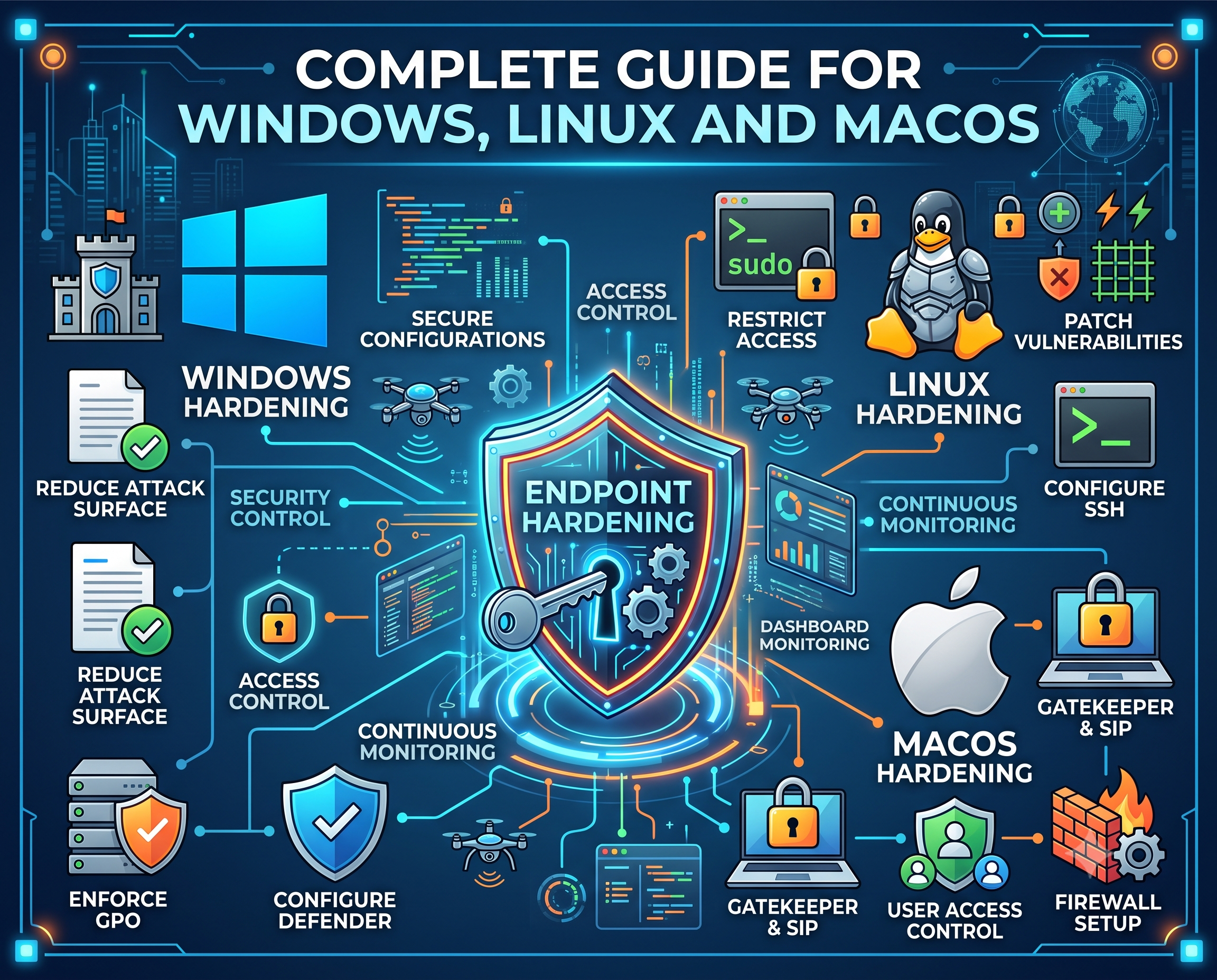
Endpoint hardening is one area where CIS Controls and CIS Benchmarks can complement each other effectively.
CIS Controls can help establish the broader requirement for secure configuration and protection of endpoint assets.
CIS Benchmarks can then provide detailed recommendations for hardening supported endpoint technologies.
- Identify endpoint assets.
- Maintain an accurate software inventory.
- Establish secure configuration requirements.
- Select appropriate CIS Benchmarks.
- Assess endpoint configurations.
- Remediate significant deviations.
- Monitor configuration changes.
- Review security posture regularly.
CIS Controls and Vulnerability Management
Vulnerability management is another area where the two resources can complement each other.
An organisation may establish vulnerability-management practices at the broader security-programme level while using technology-specific benchmarks to strengthen system configurations that reduce unnecessary exposure.
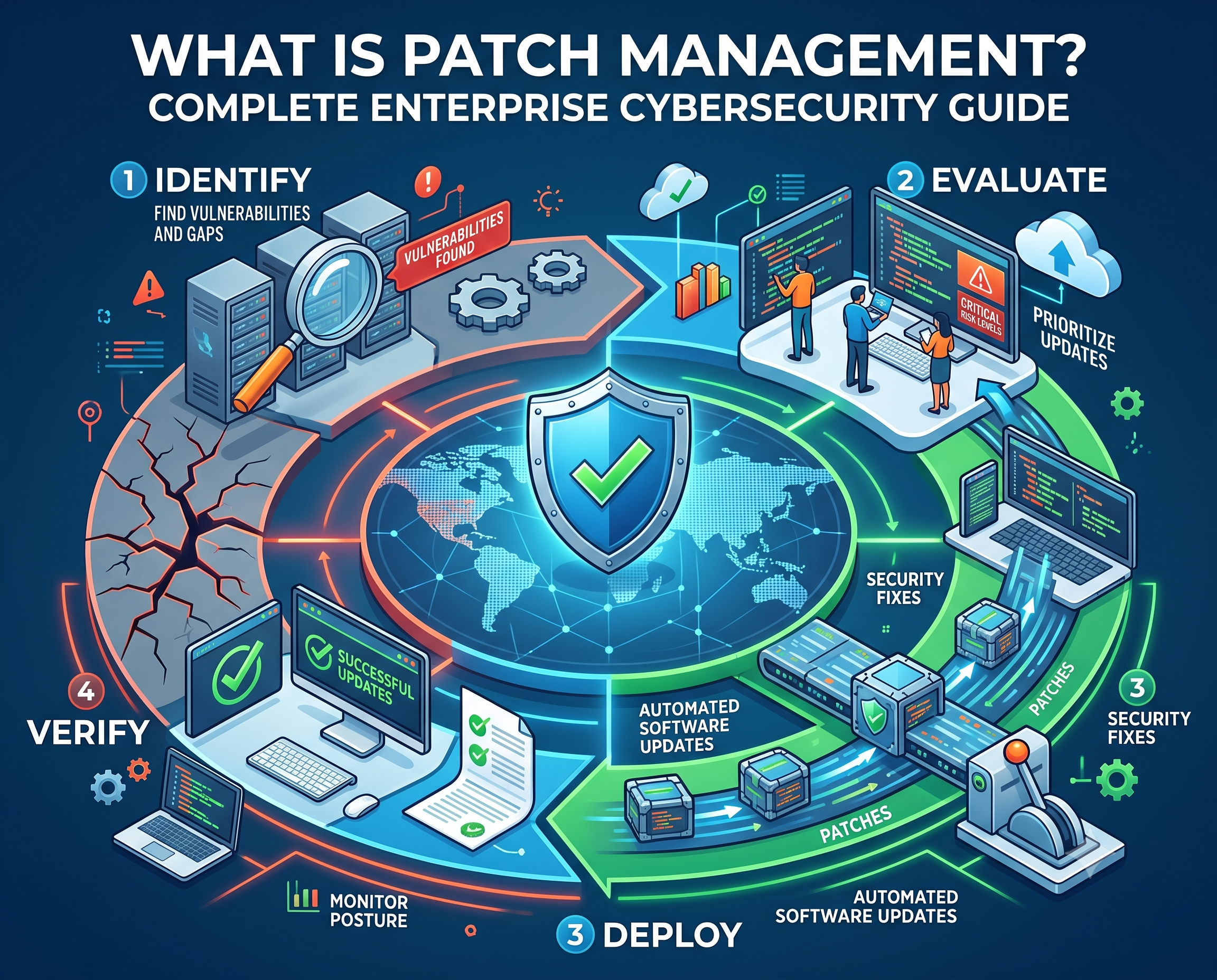
However, secure configuration does not replace vulnerability management.
An endpoint can follow a secure configuration baseline and still contain vulnerable software. Similarly, a fully patched endpoint can still have insecure configuration settings.
Organisations should therefore treat vulnerability management and secure configuration as complementary security activities.
CIS Controls and Security Configuration Management
Security configuration management provides the operational connection between broader security requirements and detailed benchmark recommendations.
A mature configuration-management process can establish approved baselines, assess systems against those baselines, identify deviations, and support remediation.
- Define the security requirement.
- Select the appropriate technology baseline.
- Assess the current endpoint configuration.
- Identify deviations.
- Prioritise findings.
- Apply approved remediation.
- Verify the result.
- Continue monitoring.
CIS Benchmarks Are Not a Complete Cybersecurity Framework
CIS Benchmarks are valuable for secure configuration, but they should not be treated as a complete cybersecurity programme.
Secure configuration is only one part of enterprise security.
- Identity and access management.
- Vulnerability management.
- Patch management.
- Endpoint protection.
- Network security.
- Data protection.
- Security monitoring.
- Incident response.
- Security awareness.
- Risk management.
- Security governance.
- Business continuity.
A strong cybersecurity programme combines these capabilities according to the organisation's risk profile and business requirements.
CIS Controls Are Not a Configuration Checklist
CIS Controls should also not be treated as a direct replacement for technology-specific hardening checklists.
A control can establish a security objective without prescribing every configuration setting required on a specific operating system or application.
Technology-specific implementation requires additional guidance, and CIS Benchmarks can provide that level of technical detail.
How to Map CIS Controls to CIS Benchmarks
Mapping does not need to be a one-to-one relationship.
A single CIS Control or safeguard may be supported by multiple technical configurations, while a single benchmark recommendation may contribute to multiple security objectives.
- Identify the relevant CIS Control or safeguard.
- Define the security objective.
- Identify the technologies involved.
- Select applicable CIS Benchmarks.
- Map relevant benchmark recommendations to the security objective.
- Document implementation requirements.
- Define assessment criteria.
- Establish remediation procedures.
- Monitor ongoing compliance.
CIS Controls, CIS Benchmarks and Security Baselines
A security baseline is the organisation-approved configuration that endpoints or systems are expected to maintain.
CIS Benchmarks can provide an important reference when creating that baseline.
CIS Controls can provide broader security direction for why secure configuration and other safeguards should exist.
The organisation should still evaluate benchmark recommendations against its own business requirements and technology environment before making them mandatory.
Why Organisational Exceptions Matter
Security teams should not assume that every benchmark recommendation can be applied identically to every system.
Some systems may have application dependencies, specialised functions, compatibility requirements, or other legitimate reasons for requiring a different configuration.
Exceptions should be controlled rather than ignored.
- Document the reason for the exception.
- Identify the affected systems.
- Obtain appropriate approval.
- Evaluate the security risk.
- Define compensating controls where appropriate.
- Set a review date.
- Monitor the exception.
- Remove the exception when it is no longer required.
CIS Controls vs CIS Benchmarks for Compliance
Both CIS Controls and CIS Benchmarks can contribute to an organisation's compliance and audit activities, but neither should automatically be considered a complete compliance framework.
CIS Controls can help demonstrate that an organisation has established broader cybersecurity safeguards.
CIS Benchmarks can provide technical evidence that specific systems are configured according to defined security requirements.
Organisations should map these resources to the specific regulatory, contractual, or internal requirements that apply to them.
Using CIS Benchmarks for Continuous Configuration Monitoring
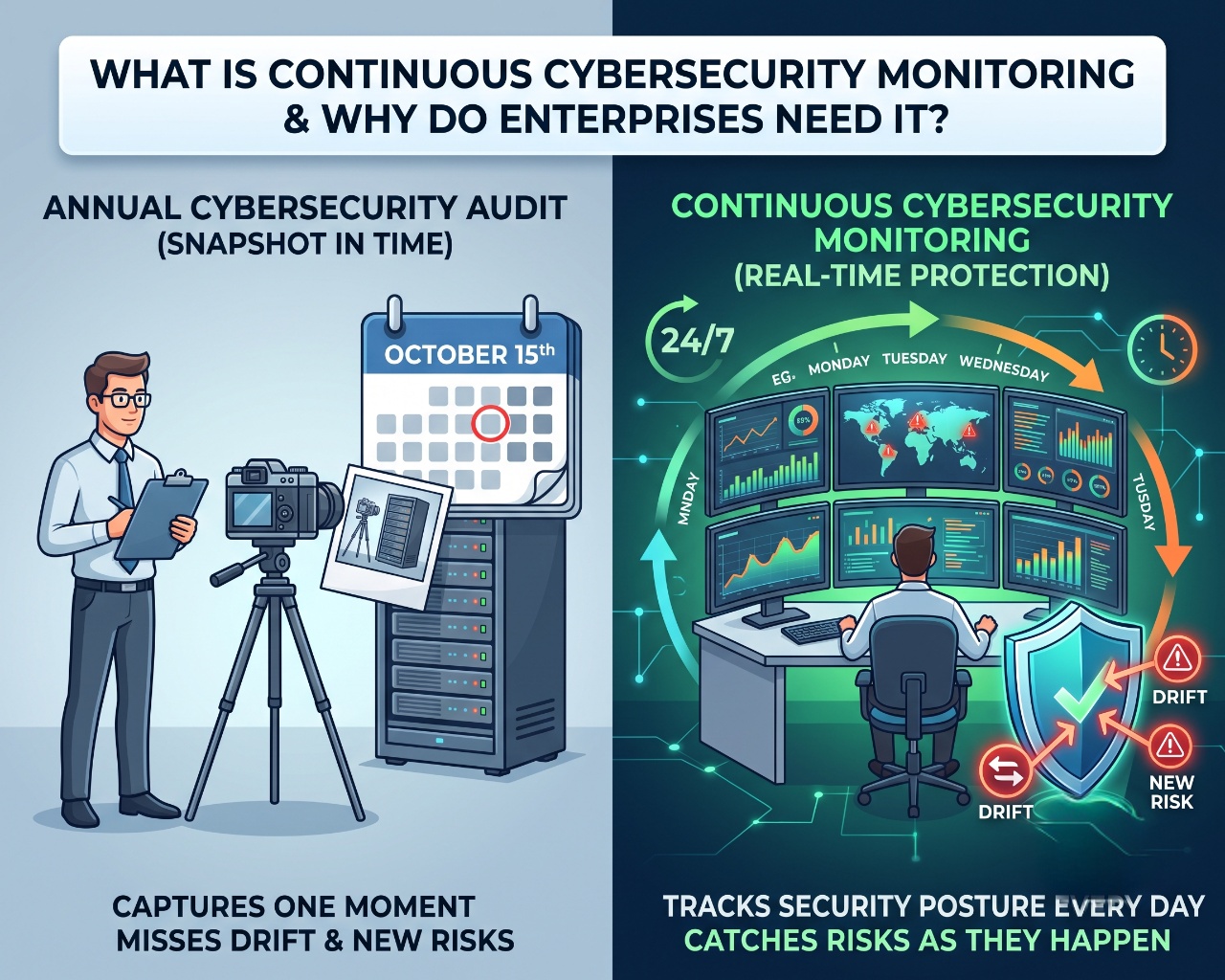
A benchmark assessment performed once provides a snapshot of system configuration at that point in time.
Endpoint configurations can change after the assessment because of software installations, administrative changes, operating-system updates, application requirements, or other operational activity.
Continuous or recurring configuration assessment can identify these deviations and help organisations maintain a more accurate view of endpoint security posture.
From CIS Controls to Continuous Security Assurance
The combination of CIS Controls and CIS Benchmarks can support a continuous security-assurance model.
- Define broader cybersecurity safeguards.
- Translate applicable safeguards into technical requirements.
- Establish technology-specific secure configurations.
- Assess endpoint and system configurations.
- Detect configuration deviations.
- Prioritise security findings.
- Remediate approved findings.
- Verify remediation.
- Monitor for future deviations.
- Report security posture and trends.
This approach moves security teams beyond simply documenting controls and toward continuously measuring whether important technical safeguards remain effective.
Common Mistakes When Using CIS Controls and CIS Benchmarks
Treating Them as the Same Thing
CIS Controls and CIS Benchmarks have different purposes. Treating them as interchangeable can create gaps in both security strategy and technical implementation.
Applying Benchmarks Without Understanding Business Requirements
Benchmark recommendations should be reviewed and tested before broad deployment.
Using CIS Benchmarks as the Entire Security Strategy
Secure configuration is important, but organisations also need identity, vulnerability management, monitoring, incident response, and other security capabilities.
Ignoring Configuration Drift
An endpoint that is compliant today may become non-compliant later. Recurring assessment is therefore important.
Measuring Only Compliance Percentage
A single compliance percentage may hide critical deviations, recurring failures, or high-risk exceptions.
Security teams should examine individual findings, trends, risk, and remediation effectiveness.
Best Practices for Using CIS Controls and CIS Benchmarks Together
- Use CIS Controls to establish broader cybersecurity priorities.
- Use CIS Benchmarks for technology-specific secure configuration.
- Maintain an accurate asset and software inventory.
- Create organisation-approved security baselines.
- Test benchmark recommendations before deployment.
- Document and manage exceptions.
- Automate configuration assessment where practical.
- Monitor for configuration drift.
- Prioritise findings according to risk.
- Verify remediation after changes.
- Integrate configuration findings with security operations.
- Review security baselines periodically.
- Maintain evidence for audits and security reviews.
CIS Controls and CIS Benchmarks in a Modern Endpoint Security Strategy
Modern endpoint environments are dynamic. Employees may use laptops, desktops, mobile devices, virtual systems, and cloud-connected endpoints from different locations.
This makes static security checklists less effective when they are not supported by ongoing assessment and management.
CIS Controls can provide broader security direction, while CIS Benchmarks can provide detailed technical configuration guidance for supported technologies.
When combined with endpoint management, vulnerability management, monitoring, and automated remediation, these resources can contribute to a more measurable endpoint-security programme.
What Should Security Teams Monitor?
Organisations using CIS-based security practices should monitor more than whether a system passed a benchmark assessment.
- Benchmark assessment status.
- Approved baseline status.
- Critical configuration deviations.
- High-risk endpoint settings.
- Repeated configuration failures.
- Unapproved exceptions.
- Remediation status.
- Configuration drift.
- Endpoint inventory changes.
- Security posture trends.
- Assessment frequency.
- Remediation verification.
Frequently Asked Questions About CIS Controls and CIS Benchmarks
What is the difference between CIS Controls and CIS Benchmarks?
CIS Controls provide broader cybersecurity safeguards and priorities, while CIS Benchmarks provide detailed security configuration recommendations for specific technologies.
Are CIS Controls and CIS Benchmarks the same framework?
No. They are related CIS resources with different purposes. CIS Controls address broader cybersecurity safeguards, while CIS Benchmarks focus on technology-specific secure configurations.
Which should an organisation use first?
There is no universal order for every organisation. Security teams can use CIS Controls to establish broader security priorities and then use relevant CIS Benchmarks to implement secure configurations for the technologies in scope.
Can CIS Benchmarks replace CIS Controls?
No. CIS Benchmarks provide detailed configuration guidance but do not replace broader cybersecurity safeguards and processes.
Can CIS Controls replace CIS Benchmarks?
No. CIS Controls provide broader security direction but do not provide all the technology-specific configuration details required for endpoint or platform hardening.
Can CIS Benchmarks be used for endpoint hardening?
Yes. CIS Benchmarks can provide technology-specific configuration recommendations that organisations can evaluate and use as part of an endpoint-hardening programme.
Are CIS Controls enough for endpoint security?
CIS Controls can provide valuable cybersecurity safeguards, but endpoint security generally requires multiple complementary capabilities including secure configuration, patch management, vulnerability management, endpoint protection, identity security, monitoring, and incident response.
Can CIS Controls and CIS Benchmarks support compliance?
They can contribute to compliance and audit activities by providing broader security safeguards and technical configuration evidence. Organisations should still map them to the specific requirements that apply to their environment.
Should every CIS Benchmark recommendation be implemented?
Not necessarily. Organisations should evaluate recommendations against their business requirements, technology environment, risk profile, and operational dependencies before implementation.
Can CIS Benchmark assessment be automated?
Yes. Configuration-assessment technologies can automate parts of benchmark assessment, reporting, monitoring, and remediation workflows.
Key Takeaways
- CIS Controls and CIS Benchmarks serve different but complementary purposes.
- CIS Controls focus on broader cybersecurity safeguards.
- CIS Benchmarks focus on detailed technology-specific configurations.
- CIS Controls help organisations establish security priorities.
- CIS Benchmarks help technical teams implement and assess secure configurations.
- CIS Benchmarks can support endpoint-hardening programmes.
- Neither resource should be treated as a complete cybersecurity strategy.
- Security baselines should be tailored to organisational requirements.
- Exceptions should be documented, approved, and reviewed.
- Configuration drift makes recurring or continuous assessment important.
- Automation can improve assessment and remediation at scale.
- The combination of broader controls and technical benchmarks can create a more measurable security programme.
Conclusion
CIS Controls and CIS Benchmarks solve different cybersecurity problems, but they work particularly well when used together.
CIS Controls provide a broader framework for identifying and prioritising cybersecurity safeguards across an organisation. CIS Benchmarks provide detailed configuration guidance that can help security and IT teams apply secure settings to specific technologies.
For endpoint security, this distinction is important. An organisation needs both the strategic direction to understand which safeguards matter and the technical guidance to configure systems securely.
The strongest approach is therefore to use CIS Controls to establish broader security priorities, use CIS Benchmarks to define and assess technology-specific configurations, and continuously monitor systems to identify configuration drift and remediate significant deviations.
When integrated with endpoint management, vulnerability management, patch management, security monitoring, and automated remediation, CIS-based practices can become an important part of a continuous endpoint-security and hardening strategy.
Recommended Solution
See how MOBISEC solves this in practice
Topics