What Is a Cybersecurity Posture Score?
A cybersecurity posture score is a measurement used to represent the overall security health of an organisation based on defined security controls, configurations, vulnerabilities, compliance requirements, and other security indicators.
The purpose of a posture score is to turn a large amount of security information into an understandable measurement that security teams and business leaders can use to identify weaknesses, prioritise improvements, and track progress over time.
A cybersecurity posture score should not be treated as a universal measurement with one standard formula. Different organisations may calculate scores differently depending on their security objectives, technologies, risk tolerance, regulatory requirements, and the security controls included in the assessment.
The most useful posture score is therefore one that is transparent, repeatable, risk-aware, and connected to actionable security findings.
Why Organisations Need to Measure Security Posture
Modern organisations operate large numbers of endpoints, applications, identities, cloud services, networks, and business systems. Security teams can generate significant amounts of security data from these environments, but raw data alone does not always provide a clear picture of overall security health.
A posture score can help provide a higher-level view of whether security controls are being maintained and where security improvements are needed.
- Provides a consolidated view of security health
- Highlights areas requiring attention
- Helps prioritise security improvements
- Tracks security posture over time
- Supports management reporting
- Identifies recurring security weaknesses
- Helps compare security performance across groups
- Supports security governance and risk discussions
- Provides a measurable security improvement target
The goal is not to create an attractive security score. The goal is to create a measurement that accurately reflects meaningful security conditions.
What Does a Cybersecurity Posture Score Measure?
A cybersecurity posture score can incorporate multiple dimensions of security. The exact components should be selected according to the organisation's environment and risk profile.
- Endpoint compliance
- Security configuration
- Security baseline compliance
- Vulnerability exposure
- Patch compliance
- Security control effectiveness
- Configuration drift
- Endpoint protection status
- Encryption status
- Identity and privilege controls
- Security policy compliance
- Incident readiness
- Monitoring coverage
- Remediation performance
- Approved security exceptions
Combining multiple dimensions provides a broader view than measuring a single security metric such as the number of vulnerabilities or percentage of patched systems.
Cybersecurity Posture Score vs Security Rating
A cybersecurity posture score is generally designed to help an organisation understand and improve its internal security condition. A security rating may instead be produced by an external service or assessment methodology and may focus on externally observable indicators.
These measurements can be useful for different purposes, but organisations should understand exactly what each score measures before using it for security decisions.
An internal posture score should ideally be based on security controls and data that are directly relevant to the organisation's systems, policies, and risk profile.
Key Components of a Cybersecurity Posture Score
Endpoint Security
Endpoints are an important component of security posture because laptops, desktops, servers, and other managed systems can contain sensitive information and provide access to business applications and networks.
A posture assessment can evaluate whether endpoints meet required security standards.
- Security software status
- Firewall configuration
- Encryption
- Password policies
- User privileges
- Remote access configuration
- Operating system security settings
- Application security settings
- Required security controls
- Endpoint compliance
Vulnerability Management
Known vulnerabilities can affect the security posture of systems and applications. A posture measurement can incorporate vulnerability severity, affected assets, remediation status, and the age of unresolved vulnerabilities.
However, vulnerability counts should not be used in isolation. A large number of low-risk vulnerabilities may not represent the same risk as a smaller number of critical vulnerabilities affecting highly exposed systems.
Patch Compliance
Patch compliance measures whether systems have received required security updates within the organisation's defined timeframe.
A posture score can incorporate the percentage of endpoints that meet patch requirements, the number of overdue updates, and the severity of affected vulnerabilities.
Security Configuration
Security configuration measures whether systems follow approved configuration requirements. This may include firewall settings, authentication policies, logging, encryption, unnecessary services, remote access settings, and other controls.
Configuration compliance is particularly important because an endpoint can be fully patched while still having insecure configuration settings.
Security Baseline Compliance
A security baseline defines the expected security configuration for a system or group of systems. Baseline compliance can be incorporated into a posture score to determine how closely endpoints align with approved security requirements.
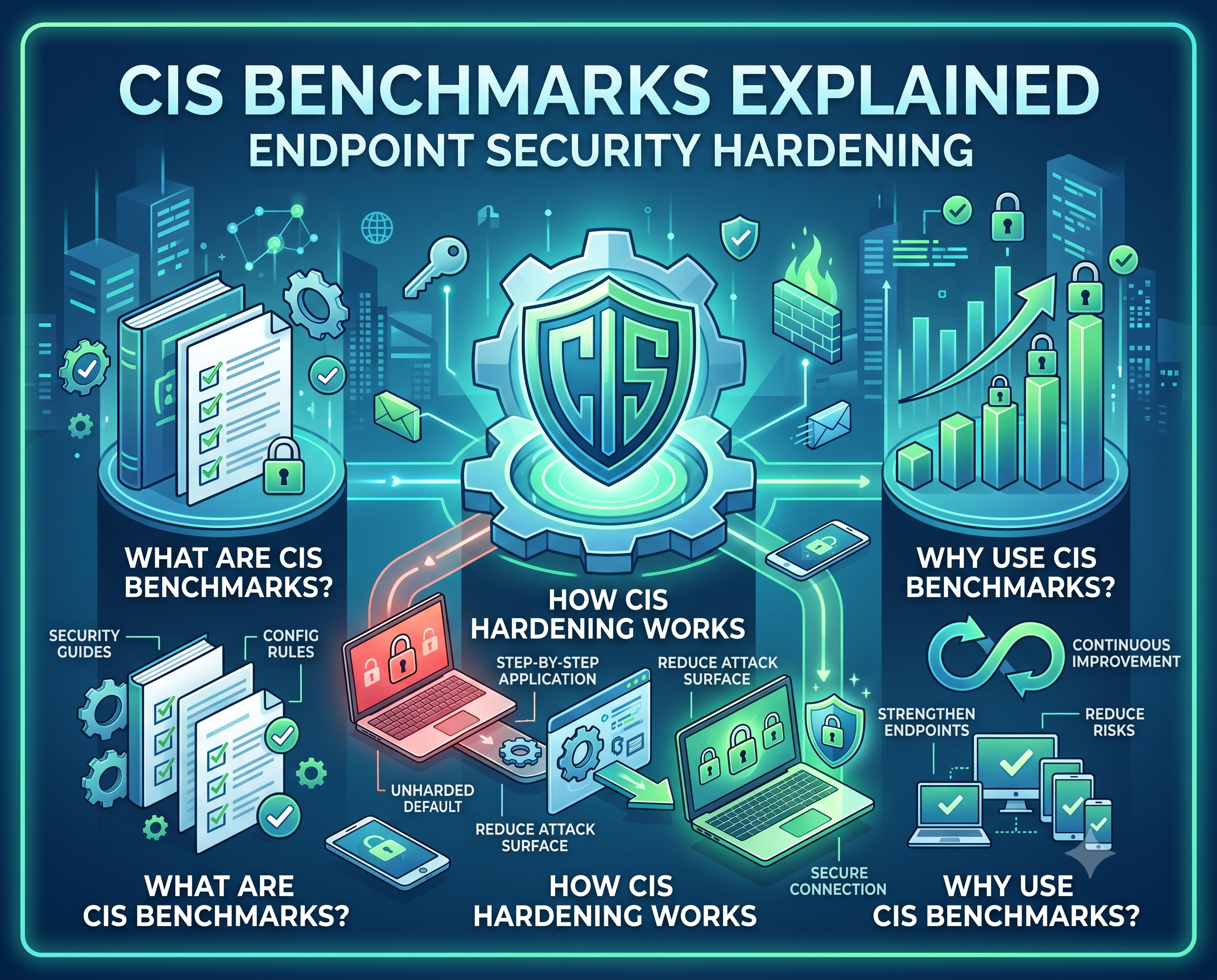
Baselines may be based on internal policies, industry guidance, CIS Benchmarks, regulatory requirements, or other recognised security practices.
Configuration Drift
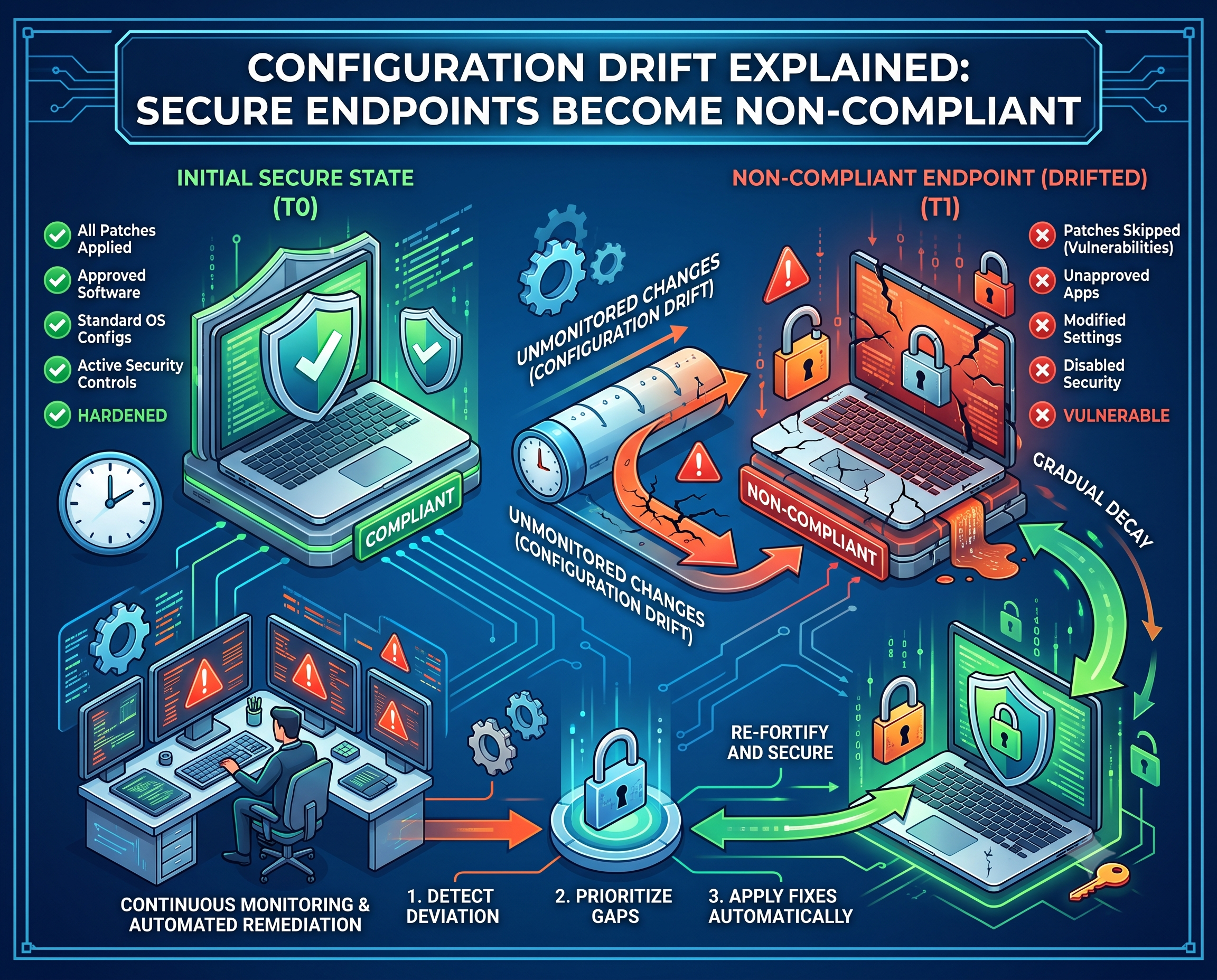
Configuration drift measures how often systems move away from their approved security configuration.
An organisation may have achieved strong endpoint hardening during an initial assessment but gradually lose that security posture as systems change. Monitoring configuration drift helps identify this degradation.
Security Control Coverage
Security control coverage measures whether required security controls are deployed and operating across the expected systems.
- Percentage of managed endpoints
- Percentage of endpoints assessed
- Percentage of endpoints meeting baseline requirements
- Percentage of endpoints with required security controls
- Percentage of systems with current security data
- Percentage of critical assets covered by monitoring
How to Calculate a Cybersecurity Posture Score
There is no single formula that applies to every organisation. A practical approach is to define security dimensions, assign appropriate weights, calculate scores for each dimension, and combine them into an overall score.
For example, an organisation could create weighted categories for endpoint compliance, vulnerability management, patch compliance, configuration security, security control coverage, and remediation performance.
- Define the security dimensions
- Identify measurable indicators for each dimension
- Assign appropriate weights
- Establish scoring thresholds
- Collect current security data
- Calculate individual category scores
- Calculate the overall posture score
- Review high-risk findings separately
- Track the score over time
The weighting should reflect organisational risk. A critical security control should not necessarily have the same importance as a low-impact configuration setting.
Example Cybersecurity Posture Score Model
An organisation could create a hypothetical posture model using the following categories.
- Endpoint security compliance: 25 percent
- Security configuration: 20 percent
- Vulnerability management: 20 percent
- Patch compliance: 15 percent
- Security control coverage: 10 percent
- Remediation performance: 10 percent
Each category can then contain multiple indicators. For example, endpoint security compliance could include firewall status, encryption, endpoint protection, password requirements, and other required controls.
The specific percentages are illustrative. Organisations should determine their own weighting based on risk, business requirements, technology, and security priorities.
Why a High Security Score Does Not Always Mean Low Risk
A high cybersecurity posture score can provide a useful indication that many defined controls are operating as expected, but it should not be interpreted as proof that an organisation is secure.
Security is multidimensional, and a score may not capture every possible threat, vulnerability, attack path, or operational weakness.
- A critical system may have an unresolved high-risk vulnerability
- An important control may not be included in the scoring model
- Threat activity may occur despite strong baseline compliance
- Some security data may be incomplete
- Third-party risks may not be represented
- Human and process risks may be difficult to quantify
For this reason, security teams should always be able to drill down from the overall score into the underlying findings.
Why a Low Score Can Be Misleading
A low score does not automatically mean that an organisation has poor cybersecurity. The result may be affected by incomplete asset inventory, missing telemetry, incorrectly configured assessment rules, newly introduced systems, or controls that are not relevant to certain environments.
Security teams should investigate the reasons behind a score rather than reacting to the number alone.
Cybersecurity Posture Score and Risk-Based Prioritisation
A useful posture management programme should connect scoring with risk prioritisation.
Not every security weakness deserves the same level of attention. Security teams should consider factors such as asset criticality, exposure, severity, exploitability, business impact, and whether compensating controls exist.
- Identify the security finding
- Determine the affected asset
- Assess the severity
- Consider business criticality
- Evaluate exposure
- Check for compensating controls
- Prioritise remediation
- Track remediation
- Recalculate or update posture after remediation
This approach prevents security teams from focusing only on improving the score while ignoring the issues that matter most.
How Continuous Monitoring Improves Security Posture Measurement
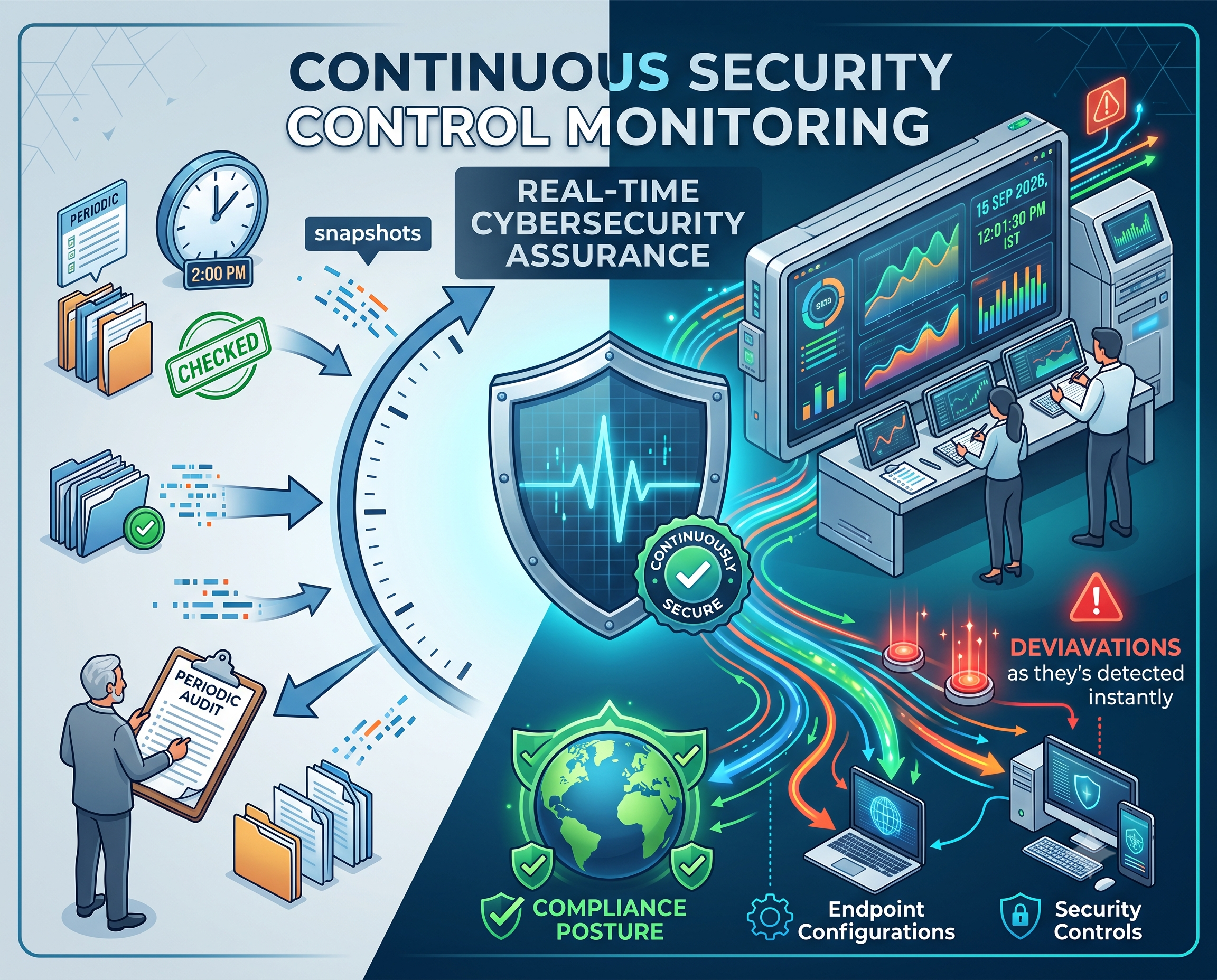
A posture score becomes more useful when the underlying security data is continuously updated. If the score is calculated only during periodic audits, it can become outdated as the environment changes.
Continuous security monitoring can provide more current information about endpoint configurations, security controls, compliance, and configuration drift.
- Detects changes between formal assessments
- Updates endpoint compliance information
- Identifies configuration drift
- Tracks remediation status
- Provides current control visibility
- Supports security posture trends
- Helps identify recurring weaknesses
Continuous monitoring turns a posture score from an occasional assessment result into a measurement that can support ongoing security operations.
Cybersecurity Posture Score and Configuration Drift
Configuration drift can directly affect security posture. An endpoint may pass a security assessment and contribute positively to the organisation's posture score. If a security configuration changes later, that endpoint may become non-compliant.
If the organisation does not reassess the endpoint, the posture score may continue to reflect an outdated state.
Continuous configuration monitoring helps close this gap by identifying when endpoints move away from their approved security baselines.
Cybersecurity Posture Score and Security Baselines
Security baselines provide the expected configuration against which endpoint security can be measured.
A posture scoring system can use baseline compliance as one of its key dimensions.
- Define approved security baselines
- Assign baselines to relevant systems
- Assess endpoint configurations
- Identify failed controls
- Calculate baseline compliance
- Track deviations
- Remediate important findings
- Verify the corrected configuration
Baseline compliance provides a more actionable measurement than simply asking whether an endpoint is secure because it defines the specific security state the organisation expects.
Cybersecurity Posture Score and CIS Benchmarks
CIS Benchmarks can provide secure configuration recommendations that organisations may use when establishing security baselines for supported technologies.
Where applicable, an organisation can assess endpoint configurations against selected CIS Benchmark recommendations and incorporate relevant results into its security posture measurement.
However, CIS Benchmark alignment should be considered one component of the overall security posture rather than the complete definition of organisational security.
- CIS Benchmark compliance
- Internal security policies
- Vulnerability exposure
- Patch compliance
- Security control coverage
- Endpoint protection
- Configuration drift
- Remediation performance
Security Posture Dashboard
A security posture dashboard can make posture information easier to understand by presenting the overall score alongside the factors that influence it.
- Overall cybersecurity posture score
- Endpoint compliance percentage
- Critical security findings
- High-risk vulnerabilities
- Patch compliance
- Security baseline compliance
- Configuration drift
- Security control coverage
- Open remediation items
- Security posture trend
- Top affected endpoint groups
A good dashboard should allow security teams to move from the high-level score to the underlying security findings.
Security Posture Score by Endpoint Group
A single organisation-wide score can hide important differences between departments, locations, operating systems, or device groups.
Breaking the posture score down by endpoint group can help identify areas where security controls are consistently weaker.
- Department-level posture
- Location-level posture
- Operating-system posture
- Server posture
- Workstation posture
- Remote endpoint posture
- Critical asset posture
This type of segmentation can reveal patterns that are not visible in a single overall score.
Tracking Security Posture Over Time
The trend of a cybersecurity posture score can be more valuable than a single score.
For example, an organisation may have a moderate score but show continuous improvement after implementing security baselines, patch management, endpoint hardening, and remediation processes.
Another organisation may have a high score that gradually declines because of configuration drift, incomplete patching, or expanding endpoint inventory.
- Current posture score
- Previous posture score
- Weekly trend
- Monthly trend
- Number of newly identified findings
- Number of remediated findings
- Recurring security issues
- Changes in compliance rate
Trend analysis helps security teams determine whether security programmes are producing sustainable improvements.
Security Posture Score and Remediation Performance
A posture score should be connected to remediation activities. If security teams identify thousands of findings but cannot determine whether those findings are being resolved, the score provides limited operational value.
Useful remediation indicators include the number of open findings, remediation rate, average remediation time, recurring findings, and verification success.
- Identify security gaps
- Prioritise findings
- Assign remediation ownership
- Apply corrective actions
- Verify remediation
- Update security status
- Measure improvement
A closed-loop process ensures that security posture measurement leads to measurable security improvement.
Security Posture Score and Compliance
Security posture and compliance are closely related but should not be treated as identical.
Compliance generally evaluates whether defined requirements are being met. Security posture provides a broader view of security health and may include additional indicators such as vulnerabilities, configuration drift, monitoring coverage, and remediation performance.
- Compliance asks whether defined requirements are satisfied
- Security posture asks how healthy the overall security environment is
- Compliance can contribute to the posture score
- A compliant system can still have other security risks
- A strong posture can support compliance readiness
Organisations should therefore avoid using a compliance percentage as a complete substitute for security posture measurement.
Common Security Posture Metrics
Security teams can use a combination of operational and technical metrics to understand security health.
- Endpoint compliance rate
- Security baseline compliance
- Patch compliance rate
- Critical vulnerability count
- High-risk vulnerability count
- Average vulnerability age
- Configuration drift rate
- Security control coverage
- Endpoint monitoring coverage
- Remediation success rate
- Mean time to remediate
- Number of recurring findings
- Number of unmanaged endpoints
- Number of approved exceptions
- Security posture trend
How to Improve a Low Cybersecurity Posture Score
Improving a posture score should begin with understanding which security dimensions are contributing most to the result.
- Review the underlying findings
- Identify high-risk weaknesses
- Verify endpoint inventory
- Improve security control coverage
- Strengthen endpoint configurations
- Improve patch compliance
- Address critical vulnerabilities
- Reduce configuration drift
- Remediate recurring security issues
- Improve monitoring coverage
- Review security baselines
- Measure the resulting improvement
Security teams should prioritise meaningful risk reduction instead of attempting to improve the score through superficial changes.
Common Mistakes When Using Security Scores
- Treating the score as proof that the organisation is secure
- Using an unexplained scoring formula
- Giving every control equal weight
- Ignoring critical findings because the overall score is high
- Focusing only on compliance
- Using outdated security data
- Ignoring unmanaged endpoints
- Failing to track configuration drift
- Not connecting scores to remediation
- Changing scoring rules without documenting the change
- Comparing scores from completely different methodologies
Transparency is essential. Security leaders should understand how a score is calculated and what the score does and does not represent.
Best Practices for Building a Cybersecurity Posture Score
- Define the purpose of the score before selecting metrics
- Use measurable and repeatable security indicators
- Include the security controls most relevant to organisational risk
- Use risk-based weighting
- Keep the scoring methodology transparent
- Separate the overall score from critical security findings
- Continuously update the underlying security data
- Track trends rather than isolated snapshots
- Connect findings to remediation workflows
- Monitor configuration drift
- Include endpoint compliance and security baseline data
- Review scoring methodology periodically
- Use the score to support decisions rather than replace security analysis
How Cyber Auditor Can Support Security Posture Assessment
Cyber Auditor can support organisations that need centralised visibility into endpoint security posture and configuration compliance.
A centralised security assessment workflow can help organisations understand endpoint configuration status, identify security control failures, monitor compliance, and prioritise remediation across managed systems.
- Centralised endpoint security visibility
- Security configuration assessment
- Security baseline monitoring
- Endpoint compliance assessment
- CIS Benchmark-oriented assessment
- Configuration drift visibility
- Security control monitoring
- Remediation tracking
- Security posture reporting
- Endpoint-level security insights
These capabilities can help security teams move from isolated security checks toward a continuous understanding of endpoint security health.
Security Posture Assessment Checklist
- Maintain an accurate asset and endpoint inventory
- Define important security controls
- Establish security baselines
- Identify applicable compliance requirements
- Monitor endpoint configurations
- Measure patch compliance
- Track vulnerability exposure
- Monitor configuration drift
- Measure security control coverage
- Track remediation performance
- Monitor security posture trends
- Investigate critical findings separately from the overall score
- Document exceptions
- Review scoring methodology
- Continuously improve security posture
Frequently Asked Questions
What is a cybersecurity posture score?
A cybersecurity posture score is a measurement that represents an organisation's security health using selected indicators such as endpoint compliance, security configurations, vulnerabilities, patching, security controls, and remediation performance.
Is there a standard cybersecurity posture score?
There is no single universal scoring formula that applies to every organisation. Organisations can design scoring methodologies based on their security objectives, risk profile, technologies, and requirements.
What is a good cybersecurity posture score?
A good score depends on the scoring methodology and the organisation's risk requirements. More important than the number itself is whether the score accurately represents security conditions and whether high-risk findings are being addressed.
What should be included in a security posture score?
A posture score can include endpoint compliance, security configuration, vulnerability exposure, patch compliance, security baseline compliance, security control coverage, configuration drift, and remediation performance.
Can a high cybersecurity score still mean an organisation is at risk?
Yes. A score is a measurement of selected security indicators and cannot represent every possible security risk. Critical findings should always be investigated independently of the overall score.
How often should cybersecurity posture be measured?
Security posture should be measured frequently enough to reflect meaningful changes in the environment. Continuous monitoring can provide more current visibility than relying exclusively on periodic assessments.
How does configuration drift affect security posture?
Configuration drift can cause previously secure and compliant endpoints to move away from their approved security baseline. If these changes are not detected, the organisation's reported posture may become outdated.
Can CIS Benchmarks be used in security posture scoring?
Yes. Applicable CIS Benchmark assessment results can be used as one component of a broader security posture measurement, particularly for endpoint and system configuration security.
Does a security posture score replace a cybersecurity audit?
No. A posture score provides a measurement of selected security conditions, while a cybersecurity audit can provide a more structured assessment of controls, processes, evidence, and requirements.
Key Takeaways
- A cybersecurity posture score provides a measurable view of organisational security health
- There is no single scoring formula that works for every organisation
- Posture scores should combine multiple meaningful security dimensions
- Endpoint security and configuration compliance are important posture indicators
- Vulnerability and patch management can contribute to security posture measurement
- Configuration drift can gradually reduce security posture
- Security baselines provide measurable expectations for endpoint configuration
- CIS Benchmarks can support secure configuration assessment
- Continuous monitoring keeps posture information more current
- A high score does not guarantee that an organisation is secure
- Critical security findings should always be reviewed separately
- Posture scores are most useful when connected to remediation
- Security posture trends are often more valuable than a single score
- Transparent and risk-based scoring produces more useful security insights
Conclusion
A cybersecurity posture score can help organisations turn complex security information into a measurable view of security health. By combining endpoint compliance, security configurations, vulnerabilities, patching, security controls, configuration drift, and remediation performance, security teams can gain a clearer understanding of where security is strong and where improvement is required.
However, a score should never become the objective by itself. A high number does not guarantee that an organisation is protected from every threat, and a low number does not necessarily explain the underlying problem. The value of a cybersecurity posture score comes from the security data behind it and the actions that follow from that data.
Organisations should therefore use posture scoring as part of a broader security management process. Security teams should continuously monitor important controls, maintain accurate security baselines, identify configuration drift, prioritise high-risk findings, and verify remediation.
When security posture measurement is combined with continuous monitoring and actionable remediation, organisations can move beyond periodic assessments and develop a more current understanding of their security health.
The ultimate objective is not simply to achieve a higher cybersecurity posture score. It is to maintain a measurable, continuously improving security environment in which important controls remain effective, security weaknesses are identified quickly, and security teams can make informed decisions based on current evidence.
Recommended Solution
See how MOBISEC solves this in practice
Topics