What Is Configuration Drift?
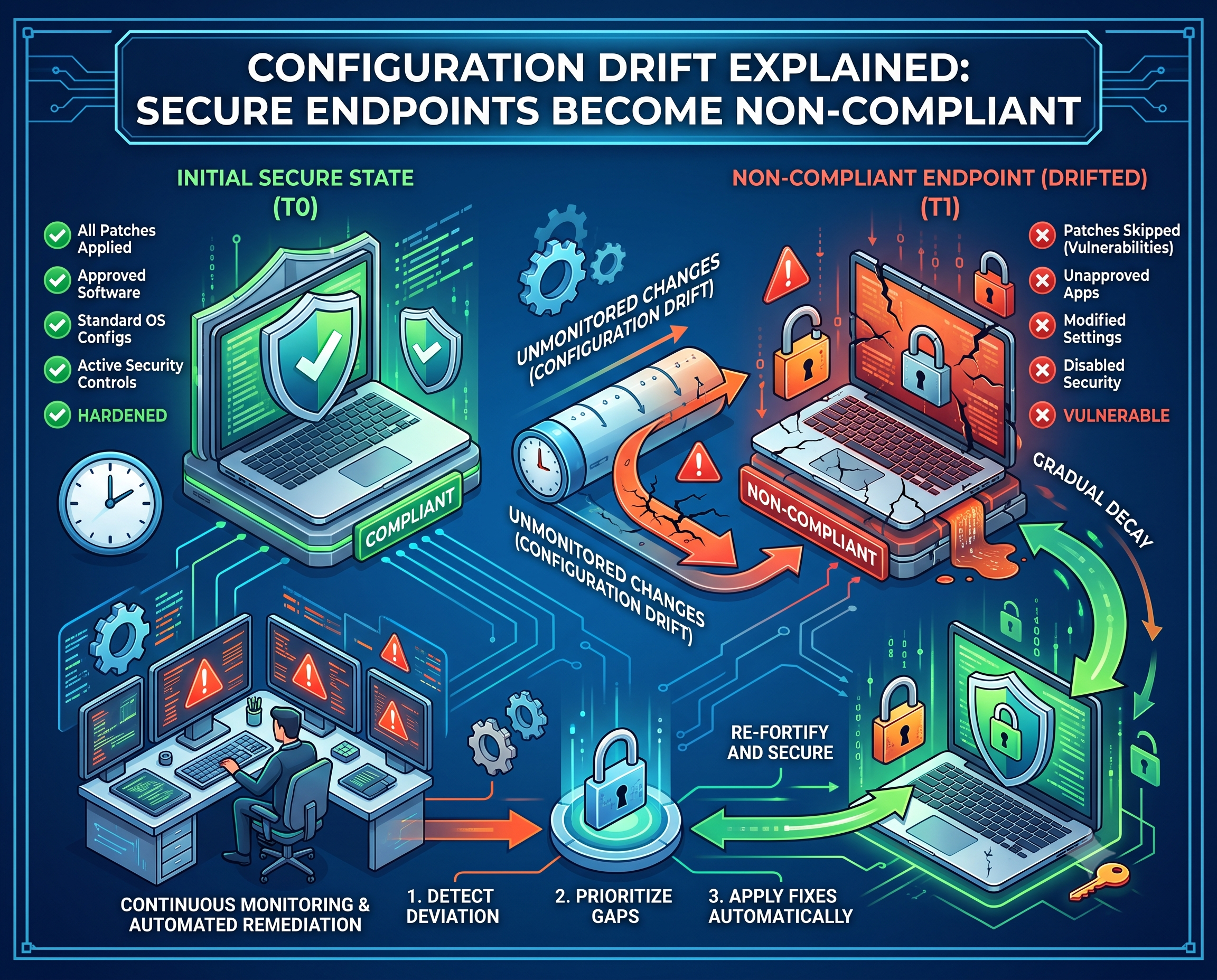
Configuration drift is the gradual change of a system's configuration away from an approved, secure, or expected state. An endpoint may initially meet an organisation's security baseline, but changes made over time can cause its configuration to differ from the original requirements.
These changes may happen because of software installations, operating system updates, administrator activity, troubleshooting, application requirements, policy changes, or user actions.
Configuration drift is not necessarily caused by malicious activity. In many environments, it is a natural result of continuous operational change. The security challenge is identifying which changes are acceptable and which changes create security or compliance risks.
Why Secure Endpoints Become Non-Compliant Over Time
An endpoint that is securely configured today may not remain compliant indefinitely. Security configurations exist within a constantly changing operating environment.
- Administrators modify system settings
- Applications change system configurations
- Operating system updates modify settings
- Security policies are changed
- Users receive new privileges
- New services or applications are installed
- Troubleshooting temporarily disables security controls
- Network requirements lead to configuration changes
- Security tools are reconfigured
- Previously remediated settings change again
Without ongoing validation, these changes can accumulate. Over time, an endpoint can gradually move away from its approved security baseline even though it originally passed a security assessment.
Configuration Drift vs Security Misconfiguration
Configuration drift and security misconfiguration are closely related but describe different aspects of an endpoint security problem.
- Configuration drift describes a change away from the expected configuration
- Security misconfiguration describes an insecure or incorrect configuration
- Configuration drift can create security misconfigurations
- A misconfiguration may exist without a previous compliant state
- Continuous monitoring can help identify both conditions
For example, if an organisation requires a host firewall to remain enabled and an administrator disables it for troubleshooting, the endpoint has drifted from its approved configuration. The resulting disabled firewall may also represent a security misconfiguration.
How Configuration Drift Happens
Configuration drift can occur through many routine activities. The most difficult aspect is that individual changes may appear harmless while their cumulative effect creates a meaningful security gap.
Administrative Changes
System administrators may change configurations while troubleshooting incidents, supporting applications, managing users, or performing maintenance.
Temporary changes can become permanent if the original configuration is not restored.
Software Installation
Installing applications can introduce new services, modify permissions, change firewall rules, or alter other system settings.
Even legitimate software can cause an endpoint to deviate from an organisation's approved baseline.
Operating System Updates
Operating system updates can change default configurations, security settings, services, or other system behaviour.
Security teams should validate important security controls after major system changes instead of assuming that previous compliance automatically remains valid.
Application Requirements
Some applications require system settings that differ from the organisation's standard security configuration. If these exceptions are not documented and controlled, they can create unmanaged configuration differences across endpoints.
User Activity
Users with sufficient privileges may modify settings, install software, or make other changes that affect endpoint security.
Strong privilege management and continuous monitoring can reduce the likelihood that unauthorised changes remain unnoticed.
Examples of Configuration Drift on Endpoints
Configuration drift can affect many areas of endpoint security.
- Firewall configuration changes
- Password policy changes
- Security logging being disabled
- Encryption settings being modified
- Unnecessary services becoming active
- Remote access settings being changed
- Security software being disabled
- User privileges being expanded
- Browser security settings being weakened
- System hardening settings being modified
- CIS Benchmark recommendations becoming non-compliant
The risk depends on the specific configuration, system role, exposure, and business context. Security teams should therefore prioritise drift based on its potential impact rather than treating every configuration difference equally.
Why Configuration Drift Is a Security Risk
Configuration drift can gradually increase the attack surface of an endpoint. A system may begin in a hardened state but become less secure as controls are disabled, permissions expand, or insecure services are introduced.
- Increases attack surface
- Weakens security controls
- Creates compliance gaps
- Reduces consistency across endpoints
- Makes security posture harder to understand
- Can reintroduce previously remediated weaknesses
- Creates additional investigation and remediation work
- Can increase exposure between security assessments
The most important risk is often not a single configuration change but the loss of confidence that endpoints still match the security requirements established by the organisation.
Configuration Drift and Endpoint Compliance
Endpoint compliance depends on systems continuing to satisfy defined security requirements. If a configuration changes after an endpoint has passed an assessment, the endpoint may no longer meet the same requirements.
This is why compliance should be treated as an ongoing process rather than a one-time certification of endpoint configuration.
- Define the required security configuration
- Assess the endpoint
- Identify non-compliant settings
- Remediate the deviation
- Verify the endpoint
- Continue monitoring for future changes
Continuous validation helps organisations determine whether previously compliant systems remain compliant as the environment evolves.
Configuration Drift and CIS Benchmarks
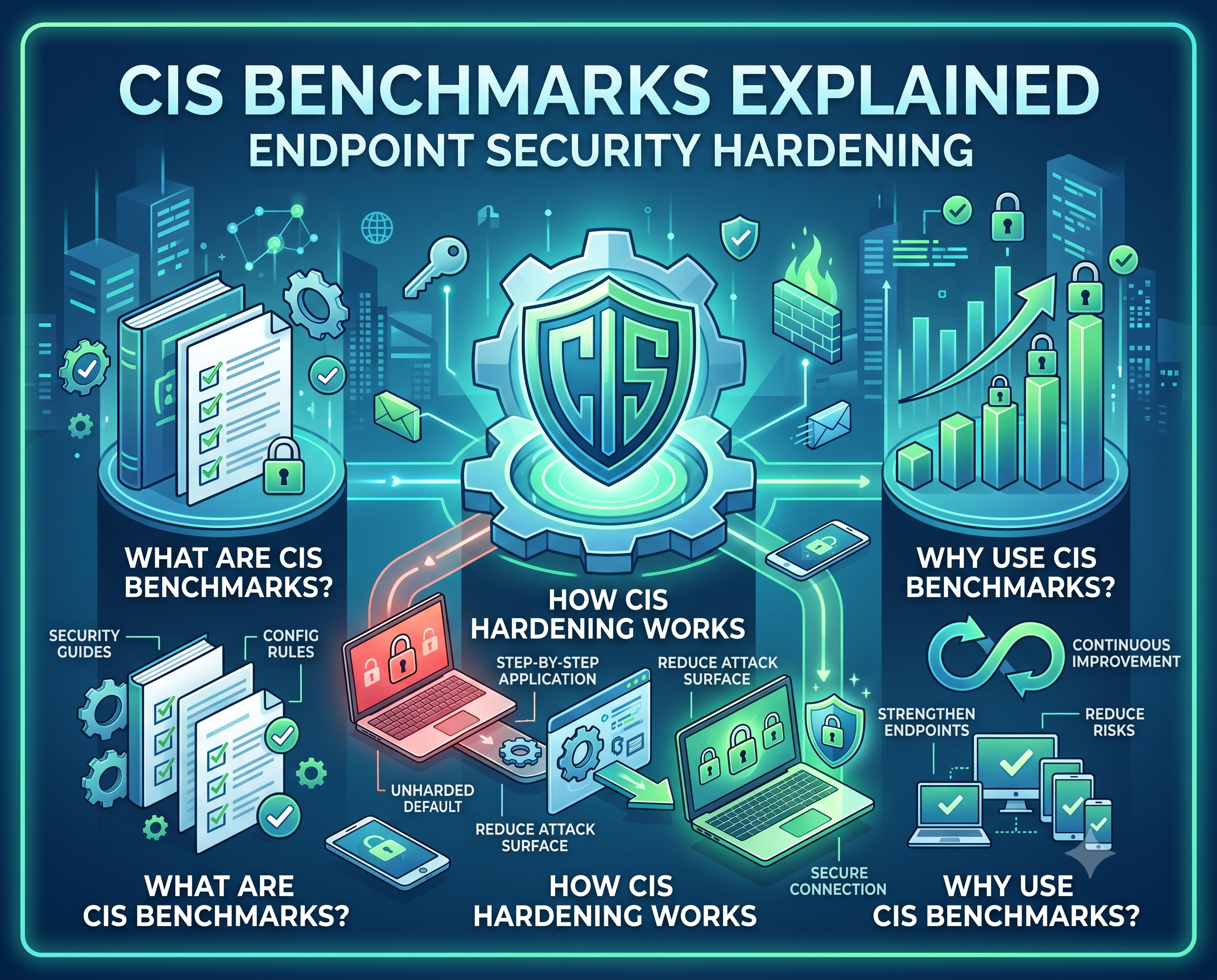
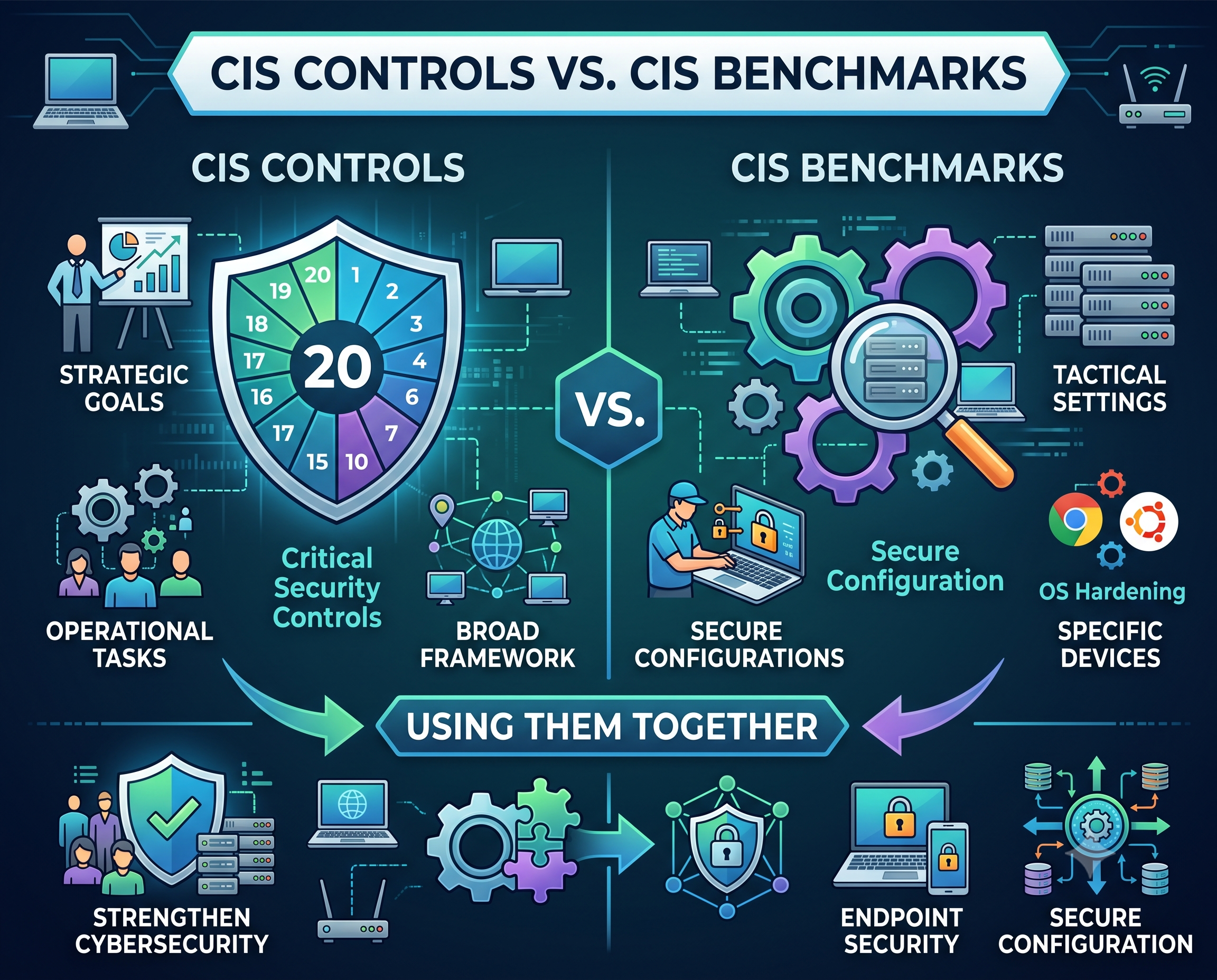
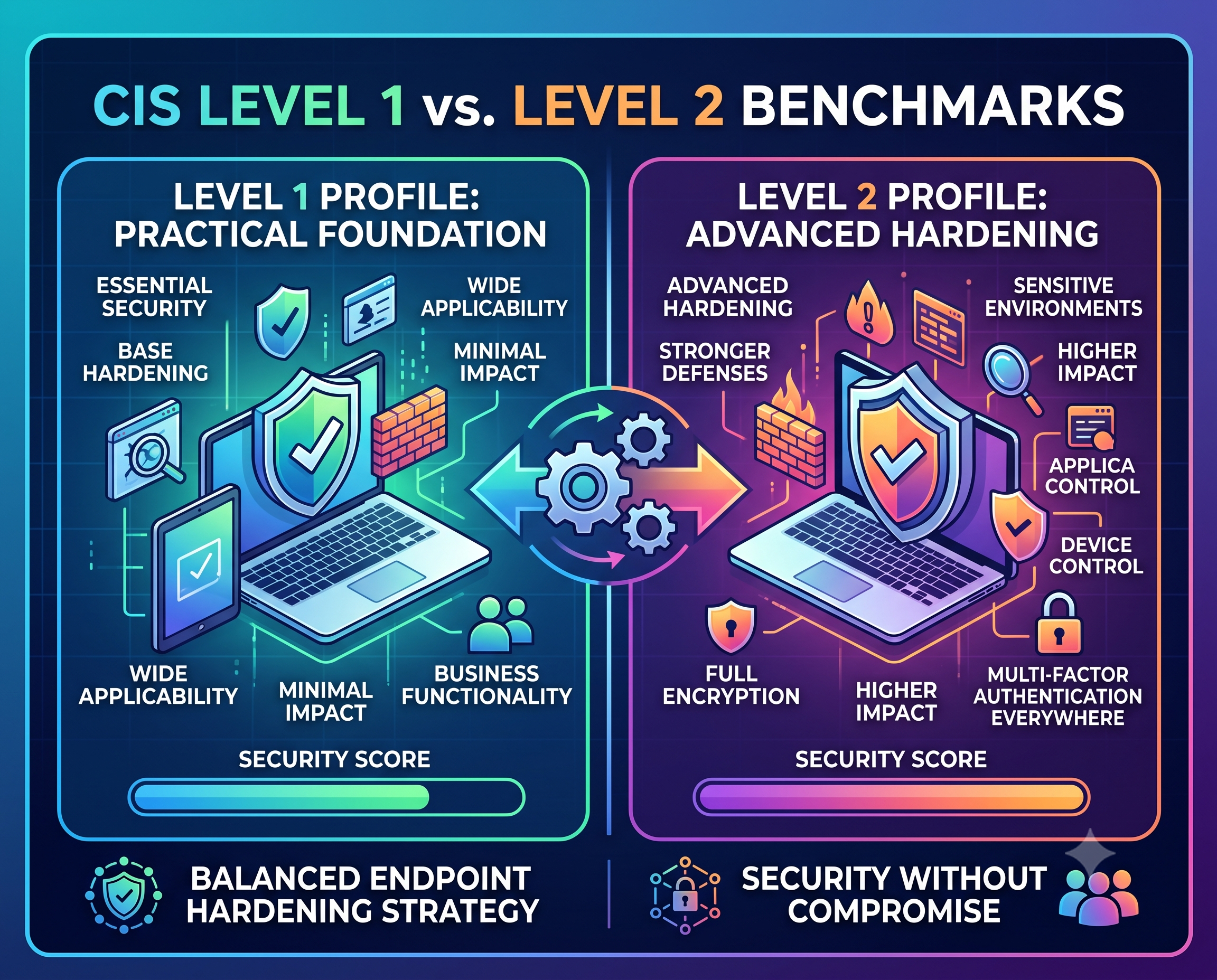
CIS Benchmarks can be used as a source of secure configuration recommendations when establishing endpoint security baselines. An organisation can assess systems against applicable Benchmark recommendations and identify configurations that do not match the selected security requirements.
However, passing a CIS Benchmark assessment at one point does not guarantee that the endpoint will remain aligned with the Benchmark indefinitely. System configurations can change after the assessment.
Continuous assessment helps identify when previously compliant endpoints deviate from their expected configuration.
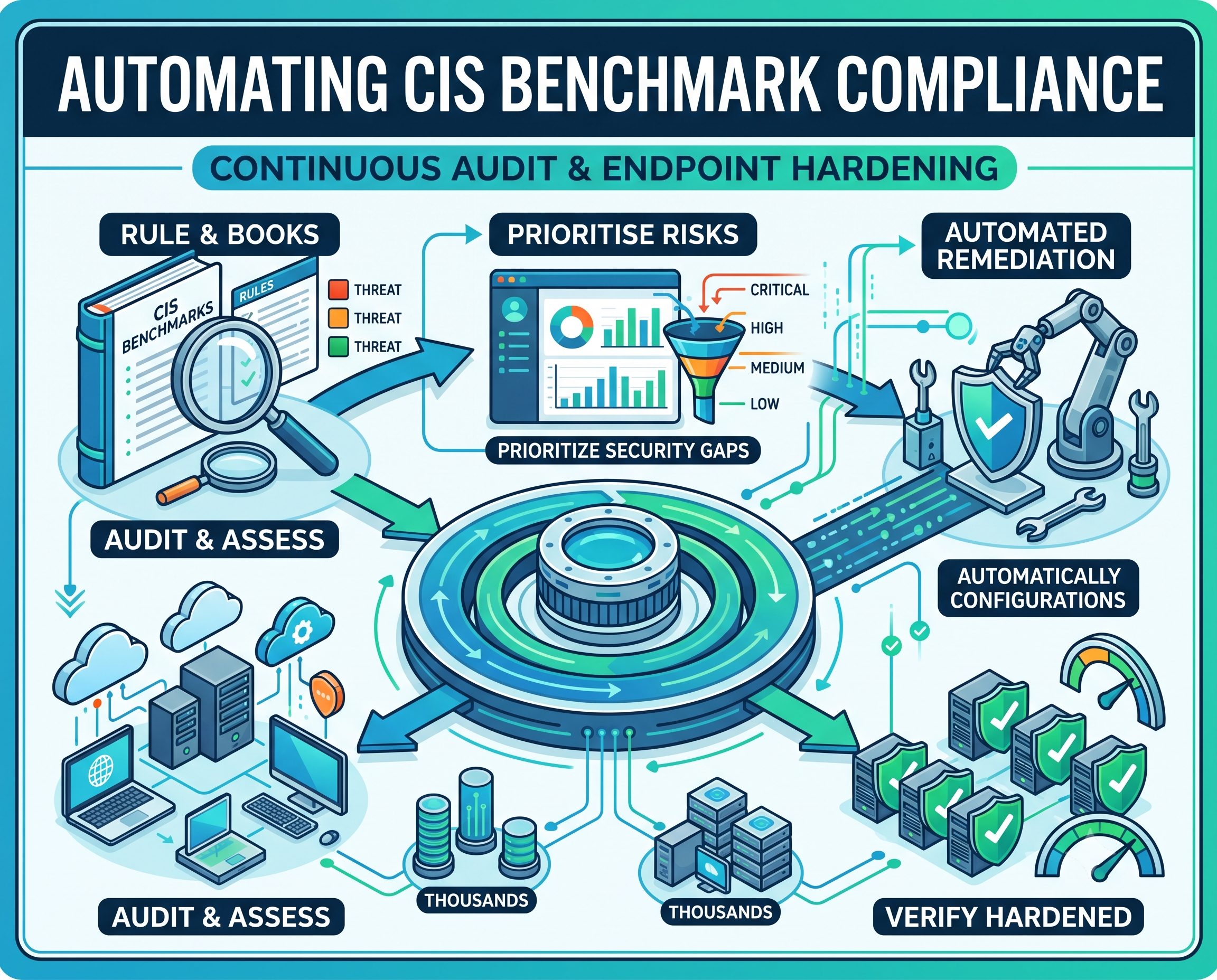
- Establish an appropriate CIS-based security baseline
- Assess supported endpoints
- Identify failed recommendations
- Prioritise important deviations
- Remediate applicable findings
- Verify the corrected configuration
- Continue monitoring for future drift
The Relationship Between Configuration Drift and Endpoint Hardening
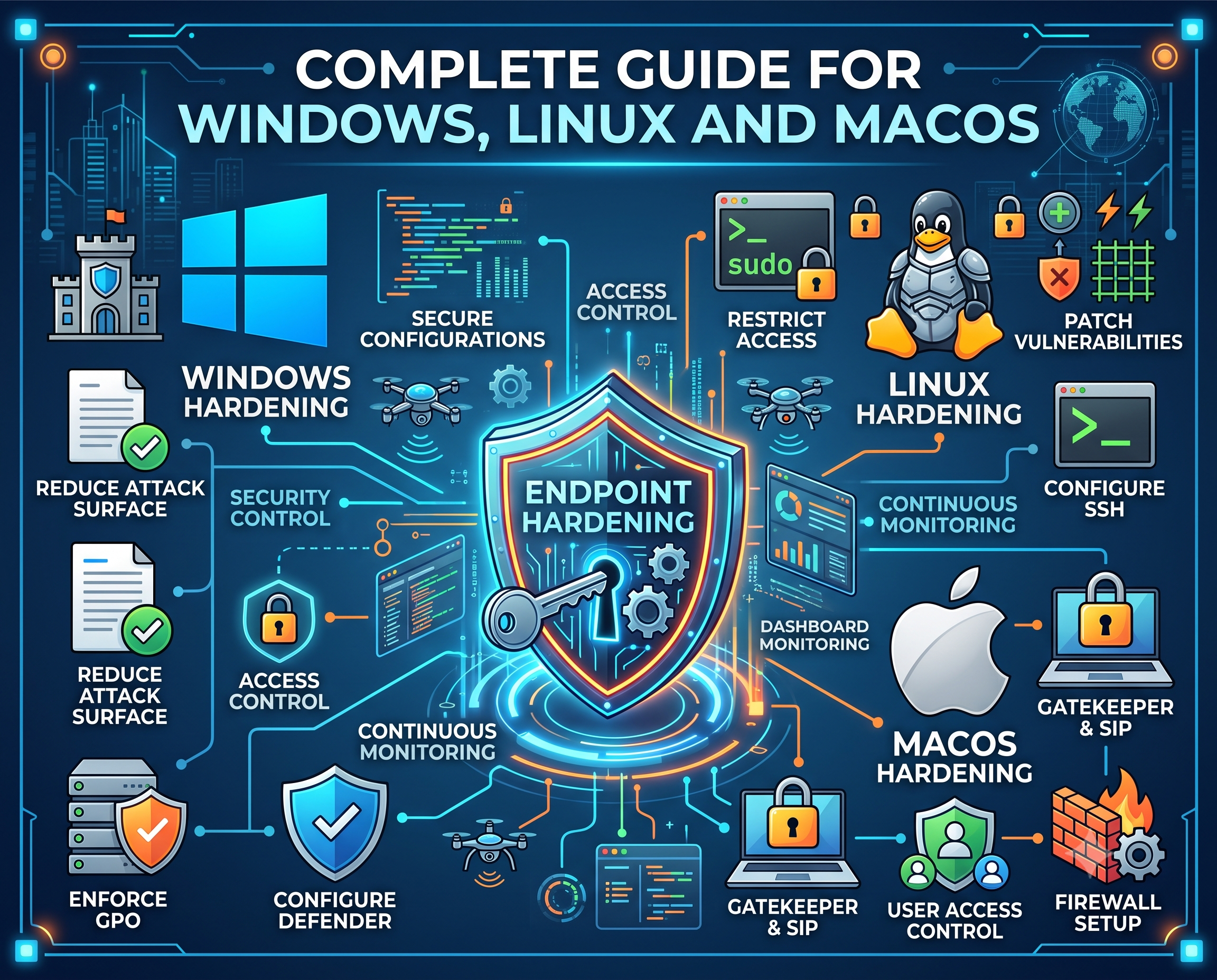
Endpoint hardening establishes a more secure configuration by reducing unnecessary services, strengthening security settings, limiting privileges, and implementing appropriate protective controls.
Configuration drift can gradually undo some of the benefits achieved through hardening.
For example, an endpoint may initially be hardened according to an approved security baseline. Later, a service may be enabled, a firewall rule may be changed, or a security setting may be weakened. If the change is not detected, the endpoint can gradually move away from its hardened state.
This makes continuous configuration monitoring an important complement to endpoint hardening.
Why Periodic Audits Can Miss Configuration Drift
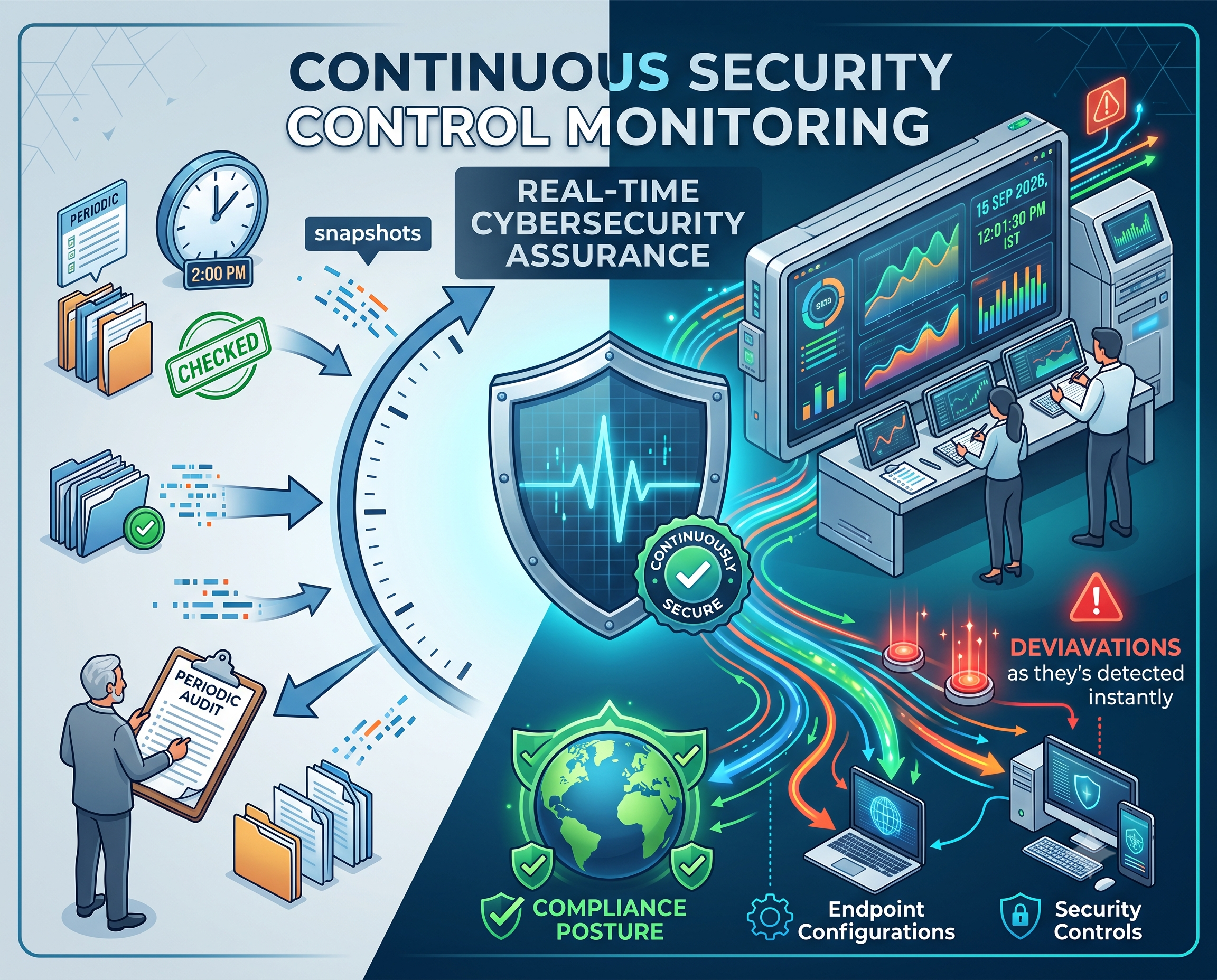
Periodic audits provide valuable point-in-time visibility, but they cannot continuously observe changes that occur after the assessment.
Consider an endpoint that passes a security audit in January. In March, an administrator changes a security configuration to resolve an application issue. If the next audit occurs in July, the endpoint may remain outside the approved security baseline for several months.
- Audit identifies the security state during the assessment
- Configuration changes occur after the assessment
- The endpoint remains potentially non-compliant
- The issue may remain undetected until the next assessment
Continuous monitoring reduces this visibility gap by checking important security controls repeatedly instead of relying exclusively on scheduled audits.
How Continuous Monitoring Detects Configuration Drift
Continuous configuration monitoring compares the current state of relevant endpoint settings against an approved baseline or security requirement.
- Establish the expected configuration
- Collect the current endpoint configuration
- Compare current and expected states
- Identify deviations
- Classify the security impact
- Generate or update the finding
- Remediate where appropriate
- Verify the endpoint configuration
- Continue monitoring
This process allows security teams to identify changes that may otherwise remain hidden until a manual review or scheduled audit.
Automated Configuration Drift Detection
Manual configuration checking becomes increasingly difficult as the number of endpoints grows. Automation can repeatedly evaluate security controls across large endpoint environments and identify systems that no longer meet defined requirements.
- Automated configuration assessment
- Automated baseline comparison
- Centralised finding collection
- Endpoint-level compliance status
- Security control tracking
- Historical configuration visibility
- Automated reporting
- Remediation verification
Automation does not remove the need for security governance. Organisations still need to define appropriate baselines, establish exception processes, and determine which findings can be automatically remediated.
Configuration Drift and Automated Remediation
Detecting configuration drift is only useful if organisations can respond effectively. Automated remediation can restore approved settings for selected controls where the corrective action is well understood and appropriately tested.
A reliable remediation process should include verification after the corrective action.
- Detect the configuration deviation
- Identify affected endpoints
- Assess the risk
- Determine whether automatic remediation is appropriate
- Apply the approved remediation
- Reassess the endpoint
- Confirm the expected configuration
- Record the result
- Continue monitoring
Verification is particularly important because remediation actions can fail, be blocked by application dependencies, or produce a different configuration than expected.
Managing Exceptions Without Creating Security Blind Spots
Not every deviation from a standard baseline represents a security failure. Some systems may require different configurations because of application compatibility, operational requirements, legacy systems, or specialised business functions.
The solution is controlled exception management rather than ignoring the deviation.
- Document the reason for the exception
- Identify affected endpoints
- Assign an owner
- Define the approved configuration
- Set a review date
- Assess the associated risk
- Monitor the exception
- Remove the exception when it is no longer required
An undocumented exception can look identical to an unmanaged security failure. Proper exception management provides context while maintaining visibility.
Configuration Drift Across Large Endpoint Environments
Configuration drift becomes more difficult to manage as organisations operate larger and more distributed endpoint environments.
Different teams may apply different settings, users may work remotely, applications may vary between departments, and systems may receive changes at different times.
- Centralised endpoint visibility
- Consistent security baselines
- Automated assessment
- Risk-based prioritisation
- Centralised remediation tracking
- Exception management
- Historical compliance data
- Security posture reporting
A centralised approach helps security teams identify whether a configuration issue affects one endpoint or represents a broader pattern across the environment.
How Configuration Drift Affects Security Posture
Security posture represents the organisation's overall level of security readiness and control effectiveness. Configuration drift can gradually weaken this posture by creating inconsistencies between intended security policies and actual endpoint configurations.
A single failed configuration may have limited impact. However, repeated drift across hundreds or thousands of endpoints can create a significant security management problem.
Monitoring trends can help organisations identify recurring sources of drift and address the underlying operational cause rather than repeatedly fixing the same individual endpoints.
Metrics for Measuring Configuration Drift
Organisations should track meaningful metrics to understand the scale and persistence of configuration drift.
- Number of non-compliant endpoints
- Configuration drift rate
- Number of failed security controls
- Recurring configuration deviations
- Average time to remediate
- Remediation success rate
- Number of endpoints without recent assessment
- Number of approved exceptions
- Percentage of endpoints meeting the security baseline
- Security posture trend over time
These metrics can help security teams determine whether hardening and monitoring programmes are producing sustained improvements.
Common Mistakes in Configuration Drift Management
- Treating security hardening as a one-time activity
- Relying exclusively on periodic audits
- Failing to maintain an accurate endpoint inventory
- Using undefined or outdated security baselines
- Treating every deviation as equally important
- Automatically remediating changes without testing
- Ignoring legitimate configuration exceptions
- Failing to verify remediation
- Not tracking recurring drift
- Focusing only on compliance scores instead of security risk
Avoiding these mistakes helps organisations build a more sustainable configuration management and endpoint security programme.
Best Practices to Prevent Configuration Drift
- Create clear security configuration baselines
- Identify the controls that matter most to the organisation
- Continuously assess important endpoint configurations
- Use risk-based prioritisation
- Monitor changes after hardening
- Document legitimate exceptions
- Test automated remediation actions
- Verify remediation results
- Track recurring configuration deviations
- Review security baselines periodically
- Combine configuration monitoring with patch and vulnerability management
- Use historical data to identify systemic causes of drift
Configuration Drift and Continuous Security Assurance
Configuration drift demonstrates why cybersecurity assurance cannot depend entirely on historical audit results. Organisations need confidence that security controls remain effective after the original assessment.
Continuous security control monitoring provides this ongoing visibility by repeatedly evaluating whether endpoints continue to meet their defined security requirements.
When combined with endpoint hardening, patch management, vulnerability management, and remediation workflows, continuous configuration monitoring creates a stronger feedback loop between security policy and actual endpoint state.
How Cyber Auditor Can Help Manage Configuration Drift
Cyber Auditor can support organisations in identifying and managing endpoint configuration deviations through centralised security assessment and monitoring workflows.
Security teams can use a centralised approach to understand endpoint configuration status, identify security control failures, assess compliance gaps, and prioritise remediation across the environment.
- Centralised endpoint security visibility
- Security configuration assessment
- Security baseline monitoring
- CIS Benchmark-oriented assessment
- Configuration drift detection
- Endpoint hardening support
- Security control monitoring
- Remediation tracking
- Compliance visibility
- Security posture reporting
The objective is to help organisations move from discovering configuration problems during periodic audits toward continuously understanding whether endpoints remain aligned with their security requirements.
Configuration Drift Management Checklist
- Maintain an accurate endpoint inventory
- Define approved security baselines
- Identify critical endpoint security controls
- Assess endpoint configurations continuously
- Detect deviations from the baseline
- Prioritise high-risk configuration changes
- Investigate unexpected deviations
- Document approved exceptions
- Remediate confirmed security issues
- Verify remediation
- Track recurring drift
- Measure compliance and remediation trends
- Review baselines regularly
- Use monitoring data to improve endpoint hardening
Frequently Asked Questions
What is configuration drift in cybersecurity?
Configuration drift is the gradual change of a system or endpoint away from its approved, secure, or expected configuration. It can occur through administrative changes, software installation, updates, policy changes, or other operational activities.
Why does configuration drift happen?
Configuration drift can happen because endpoints are constantly changing. Administrators, applications, operating system updates, users, and business requirements can all modify system configurations.
Is configuration drift always a security problem?
Not necessarily. Some configuration changes are legitimate and approved. The security concern arises when changes create unacceptable risk, violate security requirements, or remain unmanaged and undocumented.
How can organisations detect configuration drift?
Organisations can detect configuration drift by continuously assessing endpoint settings and comparing the current configuration with an approved security baseline.
Can CIS Benchmarks help prevent configuration drift?
CIS Benchmarks can help organisations define secure configuration requirements for supported technologies. Continuous assessment against applicable requirements can help identify when endpoints deviate from the expected configuration.
Does endpoint hardening prevent configuration drift?
Endpoint hardening establishes a secure configuration, but it does not guarantee that the configuration will remain unchanged. Continuous monitoring is needed to identify changes that occur after hardening.
Can configuration drift be automatically remediated?
Selected configuration deviations can be automatically remediated when the corrective action is well understood, tested, and appropriate for the affected systems. Remediation should be verified after the change.
How is configuration drift related to compliance?
Configuration drift can cause an endpoint that previously satisfied security requirements to become non-compliant. Continuous assessment helps identify when this occurs.
Key Takeaways
- Configuration drift occurs when endpoints move away from their approved configuration
- Secure endpoints can become non-compliant after routine changes
- Administrative activity, software, updates, and user actions can cause drift
- Configuration drift can weaken endpoint security and increase attack surface
- Periodic audits can miss changes that happen between assessments
- Continuous monitoring helps detect deviations earlier
- CIS Benchmarks can support secure configuration baselines
- Endpoint hardening and continuous monitoring work together
- Automated remediation can help restore selected security configurations
- Exceptions should be documented, owned, and continuously monitored
- Security teams should track recurring drift and remediation performance
Conclusion
Configuration drift is an unavoidable challenge in modern endpoint environments because systems continuously change. An endpoint can be securely hardened and fully compliant during an assessment but gradually become non-compliant as configurations, applications, policies, and user activity change.
The solution is not to prevent every configuration change. Instead, organisations need continuous visibility into whether those changes affect security requirements. By continuously monitoring endpoint configurations against approved security baselines, security teams can identify deviations, prioritise risks, manage exceptions, and remediate security gaps.
When configuration monitoring is combined with endpoint hardening, CIS Benchmark assessment, patch management, vulnerability management, and automated remediation, organisations can build a more sustainable approach to endpoint security.
Ultimately, maintaining a secure endpoint is not a one-time activity. Security posture must be continuously assessed, validated, and improved as the environment changes.
Recommended Solution
See how MOBISEC solves this in practice
Topics