Why Mobile Security Matters More Than Ever in 2026
Mobile devices have become critical enterprise endpoints. Employees use smartphones and tablets to access corporate email, collaboration platforms, cloud applications, business systems, authentication services, customer information and sensitive company data.
This makes mobile devices an attractive target for attackers. A compromised smartphone can expose credentials, authentication sessions, business communications and sensitive information, and can potentially become an entry point into wider enterprise systems.
Recent mobile threat research shows that phishing and malicious content remain significant enterprise mobile risks, while attackers continue to combine social engineering, malware and vulnerability exploitation to target mobile users and their identities.
In 2026, enterprises should therefore treat mobile devices as security-critical endpoints rather than simply communication tools.
The Mobile Enterprise Attack Surface in 2026
The modern mobile attack surface extends beyond the physical smartphone. It includes the operating system, applications, identity credentials, networks, cloud services, APIs, authentication mechanisms and data accessed from the device.
- Corporate-owned smartphones
- BYOD devices
- Tablets
- Mobile applications
- Enterprise authentication applications
- Email and messaging applications
- Cloud applications
- Mobile browsers
- Wi-Fi and cellular networks
- Bluetooth and nearby-device connectivity
- Device management platforms
- Identity and access systems
- Enterprise data
- Third-party applications and services
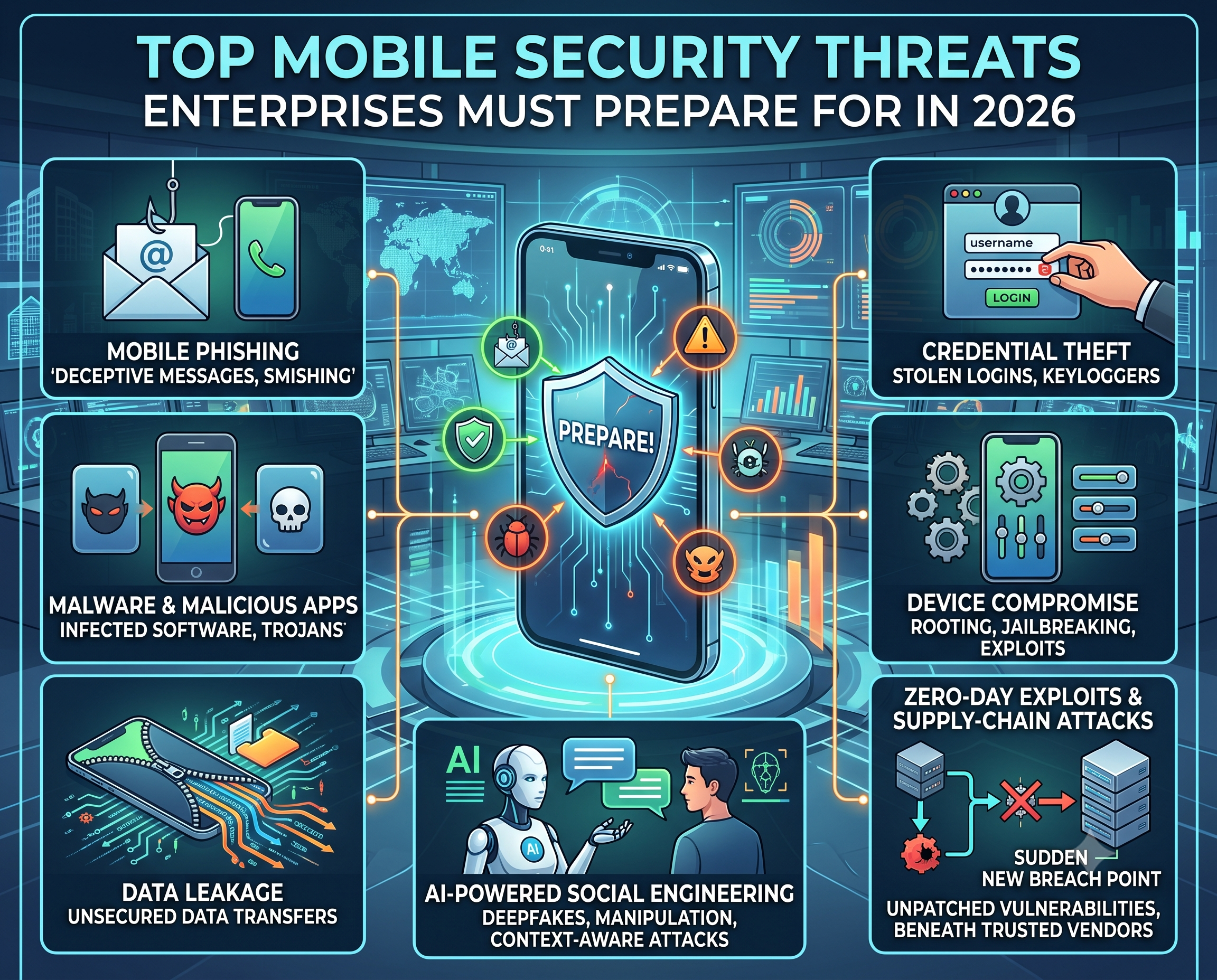
Top Mobile Security Threats Enterprises Must Prepare For
The mobile threat landscape in 2026 is increasingly identity-centric and socially engineered. Enterprises should prepare for multiple overlapping attack vectors rather than relying on a single mobile security control.
- Mobile phishing and smishing
- AI-powered social engineering
- Mobile malware and banking trojans
- Zero-day and vulnerability exploitation
- Malicious and trojanized applications
- Credential theft and session hijacking
- Device compromise and account takeover
- Data leakage through mobile applications
- Man-in-the-middle and unsafe network attacks
- Rooted and jailbroken devices
- Mobile spyware and surveillance threats
- Supply-chain and third-party application risks
- Cloud and identity attacks originating from mobile
- Lost and stolen device risks
- BYOD and unmanaged-device exposure
Mobile Phishing and Smishing
Mobile phishing is one of the most important threats enterprises need to address in 2026. Attackers use SMS messages, messaging applications, email, social media, QR codes and other mobile communication channels to direct users toward malicious websites or fraudulent services.
Smishing is particularly effective because mobile users often interact with messages quickly and may not inspect URLs or other indicators as carefully as they would on a larger screen.
Recent enterprise threat research continues to identify mobile phishing as a significant attack vector, with attackers using convincing messages and familiar brands or identities to steal credentials and other sensitive information.
- Credential harvesting
- Fake login pages
- Malicious links
- QR-code phishing
- SMS phishing
- Messaging-app phishing
- Social-media phishing
- Fake security alerts
- Fake account-verification messages
- Fake delivery or payment notifications
2. AI-Powered Mobile Social Engineering
Artificial intelligence is making social engineering campaigns easier to scale and personalize. Attackers can use AI to generate convincing messages, imitate communication styles, create realistic impersonation content and automate large-scale targeting.
The mobile environment provides attackers with multiple communication channels, including SMS, messaging platforms, email and social applications.
Enterprises should assume that phishing messages can be highly personalised and grammatically accurate, making traditional indicators such as spelling mistakes less reliable.
- AI-generated phishing messages
- Executive impersonation
- IT-support impersonation
- Personalised smishing
- Automated social engineering
- Fake security notifications
- Voice-based social engineering
- AI-generated fraudulent content
- Targeted credential harvesting
3. Mobile Malware
Mobile malware remains a major security concern. Malicious software can steal credentials, access sensitive information, monitor activity, intercept communications, abuse device permissions or enable remote control.
Mobile malware can be distributed through malicious applications, unofficial app stores, phishing campaigns, compromised websites and other delivery mechanisms.
Enterprise security teams should monitor for both known malware families and emerging variants because attackers continuously change malware behaviour and delivery methods.
- Banking trojans
- Remote access malware
- Information stealers
- Spyware
- Credential-stealing malware
- Ransomware
- Ad fraud malware
- Surveillance malware
- Botnet malware
- Trojanized applications
4. Mobile Banking Trojans and Financial Malware
Mobile banking trojans are designed to target financial applications and authentication workflows. These threats can attempt to steal credentials, intercept authentication information, manipulate transactions or enable attackers to control sensitive sessions.
ENISA's finance-sector threat landscape has documented mobile banking malware campaigns involving banking trojans and other mobile malware, highlighting the continued relevance of mobile-specific threats to financial services.
Enterprises in financial services should therefore treat mobile application and device security as part of their broader fraud and cybersecurity strategy.
5. Zero-Day and Vulnerability Exploitation
Mobile operating systems and applications contain complex software components, and vulnerabilities can become attack paths when security updates are unavailable, delayed or not applied.
Attackers may exploit vulnerabilities in operating systems, browsers, applications, device components or supporting services.
Zero-day vulnerabilities are particularly challenging because defenders may have limited time to identify and mitigate them before widespread exploitation begins.
- Operating-system vulnerabilities
- Browser vulnerabilities
- Application vulnerabilities
- Kernel vulnerabilities
- Remote-code-execution vulnerabilities
- Privilege-escalation vulnerabilities
- Authentication bypass vulnerabilities
- Mobile management vulnerabilities
- Third-party library vulnerabilities
6. Malicious and Trojanized Mobile Applications
Mobile applications can become a major security risk when they contain malicious code, excessive permissions, insecure components or compromised dependencies.
Attackers may distribute malicious applications through unofficial sources or attempt to disguise harmful applications as legitimate utilities, productivity tools or security applications.
Enterprises should therefore evaluate both the applications employees install and the permissions those applications receive.
- Fake productivity applications
- Trojanized applications
- Malicious utilities
- Fake security applications
- Unofficial application packages
- Over-privileged applications
- Applications with insecure SDKs
- Applications with data leakage risks
- Applications with malicious dependencies
7. Credential Theft and Identity Attacks
Mobile devices are increasingly used for authentication and access to enterprise applications. This makes credentials and authentication sessions valuable targets.
An attacker who compromises a user's credentials may be able to access cloud services, corporate email, collaboration systems or business applications without directly compromising a traditional desktop endpoint.
Mobile security should therefore be integrated with enterprise identity security.
- Credential phishing
- Password theft
- Session-token theft
- Authentication-code interception
- Fake authentication pages
- Account takeover
- Credential reuse
- Compromised identity providers
- Stolen authentication sessions
8. Mobile Session Hijacking
Stealing a password is not the only way to compromise an account. Attackers may attempt to obtain active authentication sessions or tokens that allow access without repeatedly entering a password.
Session hijacking can be particularly dangerous when mobile devices maintain persistent access to cloud applications and enterprise services.
Enterprises should combine strong authentication with device posture checks, session controls, risk-based access and continuous monitoring.
9. Mobile Data Leakage
Mobile applications often handle sensitive corporate information, including documents, customer data, credentials, messages and business communications.
Data can leak through insecure applications, excessive permissions, malicious applications, screenshots, copy-and-paste operations, cloud synchronisation, unsecured sharing mechanisms or compromised devices.
- Sensitive files
- Corporate email
- Customer information
- Authentication data
- Business documents
- Contacts
- Messages
- Location information
- Application data
- Cloud credentials
10. Mobile Application Data Leakage
Applications can unintentionally expose information through insecure storage, excessive permissions, insecure APIs, logging, analytics integrations or third-party software development kits.
Enterprises should evaluate the security and privacy behaviour of applications that access corporate information.
- Insecure local storage
- Excessive permissions
- Insecure APIs
- Sensitive data in logs
- Unencrypted communication
- Third-party SDK exposure
- Weak authentication
- Improper session handling
- Insecure backup behaviour
11. Man-in-the-Middle and Network Attacks
Mobile users frequently connect through public Wi-Fi, home networks, cellular networks and other environments outside the organisation's direct control.
Attackers can attempt to exploit insecure networks, malicious access points, weak configurations or vulnerable communication protocols to intercept or manipulate traffic.
Enterprises should use secure communication protocols and enforce appropriate network and application security controls.
- Rogue Wi-Fi networks
- Evil-twin access points
- Traffic interception
- DNS manipulation
- Certificate abuse
- Unsecured application traffic
- Insecure protocols
- Malicious captive portals
12. Rooted and Jailbroken Devices
Rooting or jailbreaking removes or weakens operating-system security controls and can increase the risk of malware, privilege escalation and unauthorised access.
A compromised device should not automatically receive the same level of access as a healthy and trusted corporate device.
Enterprises can use device-security posture checks to identify compromised devices and apply appropriate access restrictions.
13. Mobile Spyware and Surveillance Threats
Spyware can monitor communications, collect sensitive information, track user activity or provide attackers with persistent access to a device.
While highly targeted spyware may focus on specific individuals, enterprises should also consider commercial spyware, malicious surveillance applications and other forms of device compromise as part of their mobile risk model.
- Message monitoring
- Call monitoring
- Location tracking
- Credential theft
- Screen monitoring
- File collection
- Microphone abuse
- Camera abuse
- Persistent device access
14. Supply-Chain and Third-Party Application Risks
Mobile applications often depend on third-party libraries, SDKs, APIs and cloud services. A vulnerability or compromise within a dependency can introduce risk into applications used by employees or customers.
The broader cybersecurity landscape continues to highlight supply-chain and dependency abuse as an important organisational concern.
Enterprises should therefore consider the security of application dependencies and third-party services when evaluating mobile risk.
15. BYOD Security Risks
Bring Your Own Device programmes provide flexibility, but they also create additional security challenges because organisations may have limited control over personally owned devices.
A BYOD device may contain personal applications, unmanaged data, outdated software or configurations that do not meet enterprise security requirements.
- Unmanaged applications
- Outdated operating systems
- Personal cloud storage
- Unknown security posture
- Shared devices
- Weak device authentication
- Data mixing between personal and corporate applications
- Uncontrolled application installation
- Limited security visibility
16. Lost and Stolen Mobile Devices
Physical device loss remains a basic but important enterprise security risk. A lost smartphone may contain email sessions, business applications, authentication information and locally stored data.
Device encryption, strong authentication, remote management and appropriate data-protection controls can reduce the impact of device loss.
- Device encryption
- Strong screen authentication
- Remote lock
- Remote wipe
- Application access controls
- Device inventory
- Lost-device reporting
- Conditional access
- Secure backups
17. Mobile Account Takeover
Mobile account takeover occurs when attackers gain control over a user's account or authentication process and use it to access applications or information.
Account takeover can begin with phishing, malware, credential reuse, stolen sessions or compromised devices.
- Attacker obtains user credentials or session information
- Attacker bypasses or abuses authentication controls
- Attacker gains access to enterprise applications
- Attacker attempts privilege escalation or data access
- Attacker maintains persistence
- Compromised account is used for further attacks
18. Mobile Devices as an Entry Point Into the Enterprise
A compromised mobile device can provide attackers with valuable identity and business information even when the device itself is not directly connected to the corporate network.
Employees may use the same mobile device for email, cloud applications, authentication, messaging and access to business services.
This creates an important security relationship between mobile endpoints and the broader enterprise attack surface.
19. Why Traditional MDM Alone Is Not Enough
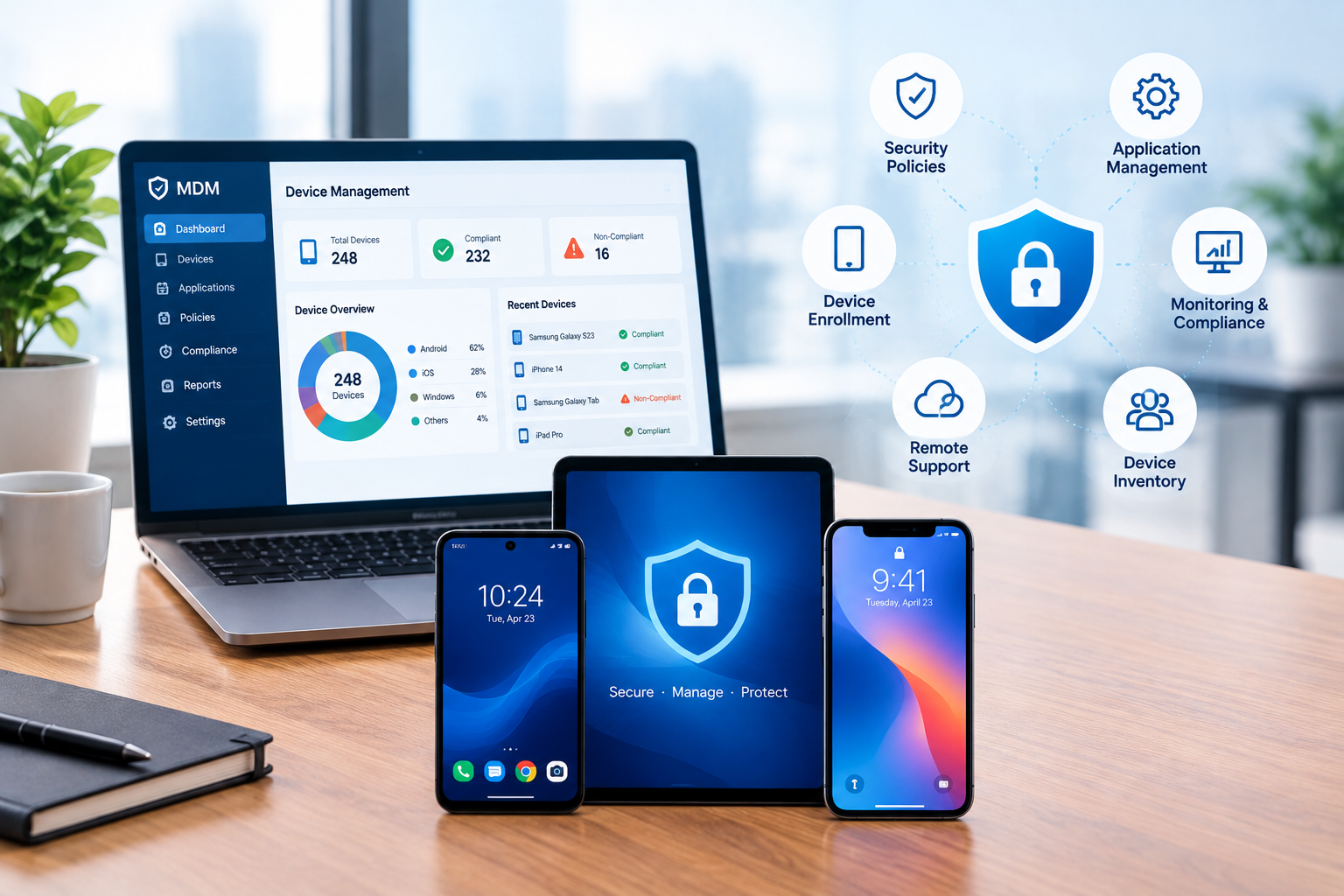
Mobile Device Management is important for managing enterprise devices, enforcing configuration policies and controlling device access. However, device management and mobile threat detection solve different security problems.
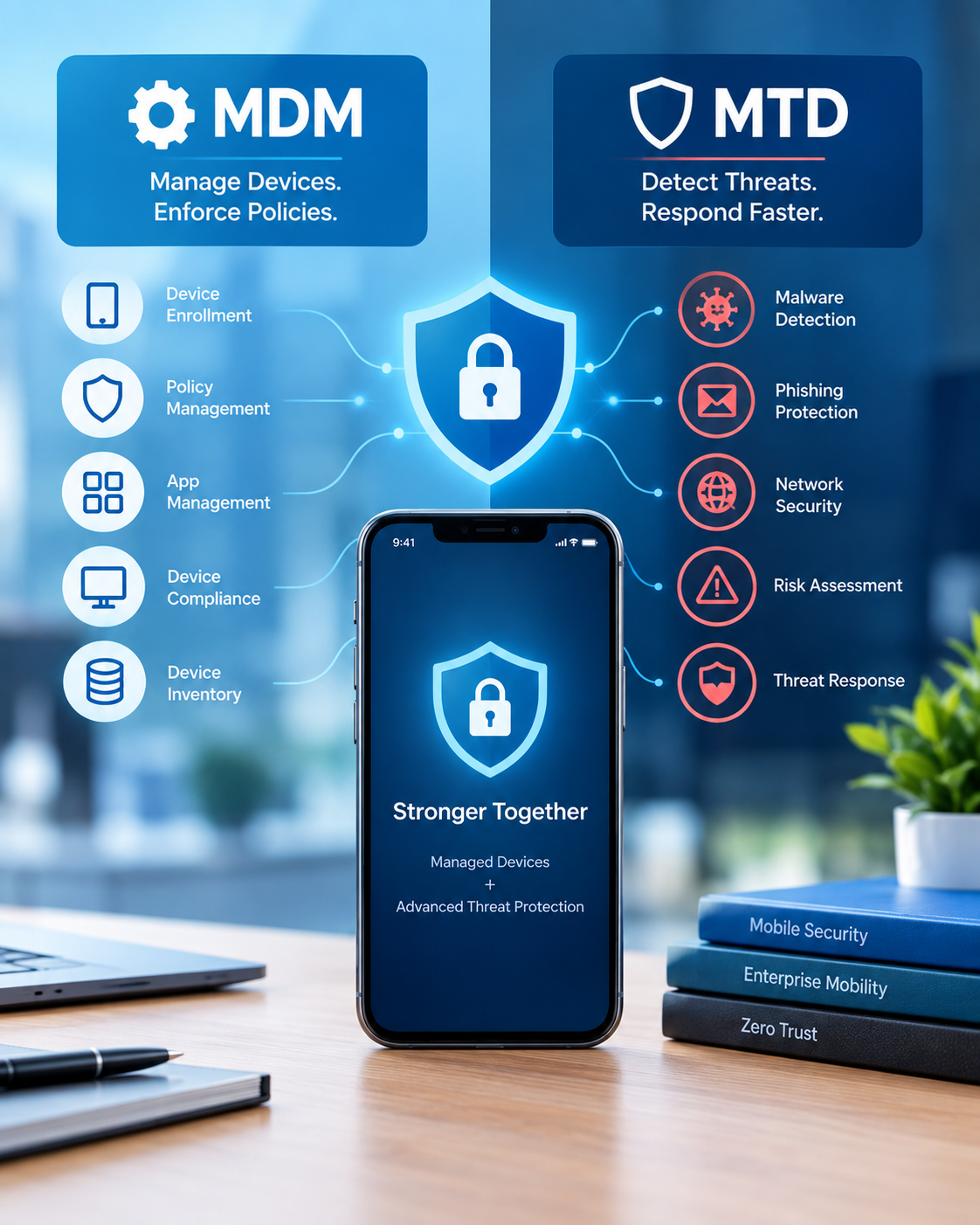
MDM primarily focuses on management, configuration and policy enforcement, while Mobile Threat Defense can provide security-focused detection and protection against threats such as phishing, malicious applications, network attacks and device compromise.
Modern enterprises should therefore consider MDM and Mobile Threat Defense as complementary security capabilities rather than interchangeable technologies.
20. MDM vs Mobile Threat Defense
- MDM manages devices and configurations
- MDM enforces device policies
- MDM supports application and device management
- MDM can control access based on device posture
- MTD focuses on detecting mobile threats
- MTD identifies malicious activity
- MTD helps detect mobile phishing
- MTD can detect malicious applications
- MTD can identify network threats
- MTD can provide mobile threat intelligence
- MDM and MTD can work together as part of an enterprise mobile security strategy
How Enterprises Should Defend Against Mobile Threats in 2026
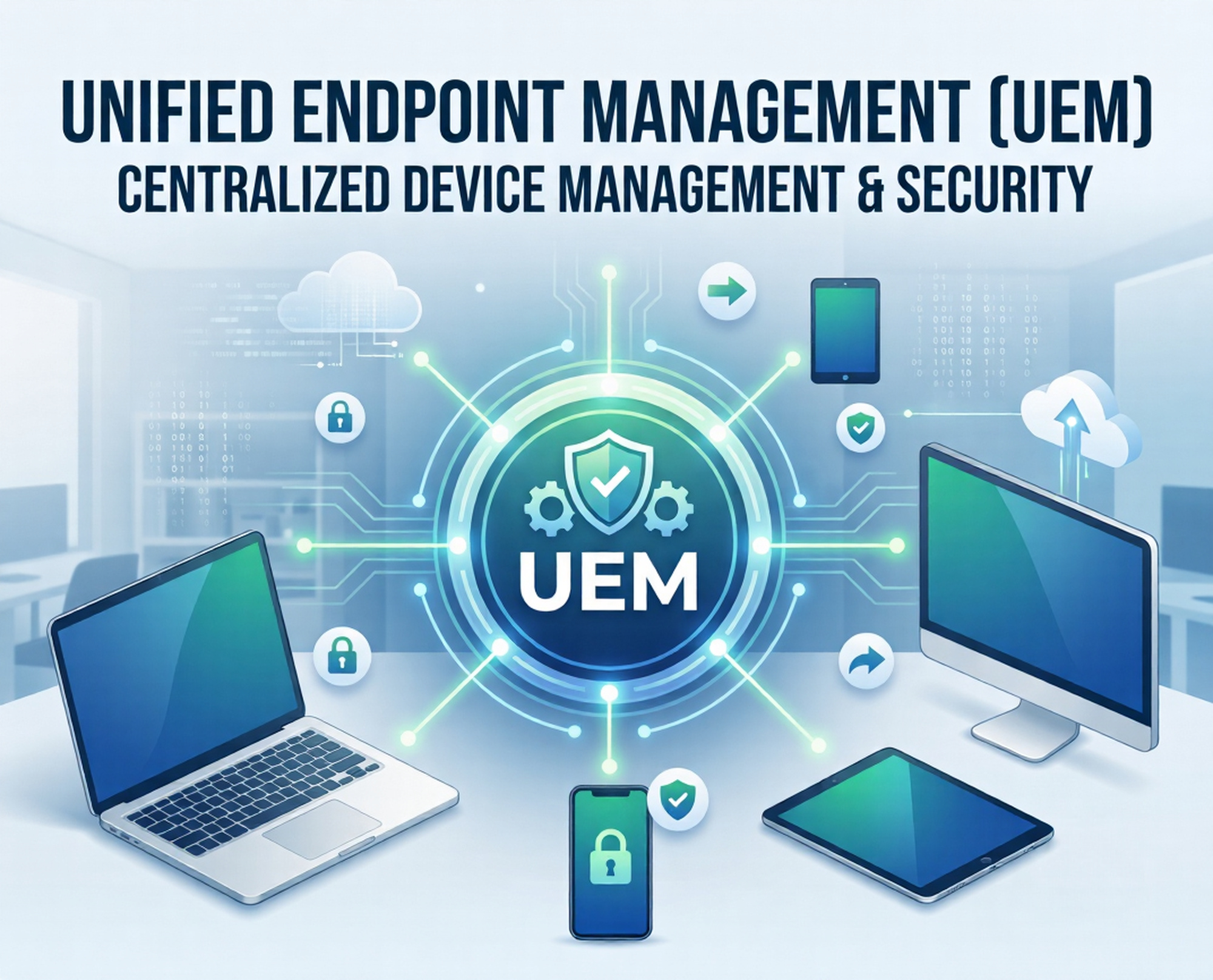
Effective mobile security requires multiple layers of protection. Enterprises should combine device management, identity security, application security, threat detection, network protection and user awareness.
- Inventory all enterprise and authorised BYOD devices
- Enforce secure device configurations
- Require strong authentication
- Use multi-factor authentication
- Deploy mobile threat detection capabilities
- Control application installation
- Monitor risky applications
- Protect sensitive enterprise data
- Secure mobile communications
- Detect phishing and malicious links
- Identify compromised devices
- Manage vulnerabilities and patches
- Monitor security events
- Integrate mobile telemetry with the wider security operation
- Maintain incident response procedures
- Train employees continuously
Mobile Security and Zero Trust
Zero Trust principles are increasingly relevant to mobile environments because device location alone does not provide sufficient evidence that a request is trustworthy.
Access decisions should consider identity, device security posture, application context, risk and the sensitivity of the requested resource.
- Verify identity
- Verify device posture
- Apply least privilege
- Use conditional access
- Monitor sessions
- Limit access to sensitive resources
- Reassess trust continuously
- Respond to risky device conditions
Mobile Security for BYOD
BYOD security requires a balance between employee privacy and enterprise security.
Organisations should clearly define which corporate information can be accessed from personal devices and what security conditions must be met.
- Define BYOD policies
- Separate business and personal information where appropriate
- Require secure authentication
- Assess device security posture
- Control corporate application access
- Protect corporate data
- Support remote removal of corporate information
- Respect employee privacy
- Define lost-device procedures
- Monitor enterprise security events
Mobile Application Security for Enterprises
Mobile security should cover both the device and the applications running on it. An organisation can have a well-managed device fleet while still exposing sensitive information through vulnerable or malicious applications.
Application security should include secure development, testing, vulnerability management, API security, authentication, data protection and runtime monitoring where appropriate.
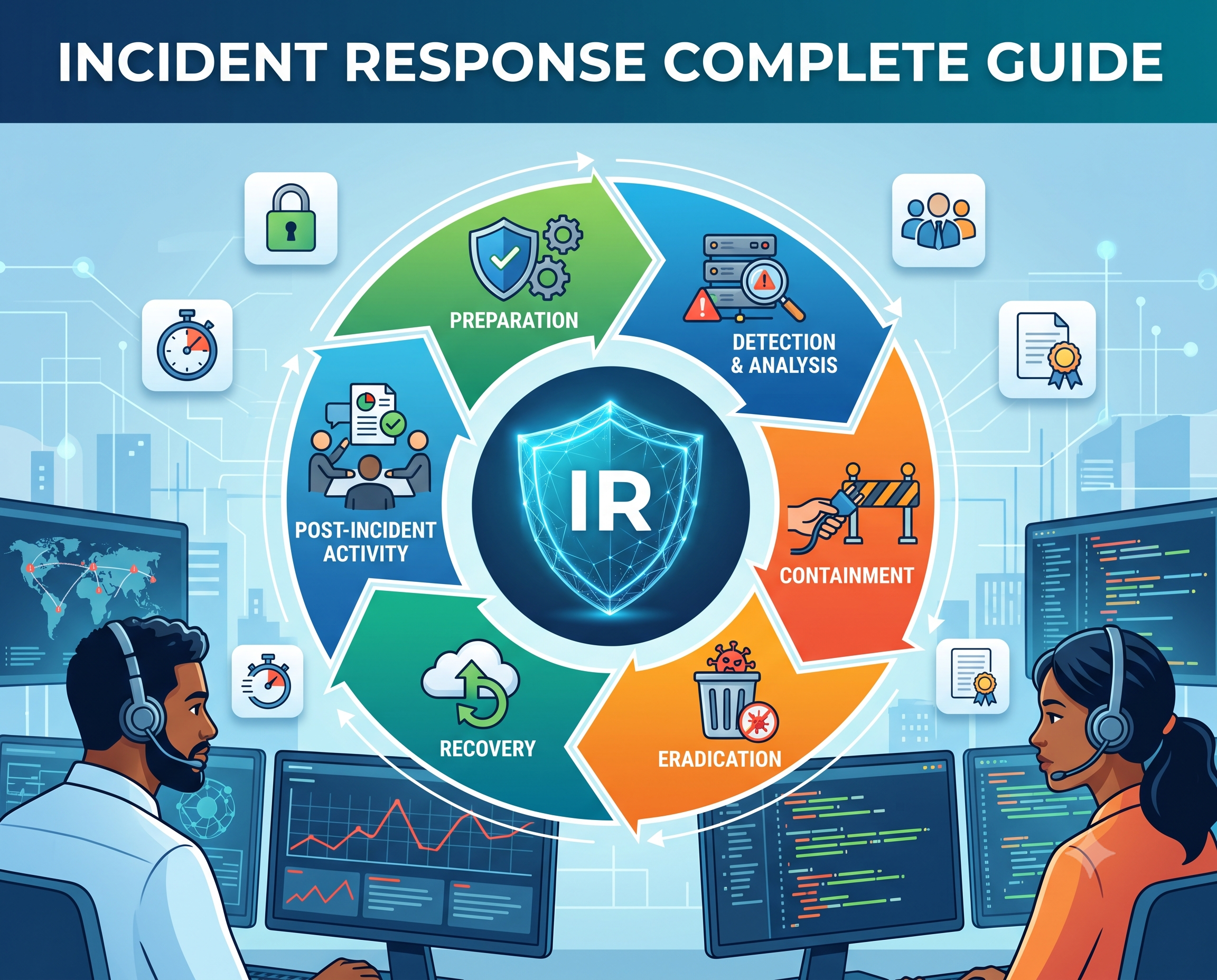
Mobile Threat Detection and Response
Detection is important because preventive controls can fail or be bypassed.
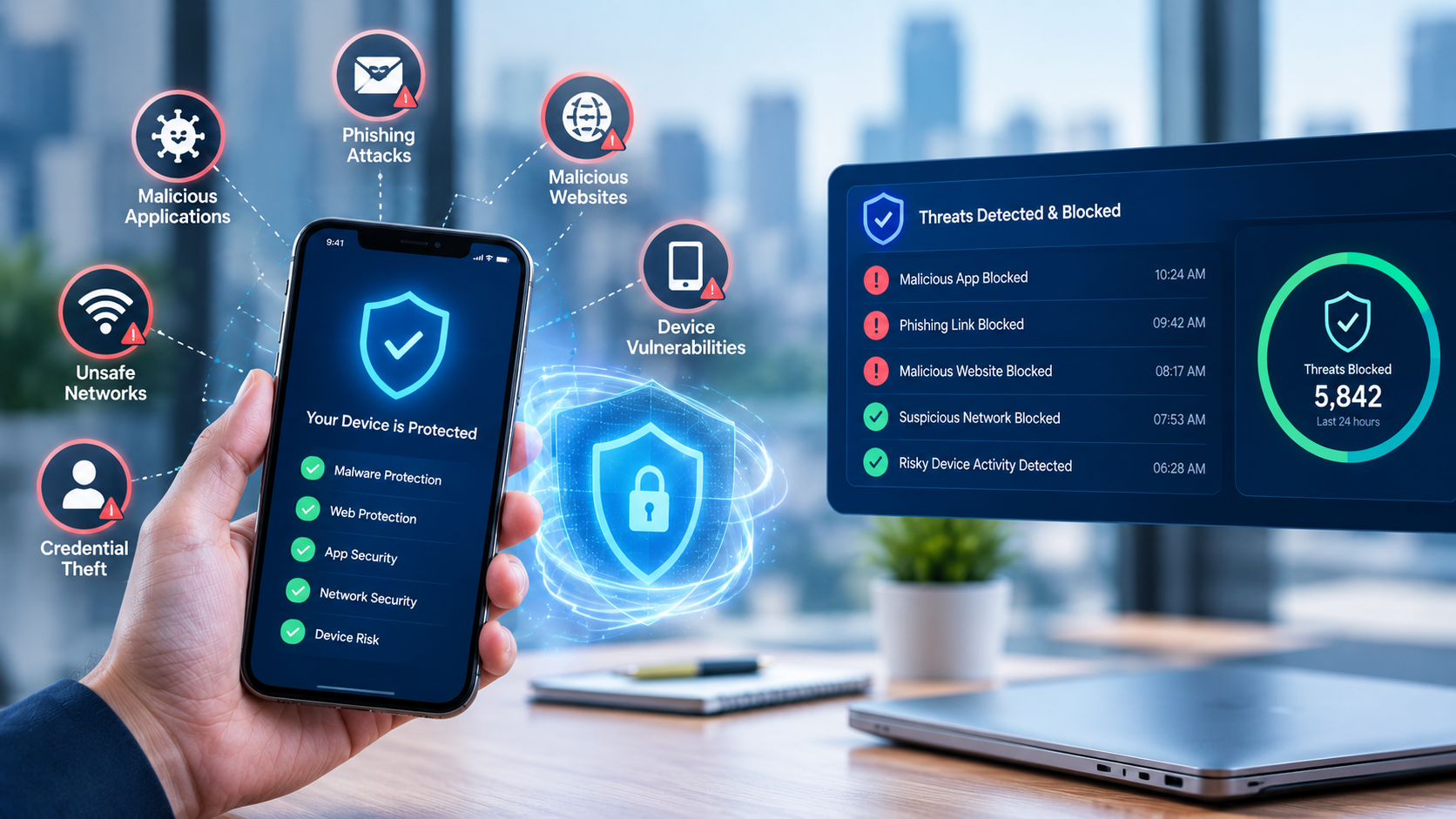
Mobile threat detection can identify suspicious device behaviour, malicious applications, phishing activity, unsafe network connections and other indicators of compromise.
- Collect mobile security telemetry
- Identify suspicious behaviour
- Classify the threat
- Determine affected users and devices
- Contain the affected device or account
- Investigate the incident
- Remove the threat
- Restore secure access
- Validate device security
- Document the incident
- Update defensive controls
Mobile Security Incident Response
Enterprises should include mobile devices in their incident response plans rather than treating them as separate from traditional endpoints.
- Define mobile incident categories
- Identify mobile security owners
- Create device-isolation procedures
- Create account-revocation procedures
- Define lost-device response
- Prepare malware investigation procedures
- Protect forensic evidence
- Integrate mobile alerts with SOC workflows
- Define escalation procedures
- Conduct response exercises
Mobile Security Metrics Enterprises Should Track
Security teams need measurable indicators to understand whether mobile security controls are reducing risk.
- Number of managed mobile devices
- Number of unmanaged devices accessing corporate resources
- Phishing attempts detected
- Malicious applications detected
- Compromised devices
- Rooted or jailbroken devices
- Critical mobile vulnerabilities
- Devices missing security updates
- Blocked malicious connections
- Account takeover incidents
- Mobile security incidents by severity
- Mean Time to Detect
- Mean Time to Respond
- Incident remediation time
Mobile Security Checklist for 2026
- Maintain an accurate mobile device inventory
- Support both corporate-owned and approved BYOD devices
- Enforce strong device authentication
- Use multi-factor authentication
- Apply secure device configurations
- Keep operating systems updated
- Control application installation
- Monitor application risk
- Deploy mobile threat defense
- Protect against mobile phishing
- Monitor suspicious network activity
- Detect compromised devices
- Protect sensitive corporate data
- Restrict risky device access
- Secure mobile applications
- Assess third-party application risks
- Integrate mobile alerts with the SOC
- Include mobile incidents in incident response
- Train employees on mobile phishing
- Test mobile security controls regularly
Frequently Asked Questions
What are the biggest mobile security threats in 2026?
Major enterprise mobile threats include phishing and smishing, AI-powered social engineering, mobile malware, malicious applications, zero-day exploitation, credential theft, session hijacking, data leakage, compromised devices, unsafe networks and third-party application risks.
Why is mobile phishing a major enterprise threat?
Employees increasingly use smartphones for authentication, communication and access to cloud services. Attackers can exploit these workflows through convincing messages, malicious links, fake login pages and other social-engineering techniques.
Are Android and iOS equally exposed to mobile threats?
Both Android and iOS can face security threats, although the attack techniques, vulnerabilities and available security controls can differ between platforms. Enterprises should avoid assuming that one platform is completely immune to mobile attacks.
Is MDM enough to protect enterprise mobile devices?
MDM is important for device management and policy enforcement, but it is not equivalent to dedicated mobile threat detection. Enterprises can use MDM together with Mobile Threat Defense to address both device-management and active-threat-detection requirements.
What is Mobile Threat Defense?
Mobile Threat Defense is a security capability designed to detect and respond to threats targeting mobile devices. Depending on the solution, it can address mobile phishing, malicious applications, network threats, device compromise and other mobile-specific risks.
How can enterprises prevent mobile phishing?
Enterprises should combine employee awareness with technical controls that detect malicious links, phishing websites and suspicious content. Strong identity protection and multi-factor authentication can also reduce the impact of stolen credentials.
How do rooted or jailbroken devices affect enterprise security?
Rooting or jailbreaking can weaken operating-system security controls and increase the risk of privilege escalation, malware and unauthorised access. Enterprises should assess device security posture before allowing access to sensitive resources.
How should enterprises secure BYOD devices?
Enterprises should establish clear BYOD policies, protect corporate data, enforce appropriate authentication, assess device security posture and control access to business applications without unnecessarily inspecting personal information.
Should mobile devices be monitored by the SOC?
Yes. Mobile security telemetry can provide valuable information about phishing, malicious applications, compromised devices and other threats. Integrating mobile security events into SOC workflows can improve visibility across the enterprise attack surface.
Key Takeaways
- Mobile devices are critical enterprise endpoints in 2026
- Mobile phishing and smishing remain major attack vectors
- AI is making social engineering more convincing and scalable
- Mobile malware continues to target credentials, applications and sensitive information
- Zero-day and vulnerability exploitation can compromise mobile devices
- Malicious applications can expose corporate data
- Credential theft and session hijacking can lead to enterprise account compromise
- BYOD increases the complexity of mobile security management
- Rooted and jailbroken devices require additional security controls
- Third-party applications and dependencies can introduce new risks
- MDM and Mobile Threat Defense address different aspects of mobile security
- Mobile security should be integrated with identity, endpoint and SOC operations
- Enterprises need continuous mobile threat detection rather than one-time security checks
Conclusion
Mobile security has become an essential part of enterprise cybersecurity in 2026. Smartphones and tablets are no longer isolated communication devices; they are endpoints used to authenticate users, access cloud applications, exchange business information and perform critical work.
Attackers are taking advantage of this dependence through mobile phishing, malware, malicious applications, vulnerability exploitation, credential theft, social engineering and device compromise.
Enterprises should respond with a layered mobile security strategy that combines MDM, Mobile Threat Defense, identity security, application security, secure access, threat intelligence, security monitoring and employee awareness.
The goal should not simply be to manage mobile devices. Organisations need to continuously understand mobile risk, detect threats quickly, protect enterprise data and respond effectively when a device or account becomes compromised.
In 2026, mobile security should be treated as a core component of enterprise endpoint security and zero-trust strategy rather than an optional extension of traditional cybersecurity.
Recommended Solution
See how MOBISEC solves this in practice
Topics