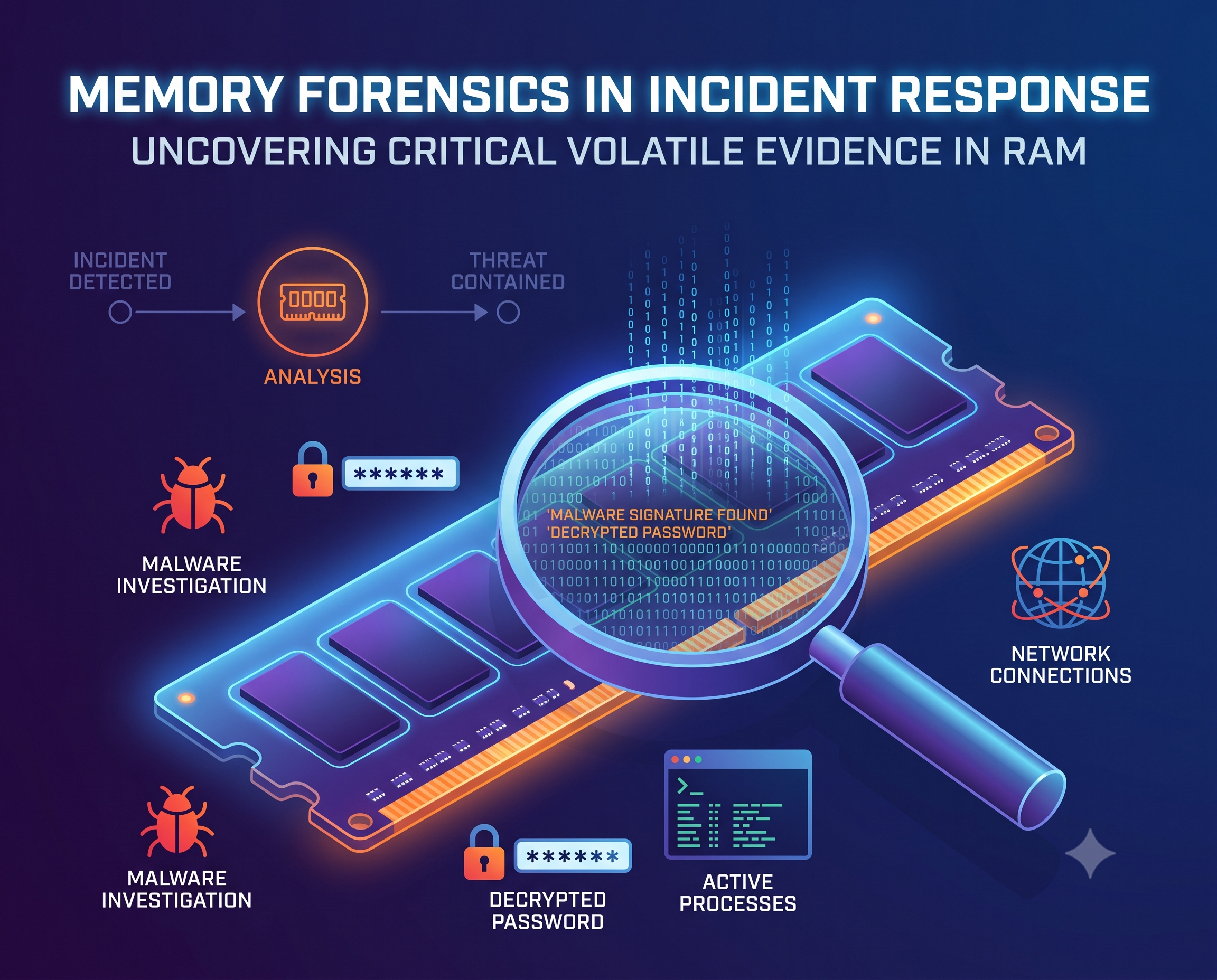
What Is Memory Forensics?
Memory forensics is the process of acquiring and analysing the volatile memory of a running computer or device to identify evidence related to security incidents, malicious activity and system compromise.
Unlike traditional disk forensics, which primarily examines persistent storage, memory forensics focuses on information that exists in RAM while a system is running.
RAM can contain information about running processes, network connections, loaded modules, active sessions and other runtime activity that may not be fully available from disk-based evidence.
This makes memory forensics particularly valuable when investigating malware, fileless attacks, credential theft, suspicious processes and advanced compromises.
What Is RAM and Why Is It Important?
Random Access Memory, or RAM, is volatile computer memory used by the operating system and applications while a device is running.
Unlike persistent storage, volatile memory depends on power to maintain its contents. When power is removed, information held in RAM can be lost. NIST describes volatile memory as information that requires power to maintain its contents, making it important to preserve volatile evidence before it disappears.
During an active security incident, this characteristic creates both an opportunity and a challenge. RAM can contain valuable evidence, but investigators may have only a limited window to collect it.
- RAM contains live system information
- RAM changes continuously
- RAM can contain information not present on disk
- RAM is volatile
- Power loss can destroy volatile evidence
- Incident response actions can alter memory
- Memory acquisition must therefore be carefully planned
Why RAM Matters During Incident Response
During an incident, security teams need to understand what happened, how the attacker gained access, what systems were affected, whether malicious code is still running and whether the attacker maintained persistence.
Disk evidence can answer many of these questions, but it may not show the complete state of a system at the time of investigation.
Memory can provide a snapshot of the system's runtime state and reveal evidence that may disappear when a process terminates, the system is rebooted or the device loses power.
CISA's ransomware guidance specifically recommends preserving highly volatile evidence such as system memory because it can be lost or altered.
Volatile vs Non-Volatile Evidence
Digital evidence can generally be considered in terms of how long it persists without active system operation.
- Volatile evidence exists primarily while a system is running
- RAM is a major source of volatile evidence
- Network connections can change rapidly
- Running processes can terminate
- Temporary system information can disappear
- Disk files are generally non-volatile
- Persistent storage remains available after shutdown
- Logs may provide longer-term historical evidence
What Information Can Be Found in RAM?
A memory image can contain many types of runtime information. The exact evidence available depends on the operating system, system state, applications, attack technique and timing of acquisition.
- Running processes
- Process identifiers
- Process relationships
- Loaded modules
- Network connections
- Open sockets
- Command-line information
- Active sessions
- Memory-resident code
- Kernel structures
- Loaded drivers
- User activity artifacts
- Temporary data
- Cryptographic material
- Malware-related artifacts
- Indicators of compromise
Running Processes and Process Relationships
One of the most useful areas of memory analysis is the examination of running processes.
Investigators can examine which processes were active, how processes were related and whether a process appears unusual compared with the expected operating-system environment.
Suspicious process names, unexpected parent-child relationships, unusual execution locations or abnormal memory behaviour can provide leads for further investigation.
- Identify running processes
- Review process identifiers
- Examine parent-child relationships
- Identify unusual processes
- Look for unexpected execution paths
- Compare processes with known system behaviour
- Investigate suspicious process activity
Network Connections in Memory
Memory can also provide evidence about active or recent network activity associated with running processes.
Investigators may examine network connections and identify processes associated with suspicious remote addresses, ports or communication patterns.
This can help security teams connect an endpoint compromise with command-and-control infrastructure or other external systems.
- Identify active network connections
- Identify listening ports
- Associate connections with processes
- Investigate suspicious remote addresses
- Identify unusual communication patterns
- Correlate network activity with other logs
Memory-Resident Malware
Some malware operates primarily in memory or uses memory-resident techniques to reduce its dependence on traditional files.
Attackers may execute malicious code, inject code into legitimate processes or use legitimate system components in ways that make traditional file-based detection more difficult.
Memory analysis can provide evidence of malicious activity that may not be obvious from a simple disk examination.
Fileless Attacks and Memory Forensics
Fileless attacks are designed to minimise or avoid traditional file-based artifacts. Attackers may abuse legitimate operating-system tools, scripts, memory injection techniques or trusted processes.
Memory forensics can be valuable in these investigations because the malicious activity may exist primarily in runtime memory rather than as an obvious malicious executable on disk.
However, memory analysis should be combined with endpoint, network, identity and log evidence rather than treated as a standalone source of truth.
Credential Theft and Memory
Memory can sometimes contain authentication-related information or remnants of sensitive data associated with running applications.
The exact information available depends on the operating system, application, authentication mechanism and system state.
Forensic investigators may therefore examine memory for evidence related to credential theft, authentication abuse and malicious access, while following appropriate legal, privacy and evidence-handling requirements.
Encryption Keys and Sensitive Runtime Data
Applications may hold sensitive cryptographic material or decrypted information in memory while performing operations.
In some investigations, memory analysis can help identify evidence related to cryptographic operations or sensitive data that existed only during runtime.
This can be particularly relevant when investigating malware, encrypted communications or attacks against applications that process protected information.
How Memory Forensics Supports Incident Response
Memory forensics can support multiple stages of an incident investigation.
- Identify suspicious processes
- Investigate malware execution
- Discover network connections
- Investigate persistence
- Identify injected code
- Investigate credential-related activity
- Correlate endpoint activity
- Support threat hunting
- Develop indicators of compromise
- Understand attacker behaviour
- Support forensic investigations
When Should Security Teams Capture RAM?
Memory acquisition should be considered when volatile evidence could materially help an investigation.
The decision depends on the type of incident, the affected system, operational impact, legal requirements, available tooling and the likelihood that valuable evidence will disappear.
- Suspected malware infection
- Fileless attack investigation
- Suspicious process activity
- Credential theft investigation
- Advanced persistent threat investigation
- Rootkit investigation
- Unexpected network connections
- Ransomware investigation
- Suspicious endpoint behaviour
- Potential attacker persistence
Why Timing Matters in Memory Acquisition
RAM is continuously changing. Processes start and stop, network connections appear and disappear, memory pages change and users continue interacting with the system.
This means a memory capture is not a perfect recording of every event that occurred on the device. It is a snapshot of the system at a particular point in time.
The longer investigators wait, the greater the possibility that important runtime evidence will change or disappear.
Memory Acquisition During Incident Response
Memory acquisition is the process of collecting the contents of volatile memory for forensic analysis.
The acquisition method depends on the operating system, device architecture, available forensic tools and incident circumstances.
Because acquisition itself interacts with the running system, investigators should understand that the collection process can alter the state of memory.
- Identify the affected system
- Determine whether memory acquisition is appropriate
- Preserve relevant incident context
- Use an approved acquisition method
- Capture volatile memory
- Record acquisition details
- Protect the collected memory image
- Calculate appropriate integrity hashes
- Document the chain of custody
- Transfer the image securely
- Perform analysis on a working copy
Preserving the Integrity of Memory Evidence
Forensic evidence must be handled carefully so that investigators can demonstrate how it was collected, stored and analysed.
The original memory image should be protected from unnecessary modification. Investigators should maintain appropriate documentation and use cryptographic hashes or other integrity mechanisms to help verify evidence.
- Record acquisition time
- Record affected system details
- Document the acquisition method
- Protect the original evidence
- Calculate an evidence hash
- Maintain chain-of-custody records
- Restrict access to evidence
- Analyse a verified copy where appropriate
- Document investigative actions
Memory Analysis Workflow
Once a memory image has been collected and preserved, investigators can perform structured analysis to identify relevant artifacts and suspicious activity.
- Validate the memory image
- Identify the operating-system context
- Enumerate processes
- Review process relationships
- Examine loaded modules
- Analyse network connections
- Inspect suspicious memory regions
- Investigate potential code injection
- Review relevant runtime artifacts
- Correlate findings with disk and network evidence
- Document indicators of compromise
- Build an incident timeline
- Prepare findings for response and remediation
What Tools Are Used for Memory Forensics?
Memory forensics can be performed using specialised forensic frameworks and incident-response tools. Tool selection depends on the operating system, memory image format, investigation requirements and analyst expertise.
- Volatility
- Rekall
- LiME
- WinPmem
- Magnet RAM Capture
- Belkasoft RAM Capturer
- Velociraptor
- Other enterprise forensic collection platforms
Tools should be selected and validated according to the organisation's forensic procedures. CISA also provides incident-response tooling guidance and describes Velociraptor as a platform that can rapidly collect and examine artifacts across a network during security investigations.
Volatility and Memory Analysis
Volatility is a widely used open-source memory-forensics framework. It can help investigators analyse memory images and examine operating-system artifacts such as processes, network activity and loaded components.
The value of a memory-forensics framework comes from being able to translate raw memory into structured evidence that investigators can use during an incident investigation.
Memory Forensics on Windows
Windows systems can contain extensive runtime artifacts that may be valuable during forensic investigations.
- Running processes
- Process trees
- Loaded DLLs
- Network connections
- Handles
- Services
- Registry-related artifacts
- Command-line activity
- Injected code indicators
- Kernel structures
- User-session information
The exact artifacts available depend on the Windows version, memory state and acquisition method.
Memory Forensics on Linux
Linux systems also contain valuable volatile artifacts that can support incident investigations.
- Running processes
- Process identifiers
- Network connections
- Loaded kernel components
- Open files
- Command-line information
- Memory mappings
- Kernel structures
- User-session information
- Suspicious processes
Memory Forensics on macOS
macOS systems can also be investigated using memory and endpoint forensic techniques. The available artifacts and acquisition methods depend on the macOS version, hardware architecture and forensic tooling.
Investigators should select acquisition and analysis methods that are appropriate for the affected system rather than assuming that a single memory-forensics workflow works identically across operating systems.
Memory Forensics and Malware Analysis
Memory analysis is especially useful when investigating suspicious malware execution.
Investigators can use memory evidence to understand which processes were active, whether code was injected, what network connections existed and whether suspicious modules or memory regions were present.
- Identify suspicious process
- Examine process context
- Review loaded modules
- Investigate memory regions
- Look for injected code
- Review network connections
- Correlate with malware indicators
- Compare against known-good system behaviour
- Determine likely execution method
- Document findings
Memory Forensics and Incident Timeline Reconstruction
Incident response often requires reconstructing a sequence of events: initial access, execution, persistence, privilege escalation, lateral movement and data access.
Memory evidence can contribute runtime context to this timeline.
However, memory should be correlated with endpoint logs, authentication records, network telemetry, application logs and persistent forensic artifacts because a single memory snapshot cannot establish the complete history of an incident.
Memory Forensics vs Disk Forensics
- Memory forensics focuses on volatile runtime information
- Disk forensics focuses primarily on persistent storage
- Memory can reveal active processes
- Disk can preserve files and historical artifacts
- Memory can reveal active network connections
- Disk can preserve application and system artifacts
- Memory can expose runtime code
- Disk can preserve executable files
- Memory is highly volatile
- Disk evidence generally persists after shutdown
The two approaches are complementary. Mature incident response programmes should use the evidence source that best answers the investigative question and correlate findings across sources.
Memory Forensics vs Network Forensics
Network forensics focuses on communications and network activity, while memory forensics focuses on the runtime state of endpoints.
Network evidence can show communication between systems, while memory may help identify which local process initiated a connection or what was happening on the endpoint at the time of collection.
Combining endpoint memory, network telemetry and logs can provide a stronger investigation than relying on any one evidence source.
Why Memory Forensics Is Important for Ransomware Investigations
Ransomware incidents can involve malicious processes, credential theft, remote access, command execution and lateral movement.
Preserving volatile evidence can help investigators understand what was running on affected systems and what activity was occurring before containment or shutdown.
CISA's ransomware guidance specifically recommends preserving highly volatile evidence such as system memory as part of evidence preservation.
Memory Forensics for Rootkit Detection
Rootkits attempt to hide malicious activity by operating at privileged levels or manipulating system visibility.
Memory analysis can provide investigators with another perspective for identifying inconsistencies between expected operating-system structures and observed runtime information.
Rootkit investigations are technically complex and should combine memory analysis with other endpoint and forensic evidence.
Challenges of Memory Forensics
Memory forensics provides valuable evidence, but it is not without limitations.
- RAM changes continuously
- Memory acquisition can alter system state
- Large memory images require significant storage
- Analysis can be computationally intensive
- Operating-system versions affect available artifacts
- Encryption can limit interpretation
- Some malware attempts to evade analysis
- Memory images may contain sensitive information
- Incorrect acquisition can reduce evidentiary value
- Investigators require specialised skills
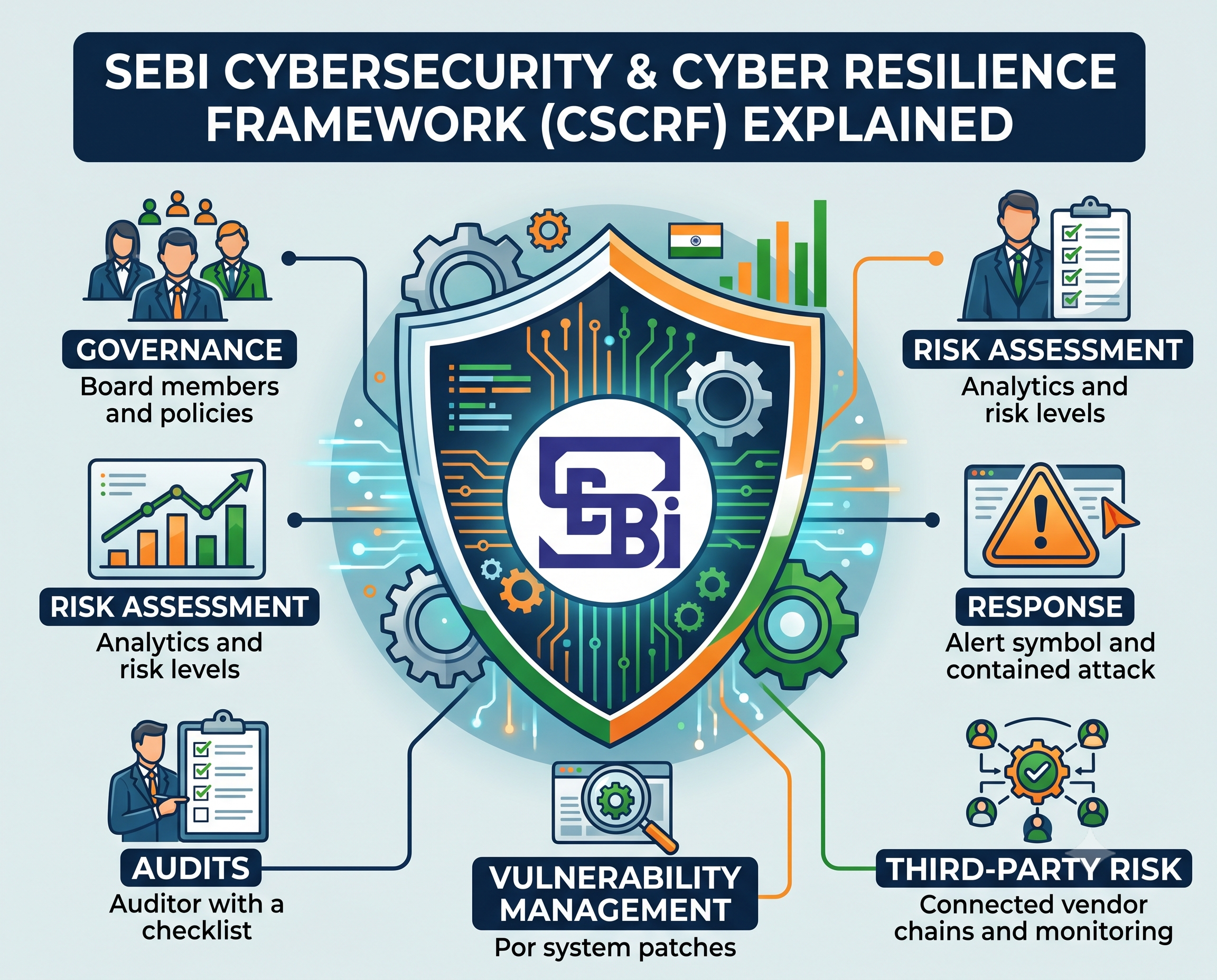
Privacy and Legal Considerations
RAM can contain sensitive information belonging to users and organisations. Memory images may contain authentication information, private communications, application data or other confidential material.
Organisations should therefore establish appropriate legal, privacy, evidence-handling and access-control procedures before collecting and analysing memory.
- Define authorised investigators
- Restrict access to memory images
- Protect collected evidence
- Document evidence handling
- Follow applicable legal requirements
- Follow organisational forensic procedures
- Minimise unnecessary exposure of sensitive information
- Maintain chain of custody where required
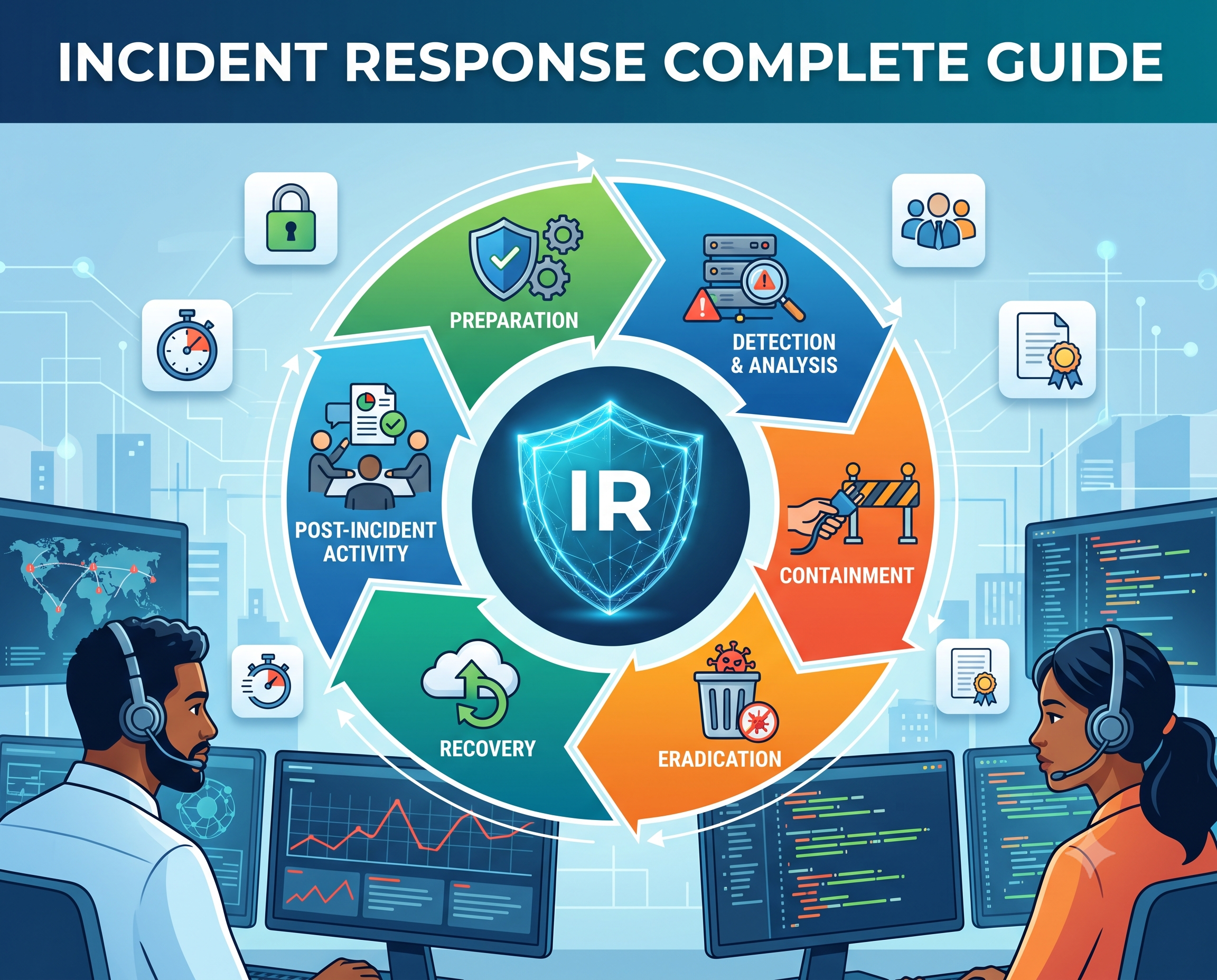
How SOC Teams Can Use Memory Forensics
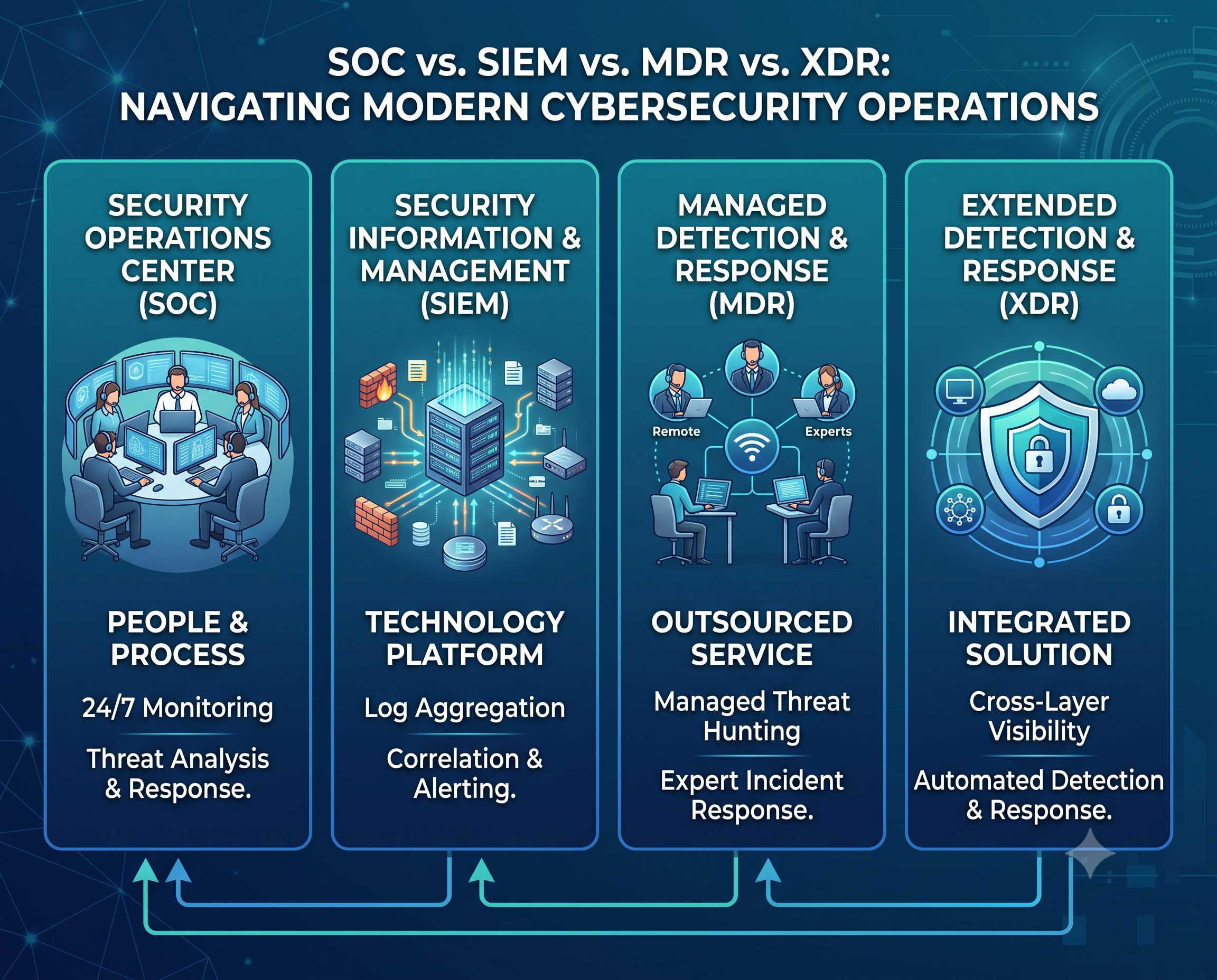
Security Operations Centres can use memory forensics as an advanced investigation capability when alerts indicate possible endpoint compromise.
Memory analysis can complement endpoint detection, SIEM, network monitoring and threat intelligence.
- SOC receives a high-confidence endpoint alert
- Analyst validates the alert
- Affected endpoint is identified
- Volatile evidence is evaluated for preservation
- Memory is collected when appropriate
- Forensic analyst examines the memory image
- Findings are correlated with SIEM and endpoint telemetry
- Indicators of compromise are identified
- Affected accounts and systems are investigated
- Containment and remediation actions are performed
- Findings are documented
- Detection rules are improved
Integrating Memory Forensics With EDR and SIEM
Memory forensics becomes more effective when integrated with other security telemetry.
- EDR provides endpoint detection and process telemetry
- SIEM provides centralised security-event correlation
- Network monitoring provides communication evidence
- Identity systems provide authentication evidence
- Threat intelligence provides external indicators
- Memory forensics provides volatile runtime evidence
Together, these sources can help investigators develop a more complete picture of an attack.
How Enterprises Should Prepare for Memory Forensics
Memory forensics is most useful when an organisation prepares before an incident occurs.
- Define when memory acquisition should be performed
- Maintain approved forensic tools
- Train incident responders
- Establish evidence-handling procedures
- Define legal and privacy requirements
- Maintain secure evidence storage
- Document acquisition procedures
- Test forensic workflows
- Integrate memory collection with incident response
- Maintain endpoint visibility
- Ensure SOC analysts understand volatile evidence
Memory Forensics Incident Response Checklist
- Identify potentially compromised systems
- Determine whether volatile evidence is relevant
- Avoid unnecessary reboot or shutdown when appropriate
- Preserve volatile evidence according to approved procedures
- Record system and acquisition details
- Protect the original memory image
- Hash collected evidence
- Maintain evidence documentation
- Analyse memory using validated tools
- Review processes
- Review network connections
- Investigate suspicious memory regions
- Correlate findings with other evidence
- Identify indicators of compromise
- Document the investigation
- Contain and remediate the incident
- Update security controls
Frequently Asked Questions
What is memory forensics?
Memory forensics is the forensic acquisition and analysis of volatile computer memory to identify evidence related to system activity, malware, compromise and security incidents.
Why is RAM important during incident response?
RAM contains runtime information that may not be available in persistent storage. Because RAM is volatile, valuable evidence can disappear when a system is powered off or otherwise changes state.
What can memory forensics detect?
Memory analysis can help investigators identify suspicious processes, network connections, loaded modules, injected code, malware artifacts and other runtime evidence. The exact findings depend on the operating system, attack and state of the system.
Is RAM volatile evidence?
Yes. RAM is volatile memory and requires power to maintain its contents. This makes it an important evidence source that can be lost when a system is shut down or loses power.
Should you always capture RAM during an incident?
Not necessarily. Memory acquisition should be based on the incident type, investigative requirements, system impact, legal considerations and the organisation's forensic procedures. When volatile evidence is likely to be valuable, teams should consider preserving it before it disappears.
What is the difference between memory forensics and disk forensics?
Memory forensics examines volatile runtime information, while disk forensics primarily examines persistent storage. Both are complementary and are often used together during incident investigations.
Can memory forensics detect fileless malware?
Memory analysis can provide valuable evidence in investigations involving fileless or memory-resident techniques because malicious activity may exist primarily in runtime memory rather than as a conventional malicious file on disk.
What tools are commonly used for memory forensics?
Commonly used tools and frameworks include Volatility, Rekall, LiME, WinPmem, Magnet RAM Capture, Belkasoft RAM Capturer and enterprise incident-response platforms with memory-collection capabilities.
Can memory forensics recover passwords?
Memory can sometimes contain authentication-related information or remnants of sensitive data, depending on the operating system, applications and system state. Investigators must handle such evidence carefully and only within authorised forensic procedures.
Is memory forensics part of incident response?
Yes. Memory forensics is an important specialised capability within digital forensics and incident response. NIST's forensic guidance describes the integration of forensic techniques into incident-response activities.
Key Takeaways
- Memory forensics examines volatile system memory
- RAM can contain valuable runtime evidence
- RAM evidence can disappear when power is removed
- Memory analysis can reveal processes, connections and other runtime artifacts
- Memory forensics is valuable for malware investigations
- Fileless and memory-resident attacks can benefit from memory analysis
- Memory should be correlated with disk, network, identity and log evidence
- Evidence acquisition must be carefully documented
- Memory images can contain sensitive information
- SOC teams can integrate memory forensics into advanced incident response
- Organisations should prepare forensic procedures before incidents occur
Conclusion
Memory forensics provides incident responders with a view into what was happening inside a system while it was running. Unlike persistent storage, RAM contains volatile runtime information that can disappear when a system is powered down or changes state.
Processes, network connections, loaded components, memory-resident malware and other runtime artifacts can provide valuable clues during investigations. This makes RAM particularly important when investigating sophisticated malware, fileless techniques, credential-related attacks and other incidents where disk evidence alone may not tell the complete story.
However, memory forensics should not replace other forensic techniques. The strongest investigations correlate memory with endpoint telemetry, network evidence, authentication records, application logs and persistent storage.
For enterprises, the most important step is preparation. Security teams should define when volatile evidence should be captured, maintain appropriate tools and procedures, train investigators and integrate memory analysis into the broader incident response process.
When an incident occurs, preserving the right evidence at the right time can make the difference between a limited investigation and a clear understanding of how an attacker operated.
Recommended Solution
See how MOBISEC solves this in practice
Topics