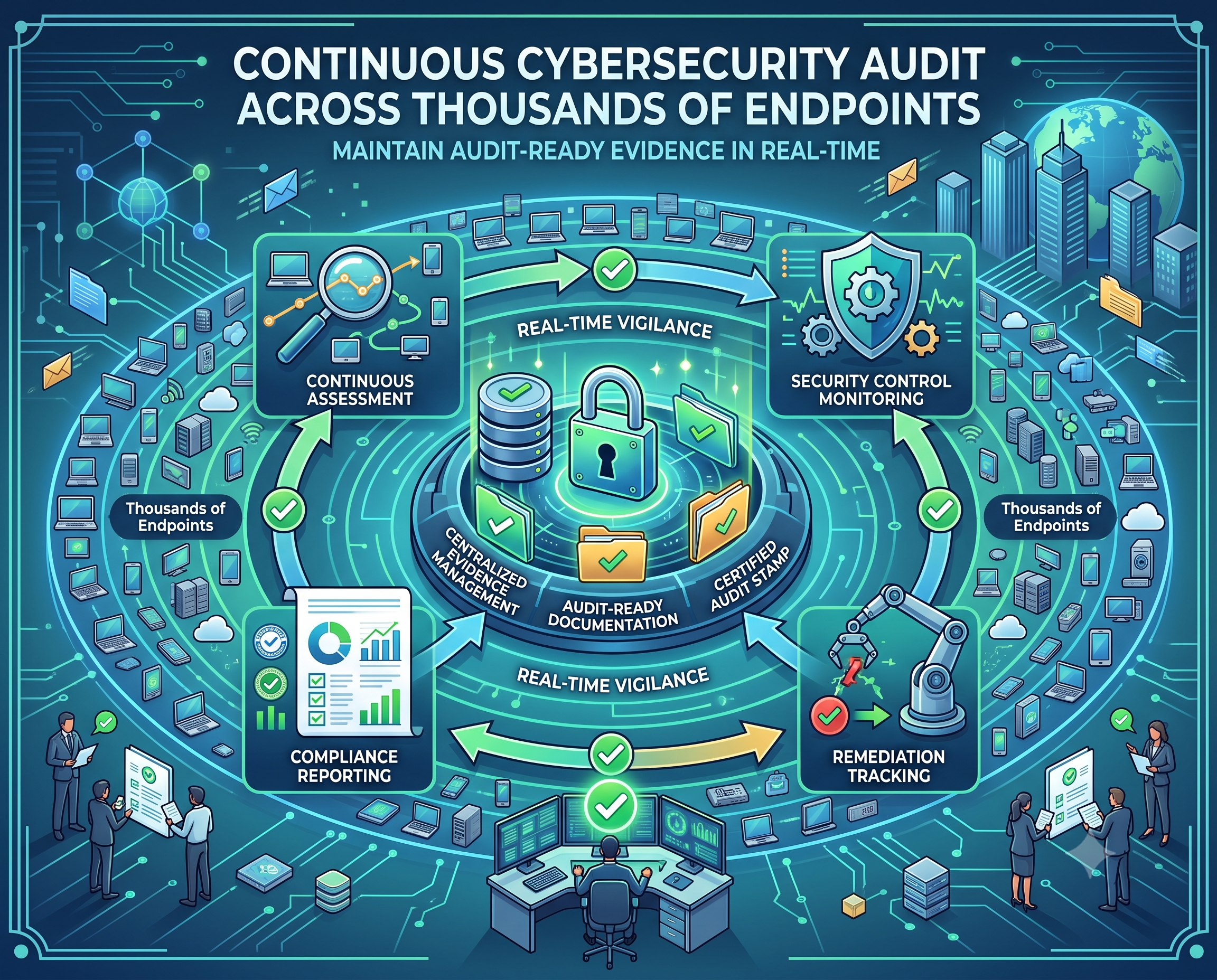
What Is a Continuous Cybersecurity Audit?
A continuous cybersecurity audit is an ongoing approach to assessing security controls, configurations, compliance requirements, and security posture instead of relying exclusively on periodic audit exercises.
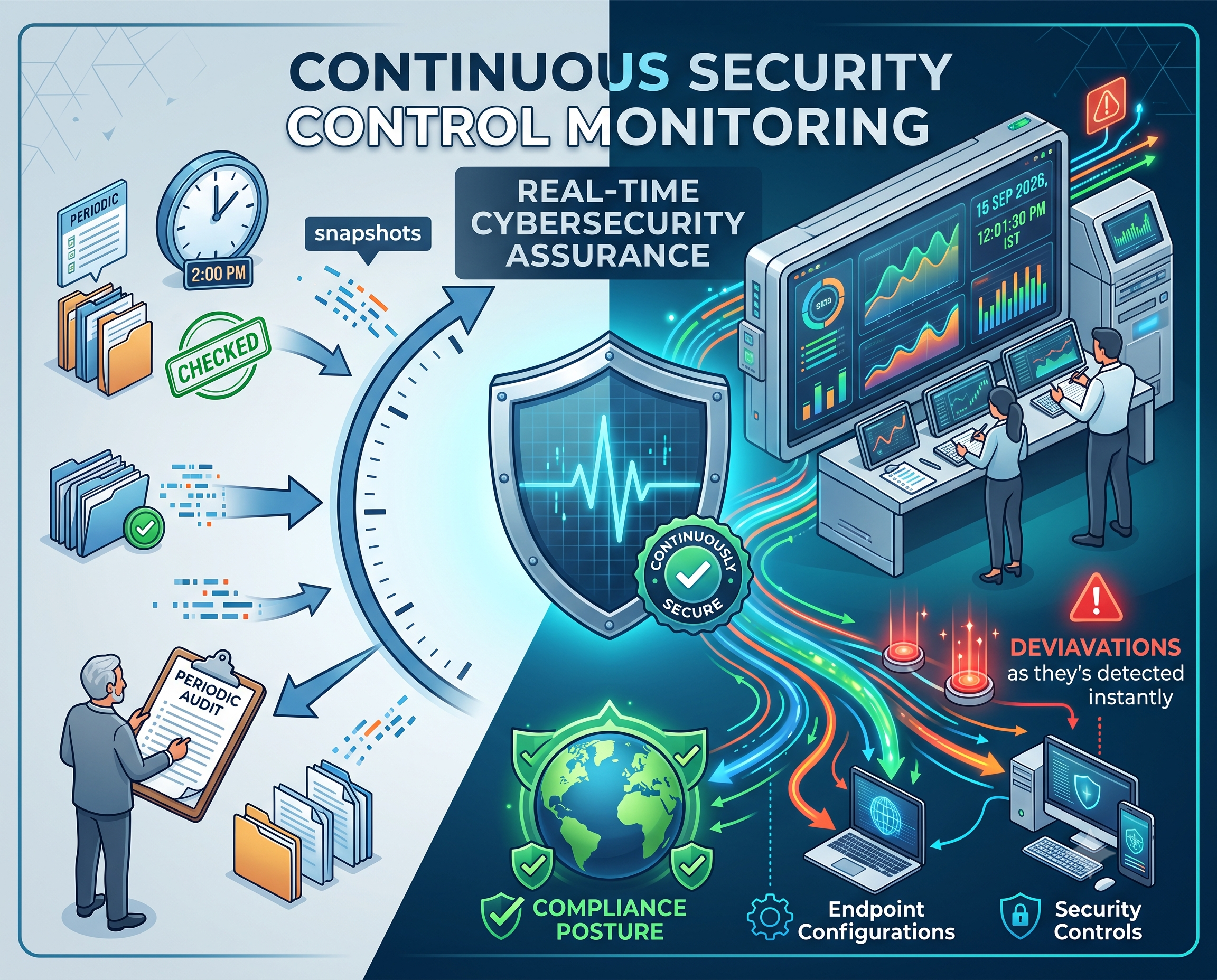
Traditional audits often provide a point-in-time view of an organisation's security condition. Continuous auditing extends this process by repeatedly collecting security information, identifying deviations, tracking remediation, and maintaining evidence over time.
For organisations managing thousands of endpoints, continuous auditing can provide a more practical way to maintain visibility into whether security requirements remain satisfied between formal audit periods.
The objective is not to eliminate formal audits. Instead, continuous auditing helps organisations maintain a consistent state of security evidence so that preparation for formal assessments becomes an ongoing process rather than a last-minute exercise.
Why Audit-Ready Evidence Matters
An audit finding or compliance assessment usually requires more than a statement that a security control exists. Organisations may need to demonstrate how controls are configured, whether they are operating, which systems are covered, when assessments were performed, and how identified issues were addressed.
Without organised evidence, security teams may spend significant time collecting information from endpoint management systems, spreadsheets, ticketing systems, vulnerability scanners, configuration tools, and individual administrators.
- Security control configuration
- Endpoint compliance status
- Security assessment results
- Configuration changes
- Remediation activity
- Remediation verification
- Security exceptions
- Policy changes
- Historical assessment records
- Control ownership
The Challenge of Auditing Thousands of Endpoints
Endpoint environments can contain thousands of laptops, desktops, workstations, and servers across offices, remote locations, cloud environments, and distributed teams.
Collecting and validating evidence manually across such an environment can become difficult to maintain.
- Large numbers of endpoints
- Different operating systems
- Remote and distributed devices
- Changing configurations
- Configuration drift
- Different endpoint roles
- Frequent software changes
- Multiple security policies
- Security exceptions
- Incomplete historical records
The larger the environment becomes, the more important centralised assessment and evidence collection become.
Point-in-Time Audit vs Continuous Audit
Point-in-Time Audit
- Assesses the environment at a specific time
- Provides a snapshot of security controls
- Often requires significant preparation
- May rely on manually collected evidence
- Can miss changes that occur after assessment
Continuous Cybersecurity Audit
- Continuously evaluates defined security requirements
- Tracks security state over time
- Identifies changes between formal assessments
- Maintains historical assessment information
- Connects findings with remediation
- Supports ongoing evidence collection
Both approaches have value. Formal audits provide structured assurance, while continuous auditing helps maintain visibility and evidence between formal assessment periods.
What Makes Evidence Audit-Ready?
Audit-ready evidence should be accurate, relevant, traceable, current, and associated with the systems and controls it represents.
A useful evidence record should answer basic questions about what was assessed, which system was involved, what the result was, when the assessment occurred, and what happened when a control failed.
- What was assessed
- Which endpoint was assessed
- Which security control was evaluated
- What configuration was observed
- What the expected state was
- When the assessment occurred
- Whether the control passed or failed
- What remediation was performed
- Who or what performed the remediation
- Whether remediation was verified
- Whether an exception was approved
The Continuous Audit Evidence Lifecycle
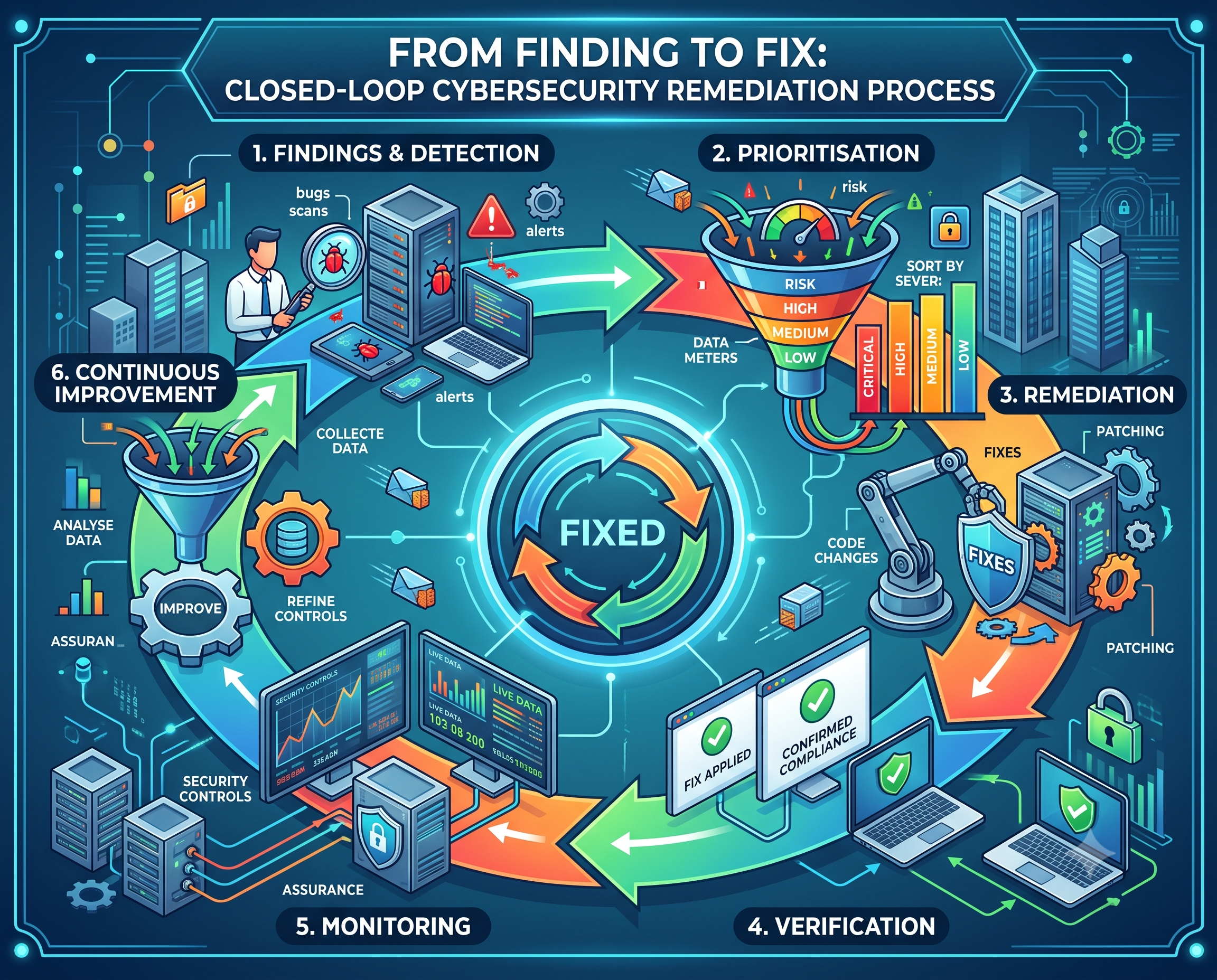
A continuous audit process can be organised as a repeatable evidence lifecycle.
- Define security and compliance requirements
- Identify endpoints and systems in scope
- Assess relevant security controls
- Collect assessment results
- Identify compliance gaps
- Prioritise findings
- Remediate approved issues
- Verify remediation
- Store evidence
- Monitor continuously
- Refresh evidence as systems change
This lifecycle helps ensure that audit evidence reflects the current state of the environment rather than relying exclusively on historical documents.
Step 1: Define What Needs to Be Audited
Organisations should first identify the security controls and requirements that need continuous monitoring.
The exact requirements depend on the organisation's risk profile, industry, internal security policies, contractual obligations, and applicable compliance frameworks.
- Endpoint configuration requirements
- Authentication controls
- Access controls
- Firewall settings
- Security software
- Patch status
- Logging and auditing
- Encryption
- Remote access
- Security baseline compliance
- Security policy configuration
- Security-sensitive changes
Step 2: Identify All Endpoints in Scope
Audit evidence is only useful when organisations know which systems are included in the assessment.
A central endpoint inventory should identify managed devices and provide enough context to understand their role and security requirements.
- Endpoint identity
- Operating system
- Device role
- Business group
- Security policy
- Compliance status
- Last assessment
- Last remediation
- Current risk status
Endpoint inventory should be continuously updated because devices are added, removed, replaced, reconfigured, or moved between organisational groups.
Step 3: Continuously Assess Security Controls
Continuous assessment provides the data required to maintain current audit evidence.
The organisation should regularly evaluate important security controls against approved baselines or security requirements.
- Firewall configuration
- Endpoint protection
- Authentication
- Privileged access
- Patch status
- Security auditing
- Logging
- Remote access
- Encryption
- Security baseline
- Application configuration
- Operating system security settings
Step 4: Record Assessment Results
Each assessment should generate a traceable result showing the state of the relevant security control.
Evidence records should preserve enough information to understand whether the control was compliant at the time of assessment.
- Endpoint identifier
- Control identifier
- Expected configuration
- Observed configuration
- Assessment date and time
- Compliance result
- Finding severity
- Assessment source
- Remediation status
Historical records are important because they allow organisations to demonstrate how security posture changed over time.
Step 5: Track Security Findings
When an endpoint fails a security control, the failure should become a trackable finding.
The finding should remain connected to the original assessment and should provide enough information for remediation and later verification.
- Finding description
- Affected endpoint
- Security control
- Risk level
- Detection date
- Current status
- Assigned owner
- Remediation requirement
- Verification status
Step 6: Track Remediation Activity
Audit evidence should not stop at identifying a security gap. Organisations should also be able to demonstrate how important findings were addressed.
Remediation records can show whether an issue was corrected, when the corrective action occurred, and whether the result was verified.
- Original finding
- Remediation action
- Remediation date
- Affected endpoint
- Remediation status
- Verification result
- Failed remediation
- Reopened finding
- Exception status
Step 7: Verify Security Controls After Remediation
Verification is essential because an attempted remediation does not necessarily mean that a security issue has been resolved.
A security control should be reassessed after remediation to confirm that the endpoint has returned to the expected state.
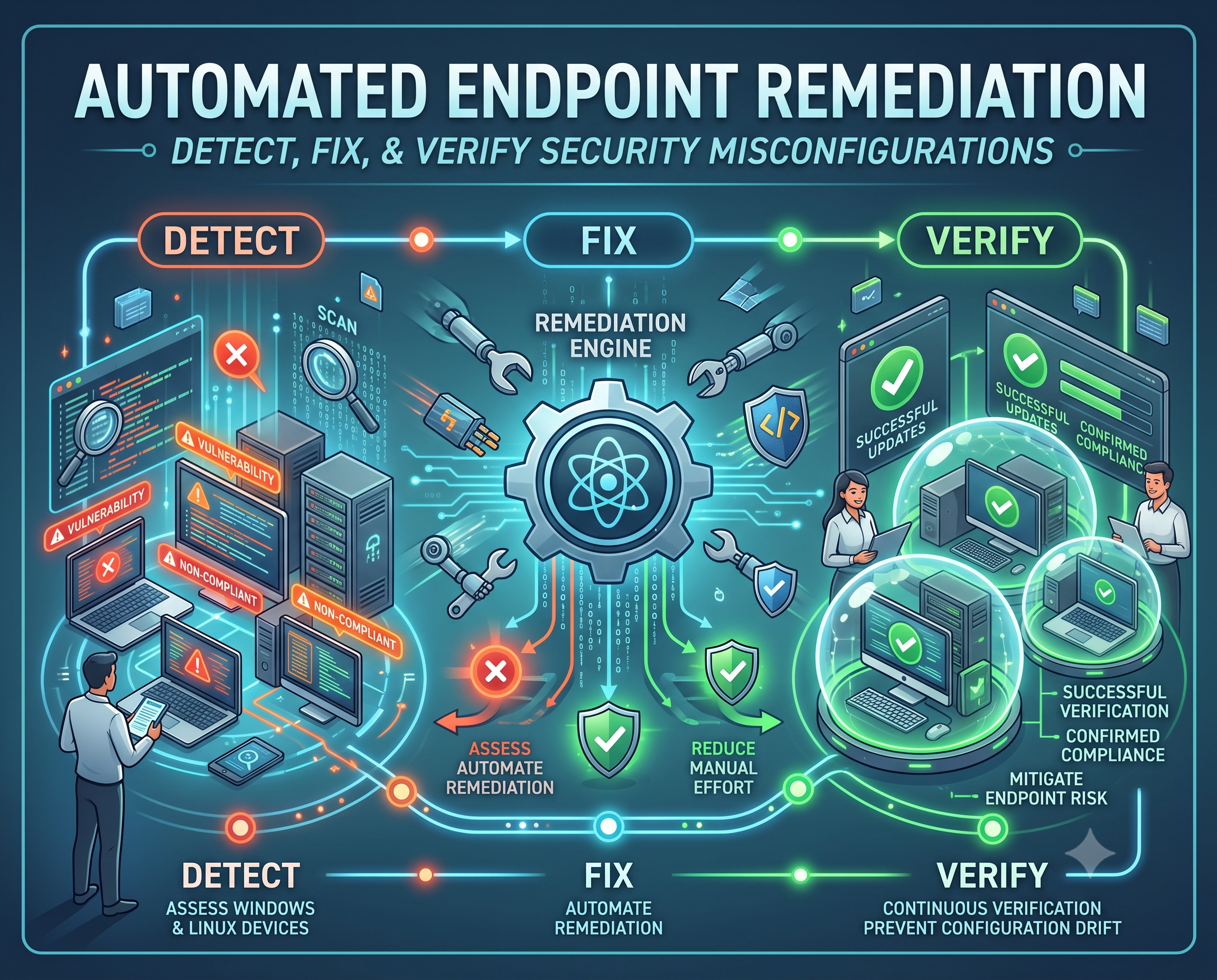
- Detect the control failure
- Record the original evidence
- Apply the approved remediation
- Reassess the endpoint
- Compare the new state with the required state
- Confirm remediation success
- Update the evidence record
Step 8: Maintain Historical Evidence
Audit readiness requires more than current compliance information. Historical evidence can help demonstrate that security controls were monitored and that identified issues were addressed over time.
Historical records may include assessment results, configuration states, findings, remediation activities, verification results, and approved exceptions.
Maintaining this history allows security teams to investigate when a control changed and how quickly the organisation responded.
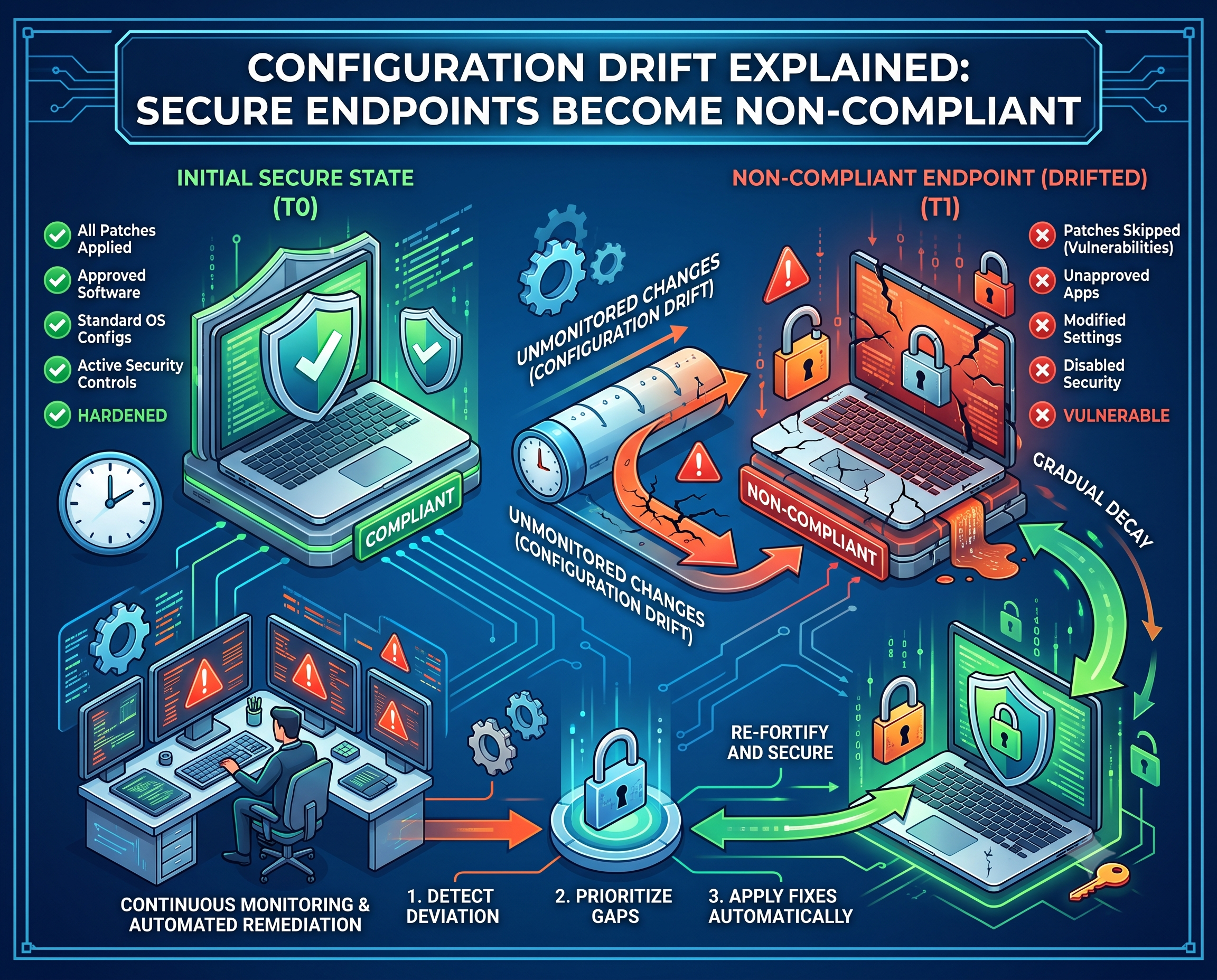
Configuration Drift and Audit Readiness
Configuration drift occurs when endpoints move away from their approved security state after they have been hardened or assessed.
This creates a challenge for audit readiness because an endpoint may have been compliant during a previous assessment but become non-compliant later.
Continuous monitoring helps identify these changes and provides evidence of when deviations occurred.
- Original compliant state
- Configuration change
- Detected deviation
- Finding creation
- Remediation
- Verification
- Return to compliance
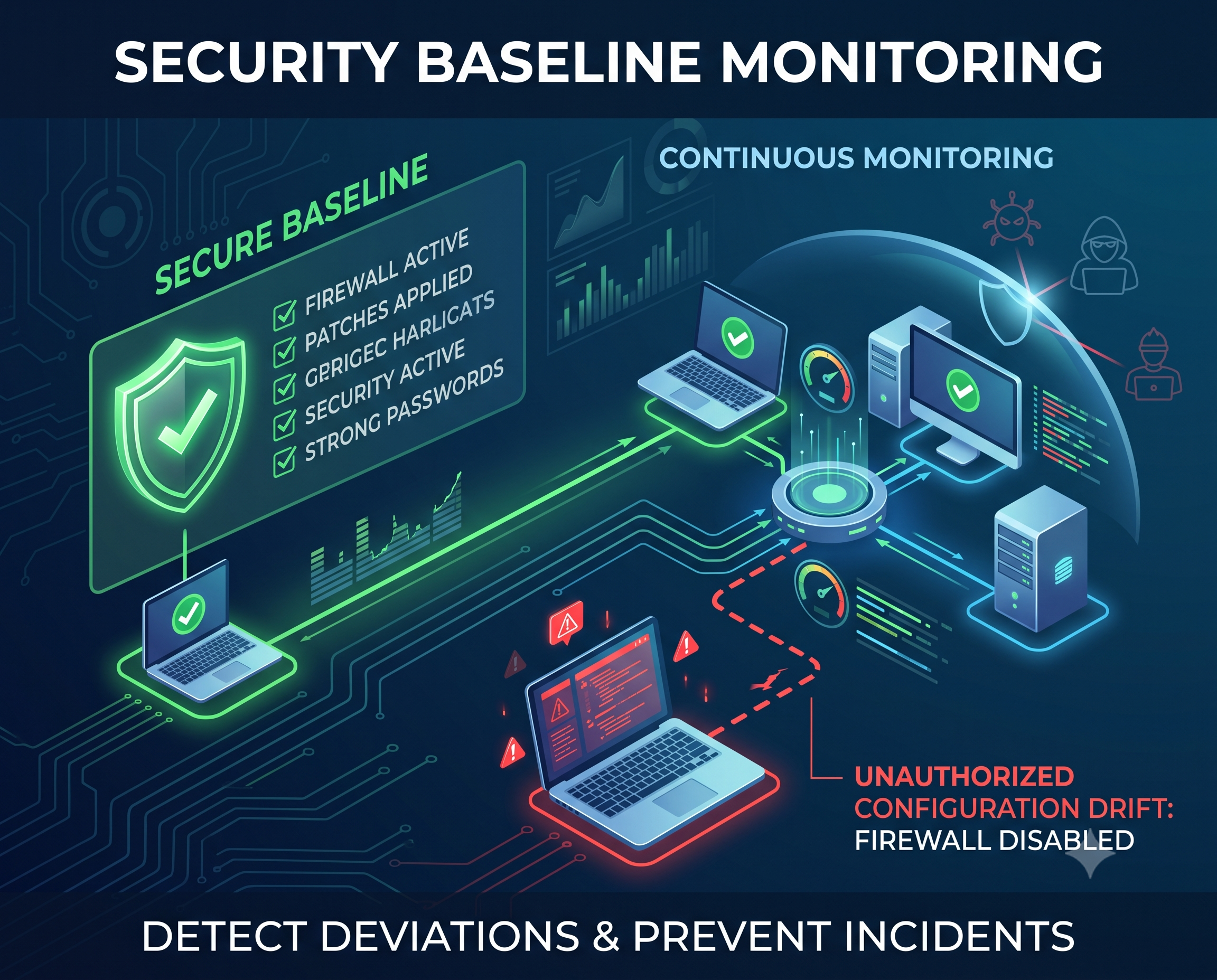
Security Baselines as Audit Evidence
A security baseline defines the expected configuration for an endpoint or group of endpoints.
Baselines are useful for continuous auditing because they provide a measurable standard against which actual endpoint configurations can be assessed.
An audit evidence record can therefore connect the expected security requirement with the observed configuration and the resulting compliance status.
- Baseline requirement
- Observed configuration
- Compliance result
- Affected endpoints
- Finding details
- Remediation status
- Verification status
Using CIS Benchmarks for Continuous Audit Monitoring
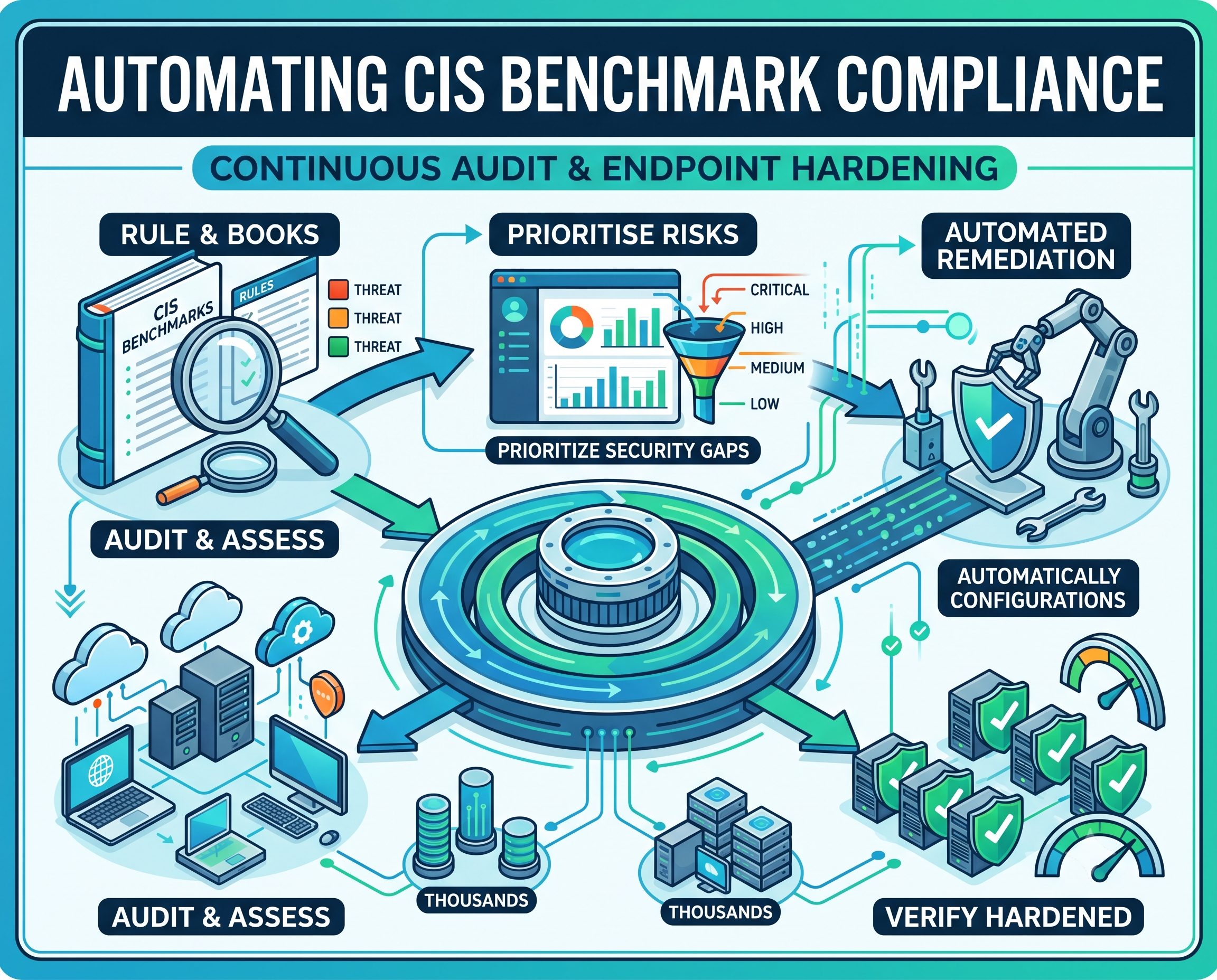
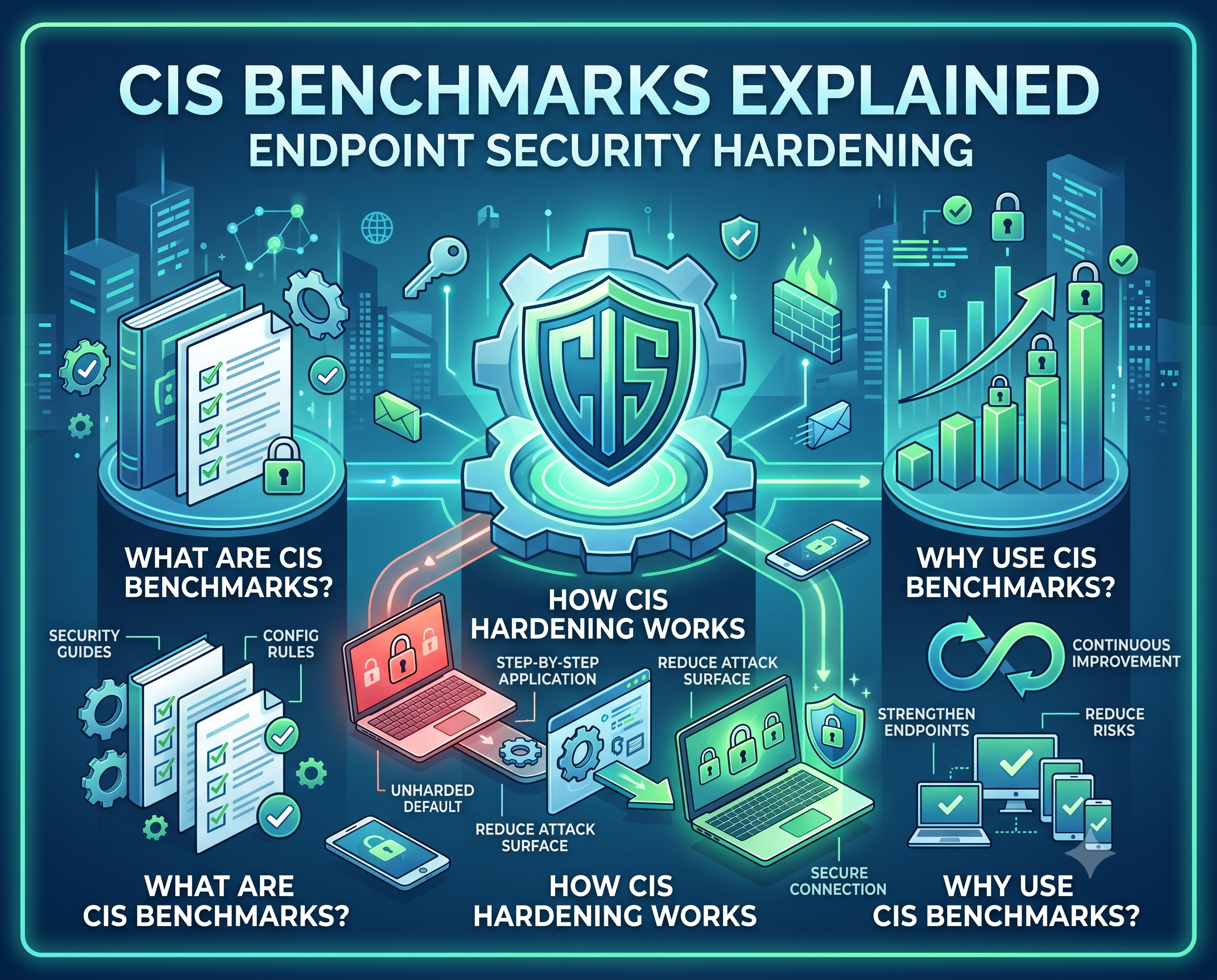
CIS Benchmarks can provide secure configuration recommendations that organisations may use as part of their endpoint security baselines.
When applicable CIS Benchmark recommendations are incorporated into an assessment process, organisations can continuously evaluate whether endpoints remain aligned with the selected security configuration requirements.
The resulting evidence can support internal security reviews and provide structured information for compliance and audit activities.
Organisations should select the appropriate Benchmark and profile for their environment and account for approved business requirements and exceptions.
Audit Evidence for Windows Endpoints
Windows environments can contain large numbers of business laptops, desktops, and servers. Continuous assessment can help maintain evidence for important Windows security controls.
- Windows security configuration
- Firewall status
- Authentication policies
- User and administrator configuration
- Remote access settings
- Security auditing
- Logging
- Security software
- Operating system updates
- Application configuration
- Security baseline compliance
Audit Evidence for Linux Endpoints and Servers
Linux environments also require consistent security evidence, particularly when organisations manage large server populations.
- SSH configuration
- User and privilege settings
- File permissions
- Firewall configuration
- System services
- Authentication settings
- Logging
- Audit configuration
- Operating system security settings
- Security baseline compliance
Managing Security Exceptions
A security exception occurs when an endpoint or system is intentionally allowed to operate differently from the standard security baseline.
Exceptions should be documented because unexplained deviations can create confusion during audits and make it difficult to determine whether a control failure is expected or accidental.
- Identify the affected system
- Document the security deviation
- Record the business reason
- Assign an exception owner
- Define the approval
- Set a review period
- Continue monitoring the affected control
- Review and close the exception when appropriate
An exception should not remove the control from monitoring. Instead, it should clearly explain why the endpoint differs from the standard requirement.
Audit Evidence and Access Control
Audit evidence may contain sensitive information about endpoint configurations, security controls, vulnerabilities, and organisational infrastructure.
Evidence repositories should therefore be protected through appropriate access controls and governance.
- Role-based access
- Controlled administrative permissions
- Access logging
- Evidence integrity
- Retention policies
- Appropriate data protection
- Separation of operational and audit responsibilities
Centralised Evidence Management
Managing audit evidence across thousands of endpoints becomes more practical when assessment information is collected and organised centrally.
Centralised evidence management can help security teams understand the current compliance state while also retaining historical information about findings and remediation.
- Centralised endpoint inventory
- Centralised security assessments
- Centralised findings
- Centralised remediation records
- Centralised verification results
- Centralised compliance status
- Centralised exception tracking
- Historical evidence
Automating Audit Evidence Collection
Manual evidence collection can become one of the most time-consuming parts of an audit, particularly when information must be gathered from thousands of endpoints.
Automation can continuously collect relevant security configuration information and associate it with the appropriate endpoint and security control.
- Identify the endpoint
- Collect the required configuration
- Evaluate the security control
- Record the result
- Create a finding when required
- Track remediation
- Verify the result
- Store updated evidence
How Continuous Auditing Reduces Audit Preparation Effort
Traditional audit preparation can involve weeks of evidence collection, spreadsheet reconciliation, manual screenshots, configuration exports, and follow-up with system administrators.
A continuously monitored environment can reduce some of this preparation effort because security evidence is generated as part of normal security operations.
- Less manual evidence gathering
- More current compliance information
- Centralised security records
- Faster identification of gaps
- Clear remediation history
- Easier control validation
- Improved visibility across endpoints
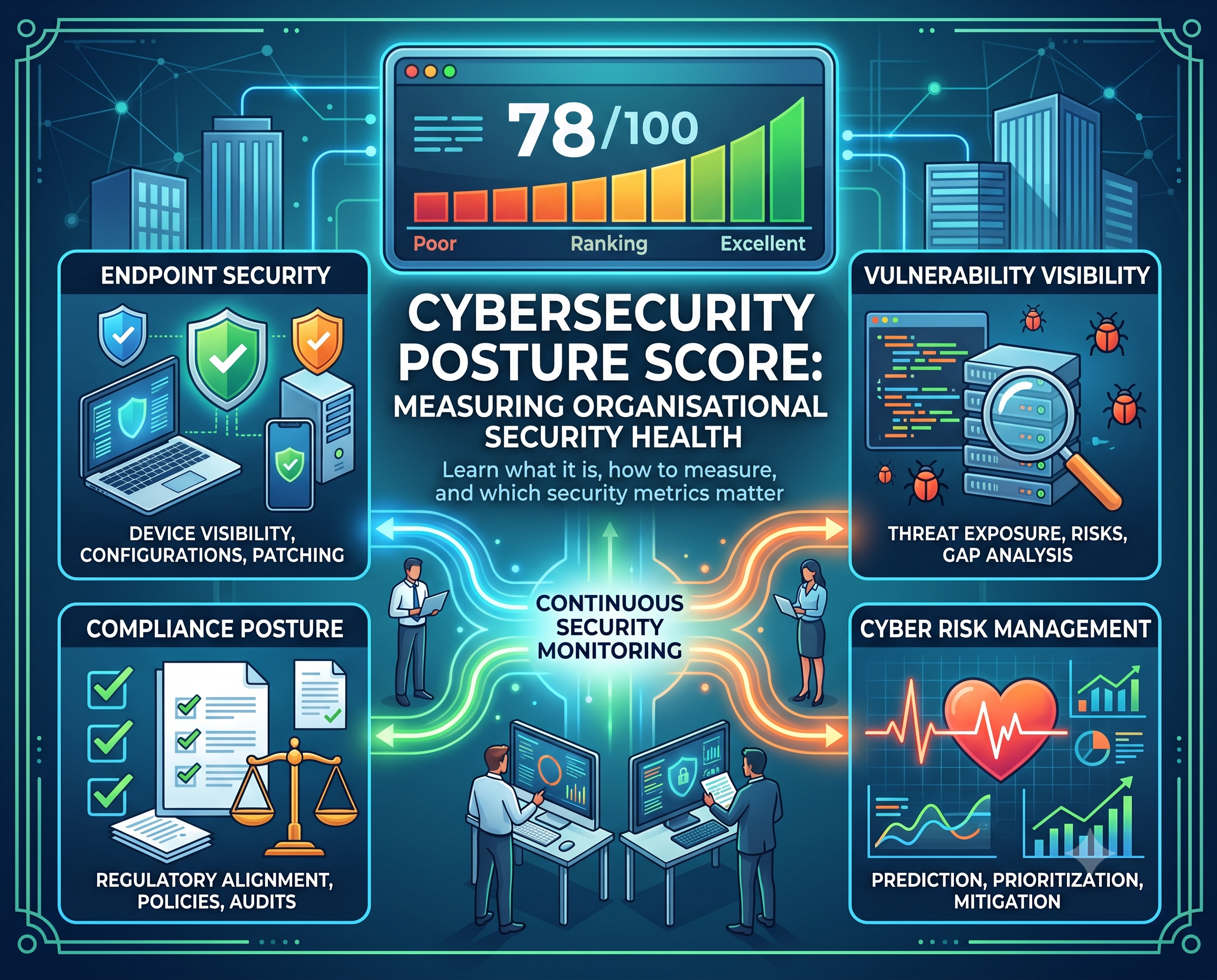
Metrics for Continuous Cybersecurity Auditing
Organisations should measure the effectiveness of their continuous audit program.
- Percentage of endpoints assessed
- Security baseline compliance percentage
- Number of failed controls
- Number of open audit findings
- Average remediation time
- Verified remediation percentage
- Number of recurring findings
- Number of active exceptions
- Evidence freshness
- Number of endpoints without recent assessment
These metrics can help security teams identify weaknesses in the audit process itself and determine whether the organisation is maintaining adequate visibility.
Common Challenges in Maintaining Audit-Ready Evidence
Incomplete Endpoint Inventory
If endpoints are missing from the inventory, their security state may also be missing from audit evidence.
Stale Evidence
Evidence that is several months old may not accurately represent the current endpoint configuration.
Manual Data Collection
Manual evidence gathering can introduce delays, inconsistent formats, and missing information.
Untracked Remediation
If security findings are not connected to remediation records, it can be difficult to demonstrate how issues were resolved.
Missing Verification
A record showing that a remediation action was attempted is weaker than evidence showing that the security control was successfully restored.
Unmanaged Exceptions
Undocumented exceptions can appear as unexplained compliance failures and create uncertainty during audits.
Best Practices for Maintaining Audit-Ready Endpoint Evidence
- Maintain an accurate endpoint inventory
- Define clear security baselines
- Identify important controls for continuous monitoring
- Automate configuration assessments
- Record assessment timestamps
- Maintain historical evidence
- Connect findings with remediation
- Verify remediation results
- Document security exceptions
- Monitor configuration drift
- Track evidence freshness
- Protect evidence repositories
- Use role-based access
- Review recurring findings
- Measure audit readiness continuously
- Test evidence retrieval before formal audits
How Cyber Auditor Can Support Continuous Audit Readiness
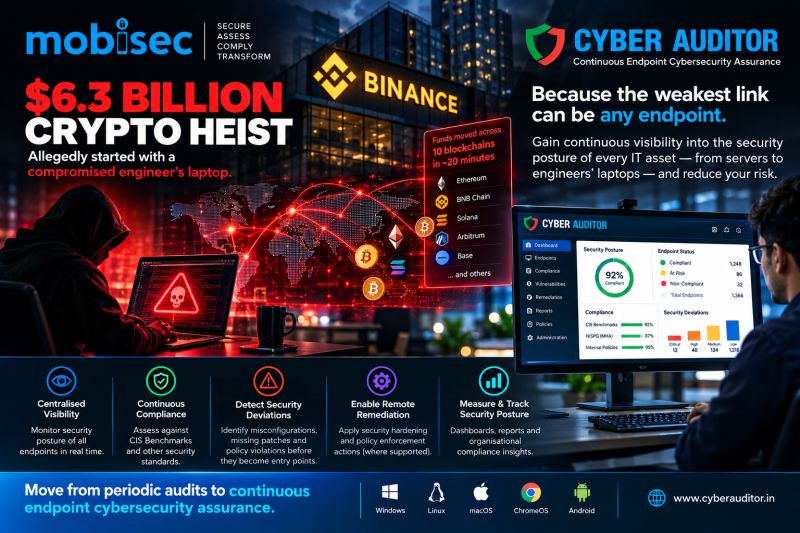
Cyber Auditor can support organisations that need continuous visibility into endpoint security configurations, security control compliance, configuration deviations, remediation status, and overall security posture.
A centralised approach can help security teams collect assessment information across managed endpoints, identify security gaps, monitor compliance, and maintain records of remediation and verification.
This can help organisations move from manually preparing evidence before an audit toward maintaining security evidence as part of their normal endpoint security operations.
The goal is to make audit readiness an ongoing state rather than a periodic preparation exercise.
Continuous Cybersecurity Audit Checklist
- Define the security controls that require monitoring
- Maintain an accurate endpoint inventory
- Create approved security baselines
- Assess endpoints continuously
- Record expected and observed configurations
- Track security findings
- Assign ownership
- Prioritise security gaps
- Track remediation activity
- Verify remediation
- Maintain historical assessment records
- Monitor configuration drift
- Document security exceptions
- Protect audit evidence
- Track evidence freshness
- Measure endpoint compliance
- Monitor recurring findings
- Review audit readiness regularly
- Test evidence retrieval before formal audits
Frequently Asked Questions About Continuous Cybersecurity Audits
What is a continuous cybersecurity audit?
A continuous cybersecurity audit is an ongoing process of assessing security controls, configurations, compliance requirements, and endpoint security posture instead of relying only on periodic assessments.
What is audit-ready evidence?
Audit-ready evidence is current, accurate, traceable information that demonstrates how a security control was configured, assessed, monitored, remediated, or verified.
Why is continuous auditing useful for large endpoint environments?
Large endpoint environments change frequently and can contain thousands of systems. Continuous auditing provides ongoing visibility into security controls and reduces dependence on manually collecting evidence before an audit.
Can configuration drift affect audit readiness?
Yes. Configuration drift can cause an endpoint to become non-compliant after a previous assessment. Continuous monitoring helps identify and document these changes.
How does remediation contribute to audit evidence?
Remediation records demonstrate how security findings were addressed. Verification records provide additional evidence that the expected security state was restored.
Can CIS Benchmarks be used for continuous security auditing?
Applicable CIS Benchmark recommendations can be used as a reference for secure configuration assessment and endpoint security baselines. Organisations should select appropriate Benchmarks and profiles for their environments.
How can organisations reduce manual audit preparation?
Organisations can reduce manual preparation by continuously assessing security controls, centralising evidence, tracking remediation, maintaining historical records, and ensuring that evidence remains current.
Key Takeaways
- Audit readiness should be treated as an ongoing security process
- Point-in-time audits provide valuable snapshots but can miss later configuration changes
- Thousands of endpoints require centralised and scalable evidence collection
- Security baselines provide measurable expectations for endpoint configurations
- Continuous monitoring helps identify configuration drift
- Security findings should remain connected to remediation records
- Remediation should be followed by verification
- Historical evidence helps demonstrate security activity over time
- Security exceptions should be documented and continuously monitored
- Evidence should be current, accurate, traceable, and protected
- Automation can reduce manual audit preparation effort
- Continuous audit readiness strengthens overall security posture
Conclusion
Maintaining audit-ready evidence across thousands of endpoints is difficult when security teams rely entirely on periodic assessments and manual evidence collection. Endpoint configurations change continuously, and historical compliance does not guarantee that systems remain compliant.
Continuous cybersecurity auditing provides a more sustainable approach by continuously assessing security controls, monitoring endpoint configurations, identifying deviations, tracking remediation, verifying security improvements, and maintaining evidence over time.
When endpoint inventory, security baselines, configuration monitoring, remediation records, exceptions, and historical assessment results are connected, organisations can build a more reliable view of their security posture.
The goal is not simply to prepare for the next audit. It is to maintain an environment where security evidence is continuously generated, continuously updated, and readily available when security teams, management, or auditors need it.
Recommended Solution
See how MOBISEC solves this in practice
Topics