What Is a Closed-Loop Cybersecurity Remediation Process?
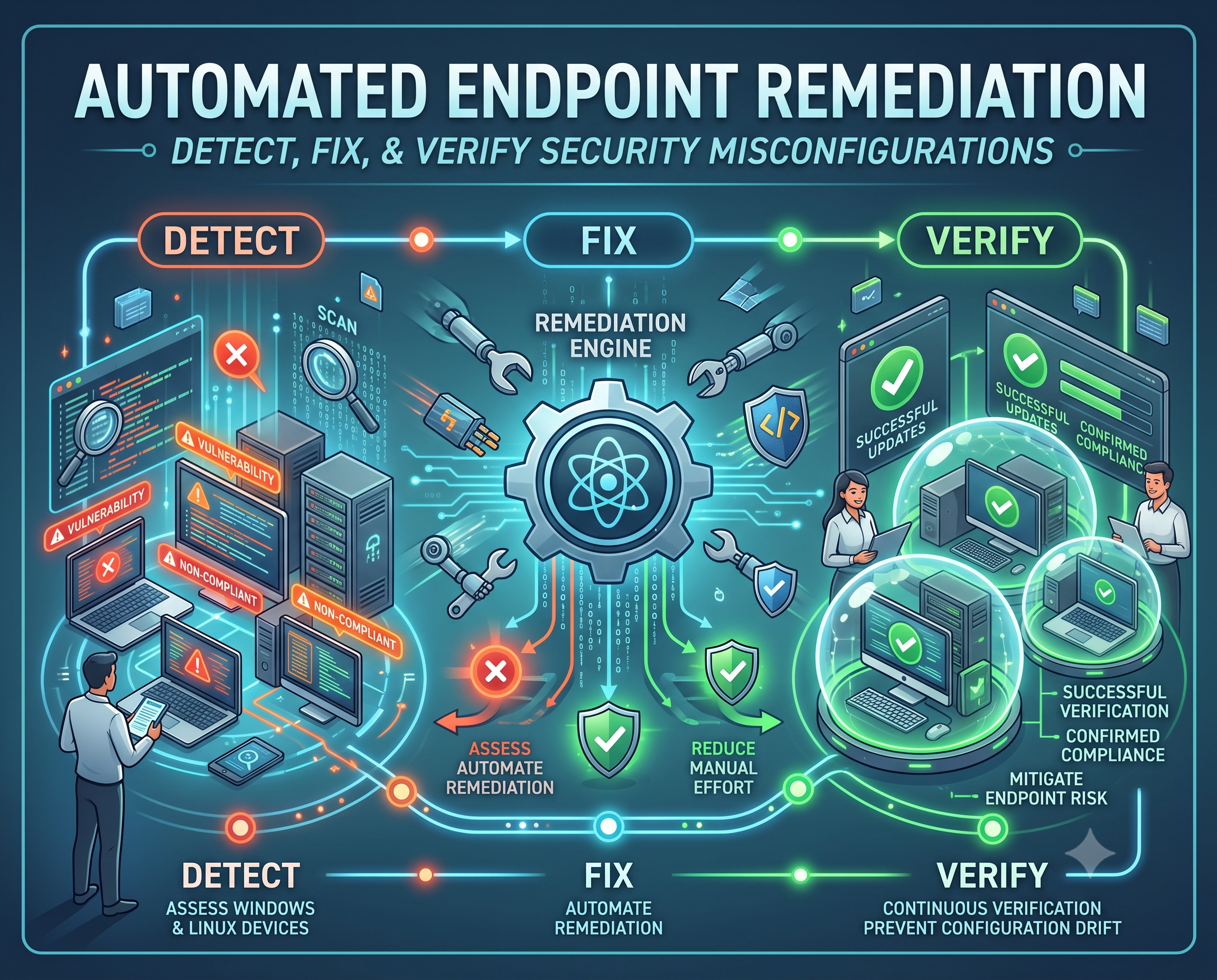
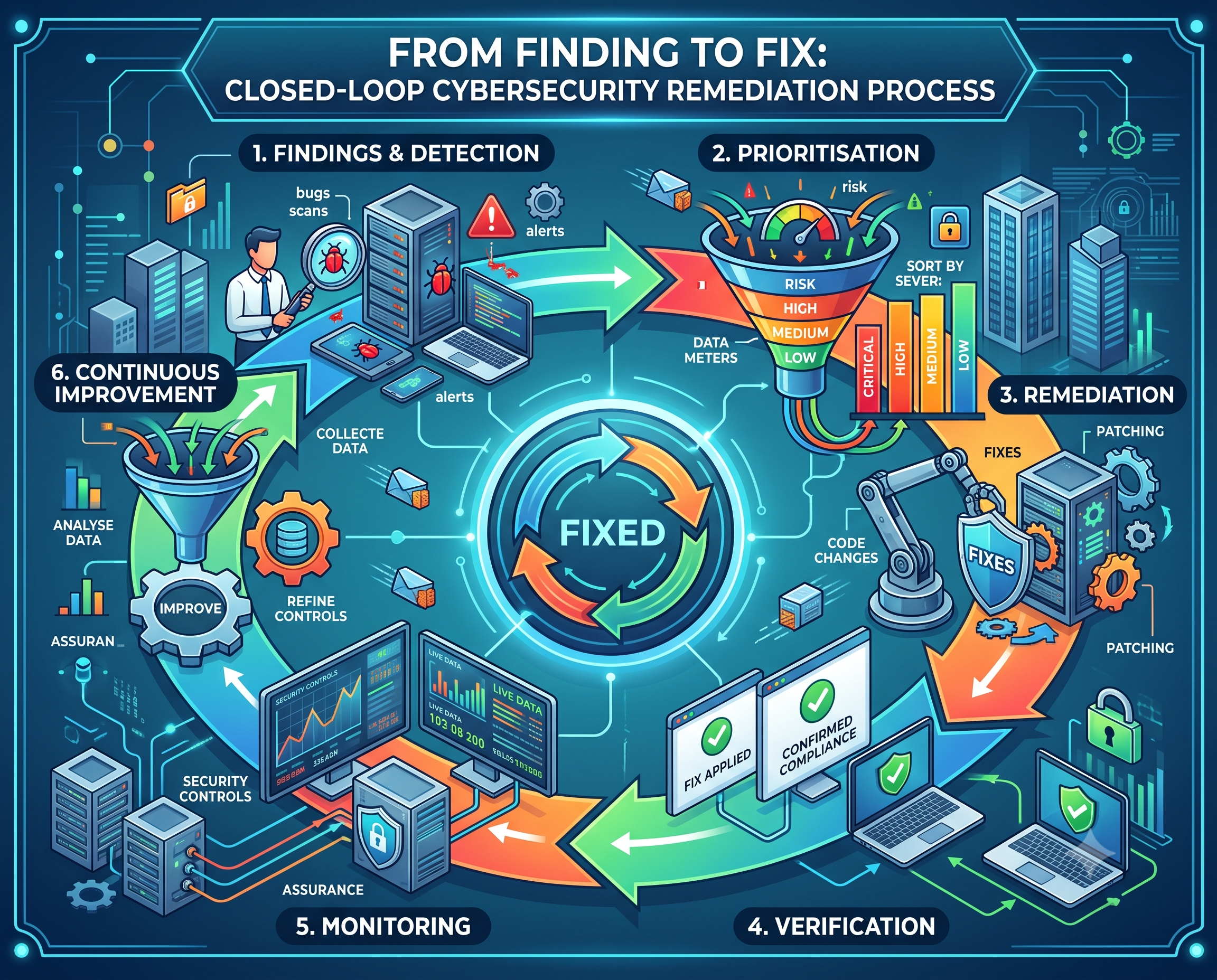
A closed-loop cybersecurity remediation process is a continuous workflow that moves a security issue from initial detection through analysis, prioritisation, remediation, verification, and ongoing monitoring.
Traditional security programs often focus heavily on identifying vulnerabilities, compliance gaps, or configuration weaknesses. However, identifying a finding does not reduce risk by itself. The finding must be understood, assigned, corrected, and verified.
A closed-loop approach connects these activities into one continuous process. When a security issue is detected, it enters a defined remediation workflow. After the fix is applied, the system checks whether the problem has actually been resolved. The endpoint or system then continues to be monitored so that the same issue does not silently return.
The result is a shift from finding security problems to continuously managing them until they are resolved and verified.
Why Finding a Security Issue Is Only the Beginning
Security tools can generate large numbers of findings from vulnerability assessments, configuration checks, compliance assessments, endpoint monitoring, and security audits.
The existence of a finding does not automatically mean that risk has been reduced. A finding that remains unresolved continues to represent a potential weakness.
- A vulnerability may remain unpatched
- A security configuration may remain incorrect
- A required control may remain disabled
- An endpoint may remain outside its security baseline
- A compliance requirement may remain unmet
- A configuration deviation may continue to spread
- A previously remediated issue may return
Security teams therefore need a process that connects detection with action. The objective should be to reduce the number of unresolved high-risk findings and shorten the time between discovery and verified remediation.
The Closed-Loop Remediation Lifecycle
A mature remediation process can be represented as a continuous lifecycle.
- Discover the security issue
- Validate and analyse the finding
- Assess and prioritise the risk
- Assign ownership
- Define the remediation action
- Apply the fix
- Verify the result
- Document the outcome
- Continue monitoring
- Reassess and improve the process
The final monitoring stage connects back to detection. If the same security issue appears again, it should re-enter the remediation workflow rather than being treated as an entirely new problem.
Step 1: Detect Security Findings
The remediation lifecycle begins with reliable detection. Security findings can originate from many different sources across the organisation.
- Endpoint configuration assessments
- Vulnerability scans
- Security audits
- CIS Benchmark assessments
- Compliance assessments
- Security baseline monitoring
- Configuration drift detection
- Continuous security monitoring
- Manual security investigations
- Incident response activities
Centralising findings from relevant security processes helps security teams build a consistent view of unresolved security issues.
Step 2: Validate and Analyse the Finding
Not every finding should immediately trigger an automated fix. The security team should first determine whether the finding is accurate, relevant, and actionable.
Validation can help eliminate false positives and identify findings that require additional investigation.
- Confirm the affected endpoint or system
- Confirm the security condition
- Determine whether the finding is still active
- Identify the affected security control
- Understand the potential security impact
- Check for existing exceptions
- Identify application or business dependencies
This stage prevents unnecessary remediation actions and helps ensure that security teams are fixing genuine problems rather than simply responding to every generated alert.
Step 3: Prioritise Findings Based on Risk
Large environments can produce more security findings than a security team can address simultaneously. Prioritisation is therefore essential.
A risk-based approach considers factors such as severity, exploitability, endpoint importance, exposure, affected systems, business criticality, and the effectiveness of existing controls.
- Critical findings requiring immediate action
- High-risk findings requiring accelerated remediation
- Medium-risk findings scheduled according to operational priorities
- Low-risk findings handled through planned security improvements
- Findings requiring additional investigation
- Approved exceptions requiring monitoring
Prioritisation ensures that remediation resources are focused on issues that can create the greatest security impact.
Step 4: Assign Ownership
A security finding must have a clear owner. Without ownership, even high-priority findings can remain unresolved.
Ownership may belong to security teams, endpoint administrators, infrastructure teams, application owners, cloud teams, or other responsible groups depending on the affected system.
- Identify the responsible team
- Assign the finding to an owner
- Define a remediation deadline
- Track remediation status
- Escalate overdue findings
- Record ownership changes
Clear accountability turns a security finding from an informational result into an actionable security task.
Step 5: Define the Remediation Action
Once the finding is understood and assigned, the organisation needs to determine how the security issue should be corrected.
The remediation action should be based on the underlying security requirement rather than simply changing the configuration until the finding disappears.
- Apply a security configuration
- Restore a secure baseline setting
- Install an approved security update
- Remove unnecessary services
- Restrict excessive privileges
- Enable required security controls
- Change insecure authentication settings
- Correct firewall configuration
- Remove unauthorised software
- Apply an approved security policy
Where possible, remediation actions should be standardised, tested, documented, and reusable across similar systems.
Step 6: Apply the Fix
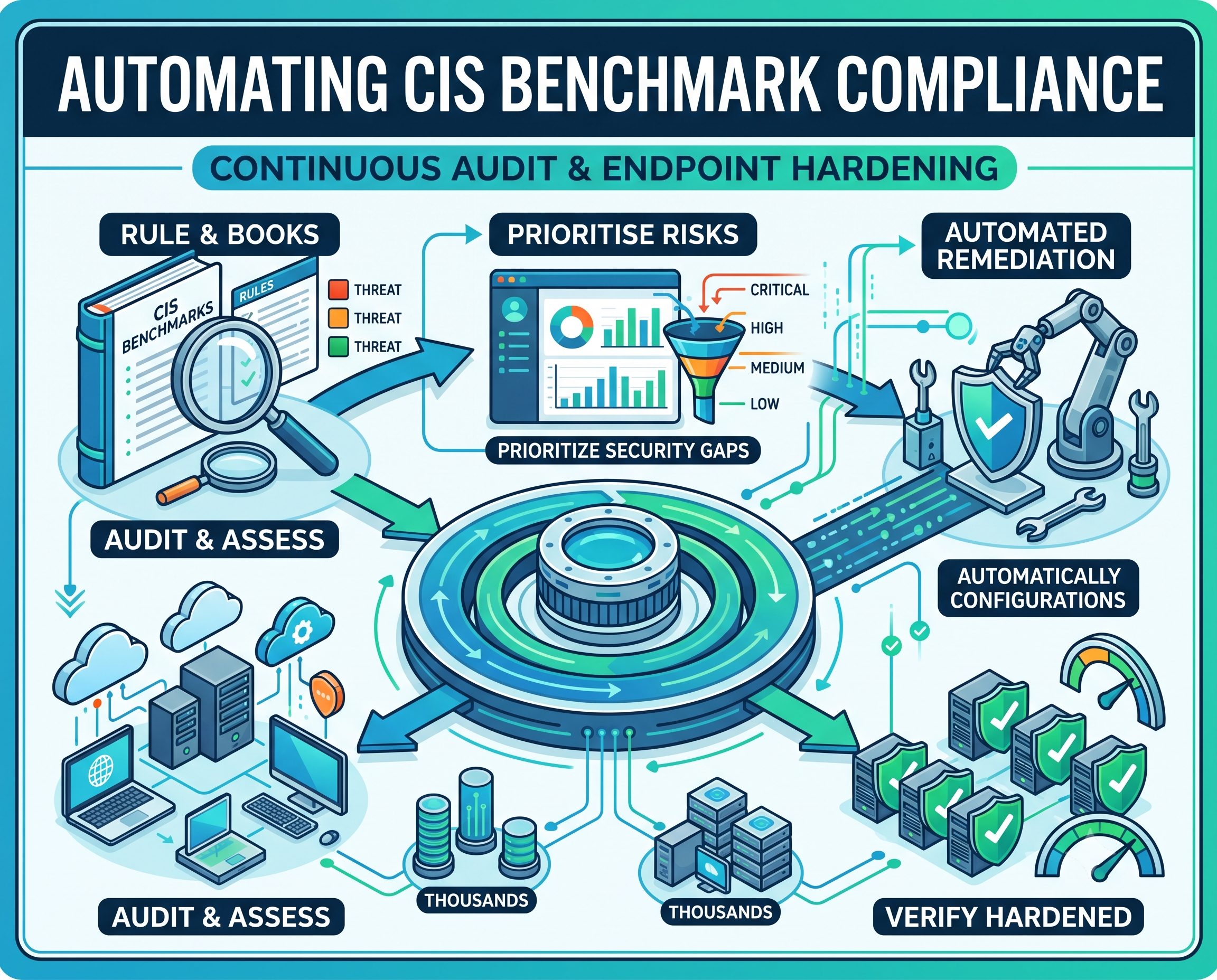
The fix can be applied manually, through endpoint management systems, configuration management tools, automation workflows, or dedicated security remediation platforms.
Automation becomes especially valuable when the same issue affects a large number of endpoints.
For example, if thousands of endpoints have the same configuration deviation, manually correcting every device can consume significant operational resources. An approved automated remediation policy can apply the required correction consistently across the affected population.
However, automation should be controlled. High-impact remediation actions should be tested, deployed gradually, and supported by appropriate rollback or recovery procedures.
Step 7: Verify the Remediation
A closed-loop process does not consider a finding resolved simply because a remediation action was executed. The security state must be checked after the fix.
- Reassess the affected configuration
- Compare the current state with the expected state
- Confirm that the security control is functioning
- Confirm that the original finding is no longer present
- Record the verification result
- Mark the finding as verified only when the expected state is confirmed
Verification provides confidence that the remediation actually reduced the security risk.
Remediation Attempted vs Remediation Verified
These two states should be treated differently. A remediation attempt indicates that an action was initiated. A verified remediation indicates that the expected security state was confirmed after the action.
- Finding detected
- Remediation assigned
- Remediation attempted
- Remediation successful
- Remediation verified
- Finding reopened
Step 8: Document the Outcome
Every remediation activity should generate useful records that explain what happened, when it happened, which system was affected, what action was taken, and whether the result was verified.
- Original finding
- Affected endpoint or system
- Security control involved
- Risk level
- Assigned owner
- Remediation action
- Remediation timestamp
- Verification result
- Failure reason when applicable
- Exception information
- Current compliance state
Detailed records support security operations, audits, compliance reporting, troubleshooting, and future investigations.
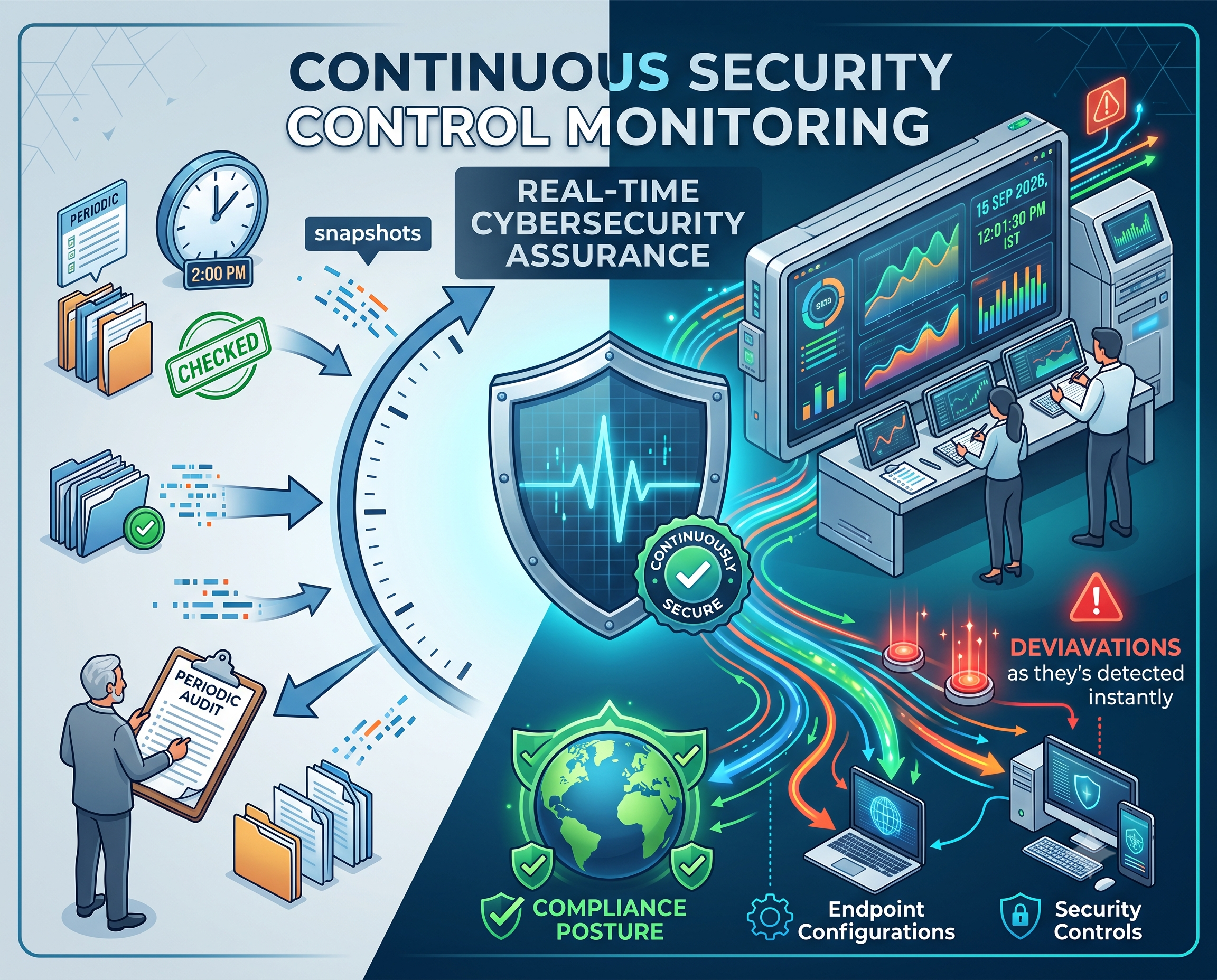
Step 9: Continue Monitoring After Remediation
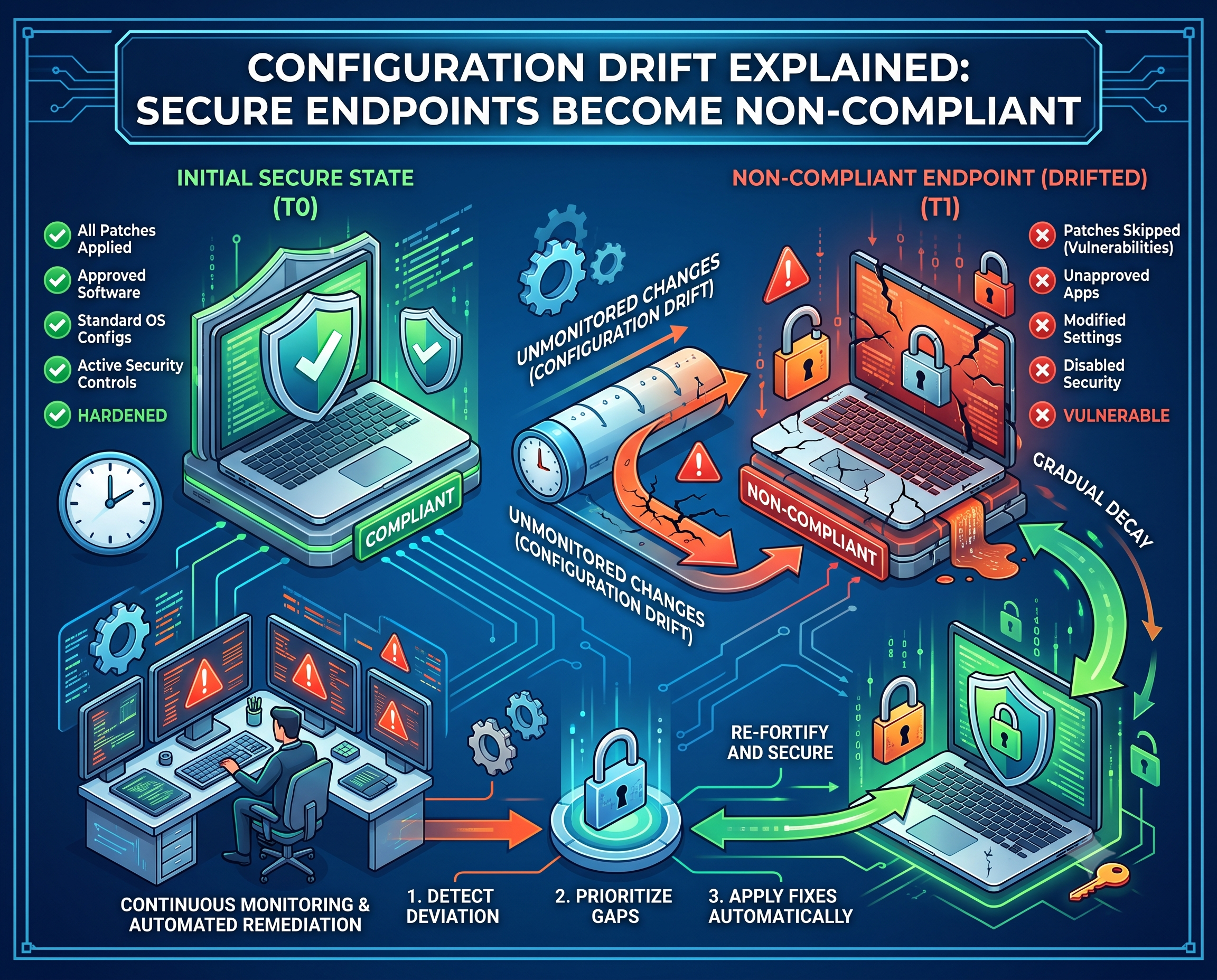
A security issue can return after it has been fixed. An administrator may change the configuration, an application may modify a setting, or a policy may overwrite the remediation.
Continuous monitoring helps detect these changes and determine whether the endpoint remains in its approved security state.
This is particularly important for configuration-related findings because remediation without continued monitoring can become a temporary fix.
The monitoring stage therefore closes the loop and allows the remediation lifecycle to begin again whenever a previously resolved issue reappears.
Configuration Drift and the Closed-Loop Remediation Process
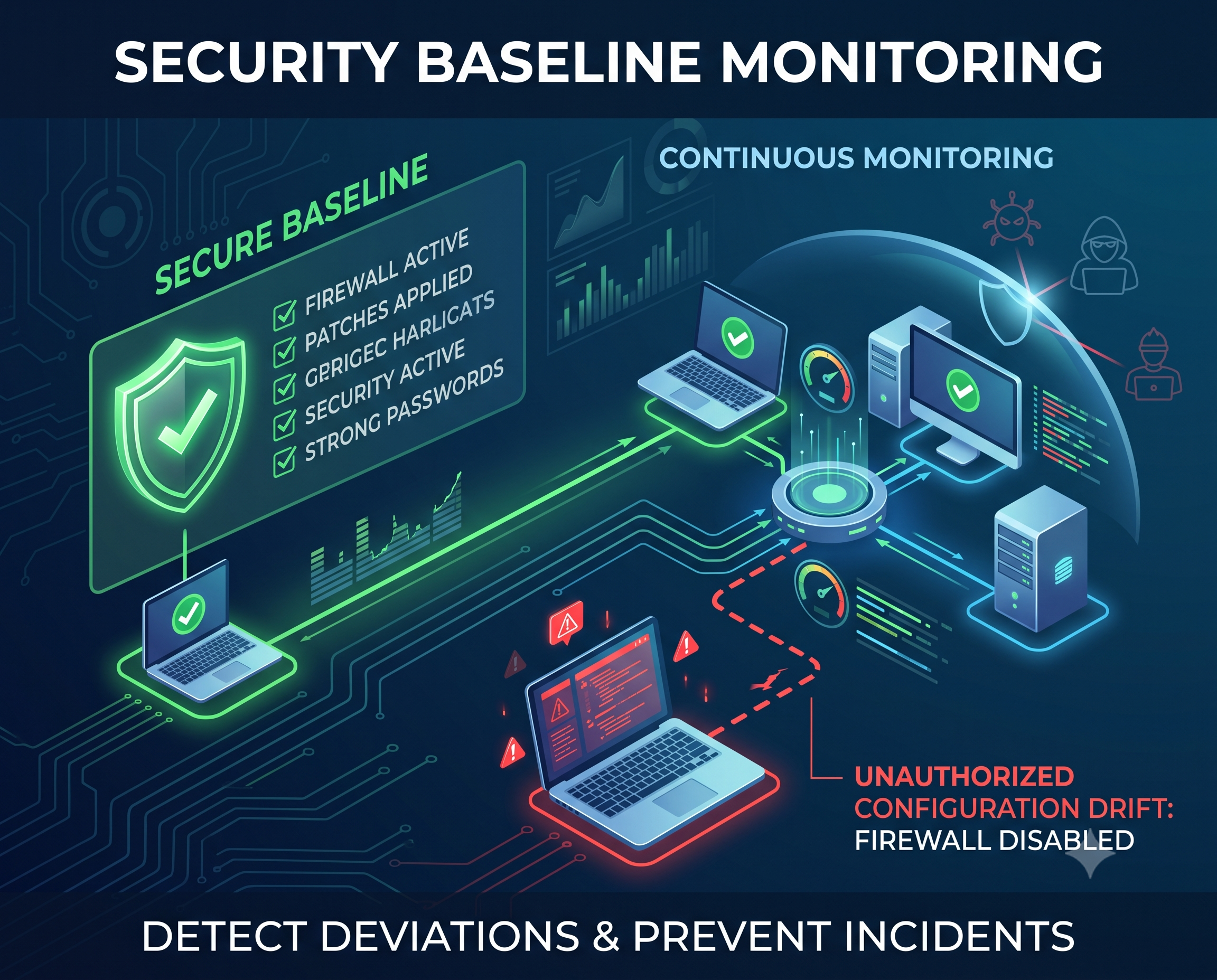
Configuration drift occurs when a system gradually moves away from its approved security configuration.
An endpoint may initially meet its security baseline and later become non-compliant because of administrative changes, software installations, troubleshooting, policy changes, or other operational activities.
A closed-loop remediation process addresses configuration drift through continuous assessment.
- Define the approved security baseline
- Assess the endpoint configuration
- Detect deviations
- Prioritise the deviation
- Apply the approved correction
- Verify the corrected configuration
- Continue monitoring
- Reopen remediation if the deviation returns
This approach helps organisations maintain secure configurations instead of treating endpoint hardening as a one-time activity.
Closed-Loop Remediation and CIS Benchmarks
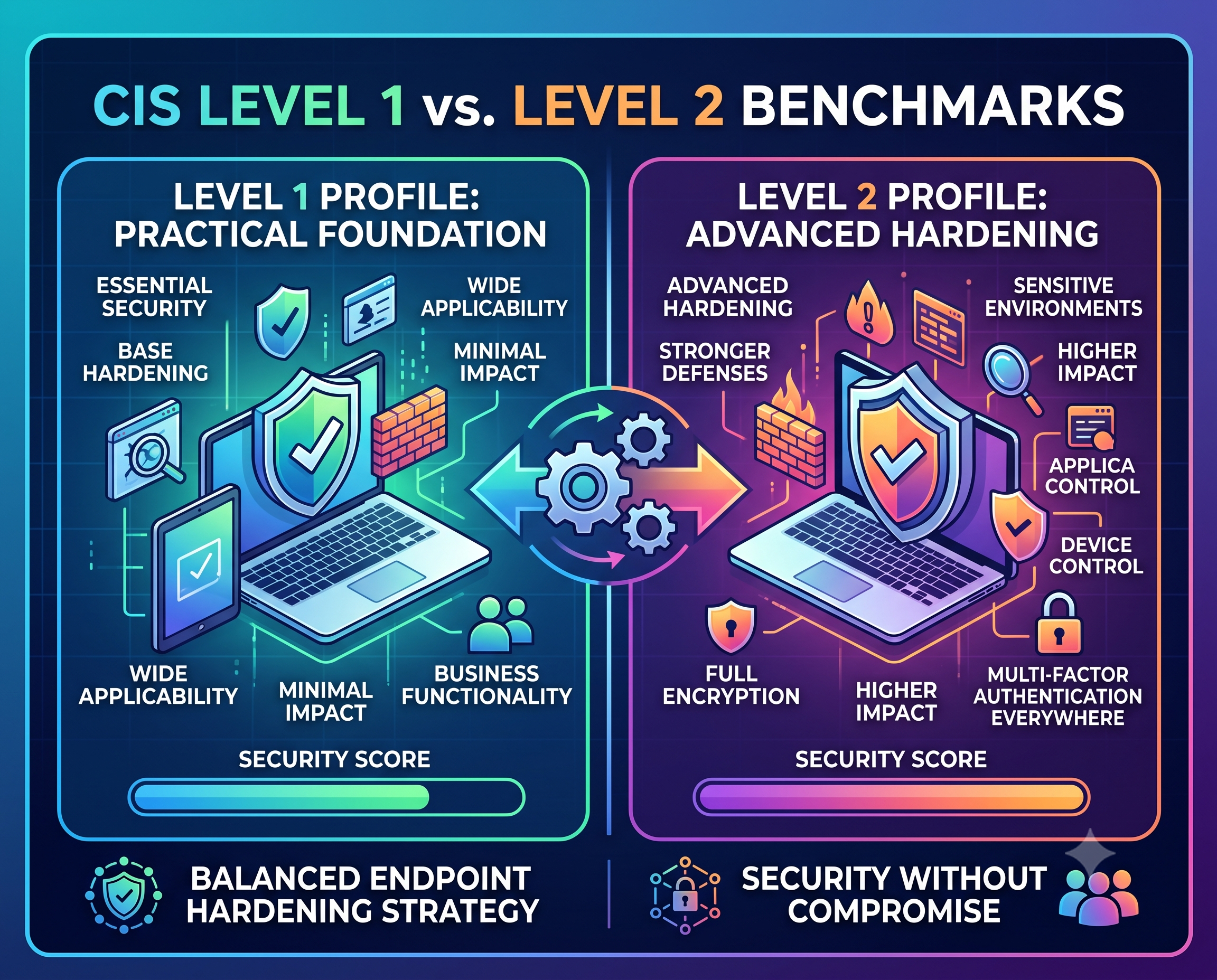
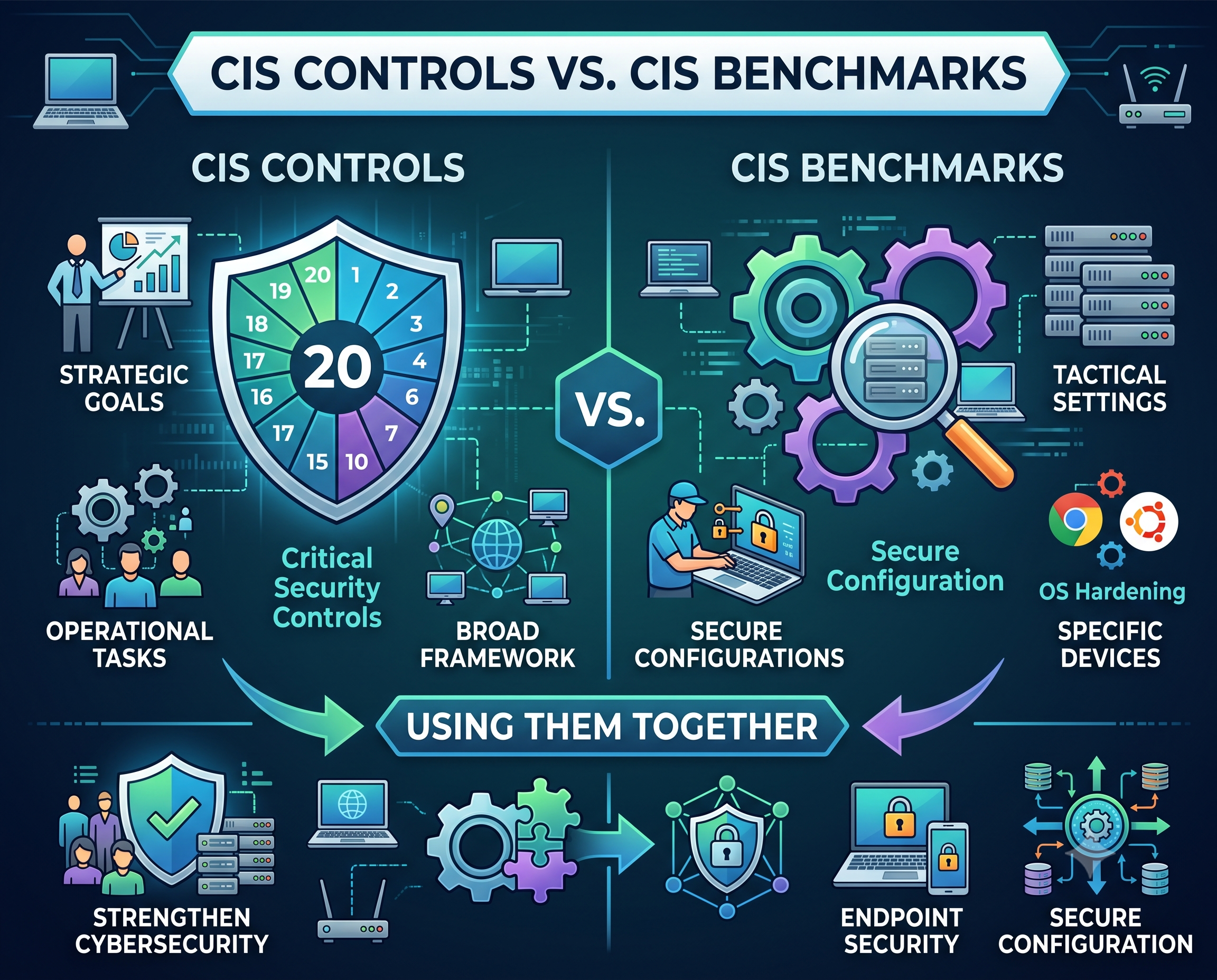
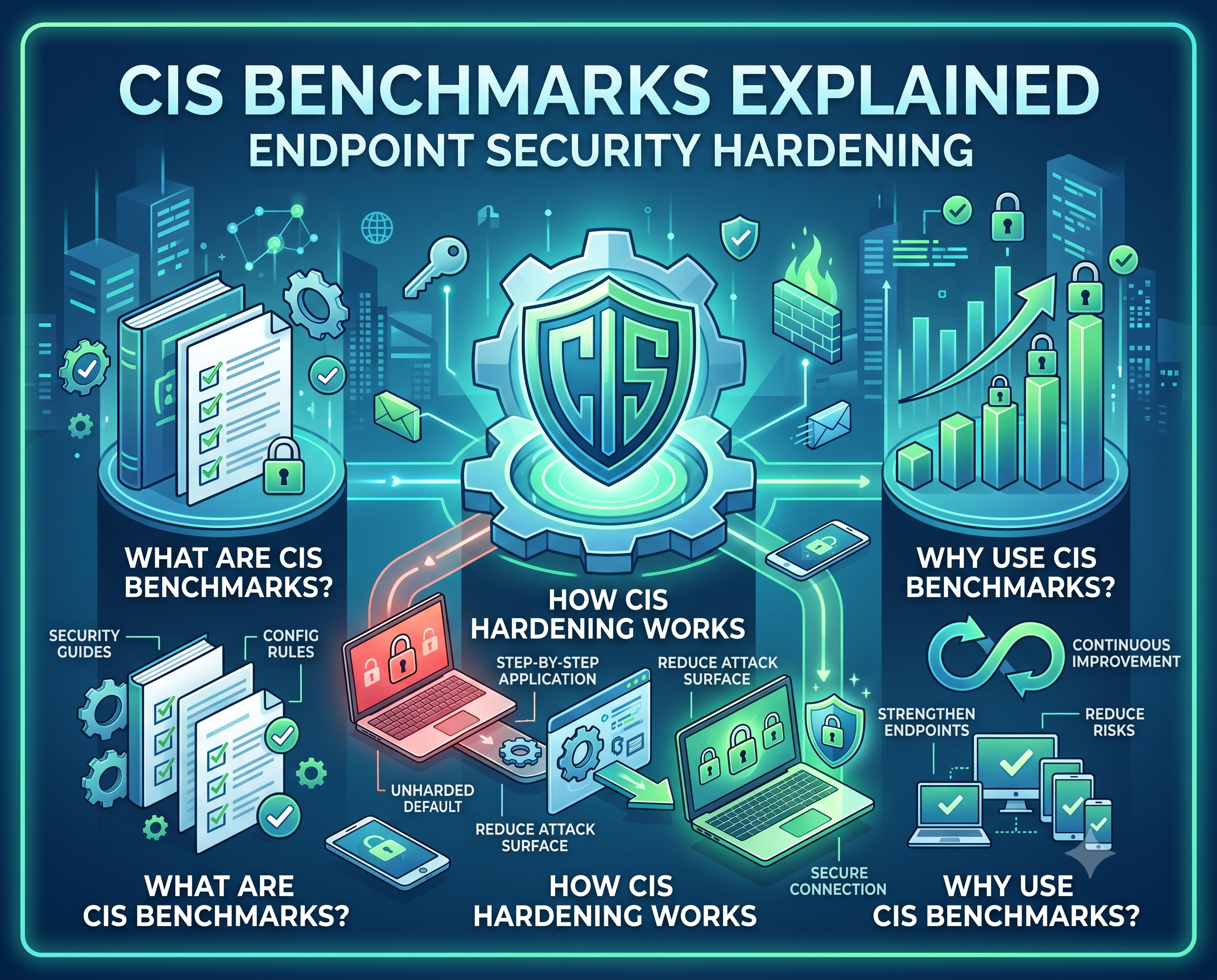
CIS Benchmarks can provide a structured reference for secure configuration requirements across supported technologies.
Organisations can use applicable Benchmark recommendations to establish security baselines and identify configuration deviations.
The remediation lifecycle can then connect those requirements with operational actions.
- Benchmark requirement
- Security baseline
- Configuration assessment
- Security finding
- Risk prioritisation
- Remediation action
- Post-remediation verification
- Continuous compliance monitoring
This creates a practical connection between security standards and day-to-day endpoint security operations.
Closed-Loop Remediation for Endpoint Security
Endpoint environments are particularly suited to closed-loop remediation because security configurations can change frequently and large numbers of devices may need to remain consistently protected.
Common endpoint remediation scenarios include:
- Weak authentication configurations
- Disabled firewall controls
- Unnecessary services
- Excessive local administrator privileges
- Insecure remote access settings
- Missing security policies
- Disabled auditing
- Incorrect security software configurations
- Unapproved applications
- Security baseline deviations
Manual vs Automated Remediation
Manual Remediation
- Useful for complex or unusual security issues
- Allows detailed administrator investigation
- Can be appropriate for sensitive systems
- Requires significant operational effort
- Can introduce inconsistent fixes
- May take longer across large environments
Automated Remediation
- Applies standardised fixes
- Reduces repetitive manual work
- Supports large endpoint populations
- Can improve remediation speed
- Provides consistent corrective actions
- Can automatically verify results
- Requires testing and governance
The most effective approach is not necessarily to automate every security decision. Organisations should combine automation with human oversight where business context, application dependencies, or higher-risk changes require additional review.
How to Design a Closed-Loop Remediation Process
- Define security requirements
- Create clear security baselines
- Connect detection sources
- Standardise finding information
- Establish risk-based priorities
- Define ownership
- Create approved remediation actions
- Test remediation procedures
- Automate suitable corrective actions
- Implement post-remediation verification
- Track remediation evidence
- Monitor continuously
- Review recurring findings
- Improve the remediation process
Important Controls for Remediation Governance
Automation should operate within a defined governance framework. Without governance, automated remediation can create operational risks or make changes that are not appropriate for specific systems.
- Approved remediation policies
- Role-based access
- Change control
- Testing requirements
- Deployment stages
- Exception management
- Rollback procedures
- Remediation logging
- Verification requirements
- Periodic policy review
Governance ensures that remediation remains predictable, auditable, and aligned with business requirements.
Handling Security Exceptions
Not every security finding should be automatically remediated. Some systems may require a configuration that differs from the standard baseline because of application compatibility, legacy requirements, operational constraints, or other approved business reasons.
These cases should be handled through a documented exception process.
- Identify the required exception
- Document the reason
- Identify the affected systems
- Define the exception owner
- Set an appropriate review period
- Monitor the affected security control
- Review whether the exception is still required
- Remove the exception when the underlying requirement no longer exists
An exception should not mean that the security issue is forgotten. It should remain visible and subject to appropriate monitoring.
Measuring the Effectiveness of Remediation
Security teams need measurable indicators to understand whether their remediation program is actually reducing risk.
- Total security findings
- Open high-risk findings
- Average time to remediation
- Average time to verification
- Verified remediation percentage
- Failed remediation percentage
- Recurring finding percentage
- Number of overdue findings
- Number of affected endpoints
- Security baseline compliance percentage
- Configuration drift events
- Exception count
Tracking these metrics over time can reveal whether remediation is becoming faster, more consistent, and more effective.
Why Recurring Findings Need Special Attention
A finding that repeatedly appears after remediation may indicate that the organisation is treating the symptom rather than the underlying cause.
For example, a configuration may repeatedly return to an insecure state because an application changes the setting, an administrative policy overrides it, or another management system applies conflicting configuration.
Recurring findings should therefore trigger root-cause analysis.
- Identify what changes the configuration
- Determine whether another policy is overriding the fix
- Check application dependencies
- Review administrator activity
- Check for conflicting management systems
- Determine whether the baseline is appropriate
- Create a permanent corrective action
Closed-Loop Remediation and Security Operations
A closed-loop remediation process connects security operations with IT and endpoint management activities.
Security teams identify and prioritise risk, while responsible IT or infrastructure teams may implement the required corrective actions. Automation can connect these functions by providing consistent workflows, status tracking, verification, and evidence.
This reduces the gap between security teams discovering a problem and the organisation actually resolving it.
How Cyber Auditor Can Support the Remediation Lifecycle
Cyber Auditor can support organisations in building a more structured endpoint security remediation workflow by helping identify security configuration issues, assess endpoint security posture, monitor compliance, and track remediation activities.
A centralised approach can help security teams move from isolated security findings toward a continuous lifecycle of assessment, prioritisation, remediation, verification, and monitoring.
The objective is to make security remediation measurable and repeatable across the endpoint environment rather than relying entirely on manual investigation and follow-up.
Closed-Loop Cybersecurity Remediation Checklist
- Maintain an accurate endpoint inventory
- Define approved security baselines
- Identify security requirements
- Continuously assess endpoints
- Centralise relevant security findings
- Validate findings before remediation
- Prioritise findings based on risk
- Assign clear ownership
- Define approved remediation actions
- Test remediation procedures
- Apply fixes consistently
- Verify remediation results
- Record remediation evidence
- Track failed remediation
- Monitor configuration drift
- Manage security exceptions
- Identify recurring findings
- Measure remediation performance
- Continuously improve the process
Frequently Asked Questions About Cybersecurity Remediation
What is a closed-loop cybersecurity remediation process?
It is a continuous security workflow that connects finding detection, validation, risk prioritisation, remediation, verification, documentation, and ongoing monitoring.
Why is verification important in remediation?
Verification confirms that the expected security state was actually restored. Without verification, a remediation action may have been attempted without successfully resolving the original issue.
Can cybersecurity remediation be automated?
Yes. Suitable remediation actions can be automated when they are well understood, tested, approved, and appropriate for the affected systems. Higher-risk or complex changes may still require human review.
What is the difference between remediation and vulnerability management?
Vulnerability management focuses on identifying, assessing, prioritising, and addressing vulnerabilities. Remediation is the corrective action used to reduce or remove a specific security weakness. Remediation can apply to vulnerabilities as well as configuration, compliance, and security-control findings.
How does configuration drift affect remediation?
Configuration drift can cause a previously remediated endpoint to become insecure again. Continuous monitoring helps detect the deviation and allows it to re-enter the remediation workflow.
Should every security finding be automatically fixed?
No. Organisations should use risk-based decision-making. Some findings may require manual investigation, business approval, application testing, or an approved exception before remediation.
How can organisations measure remediation performance?
Organisations can measure metrics such as remediation time, verified remediation rate, failed remediation rate, recurring findings, overdue findings, and security baseline compliance.
Key Takeaways
- A security finding is only the beginning of the remediation process
- Closed-loop remediation connects detection with verified corrective action
- Risk-based prioritisation helps security teams focus on important findings
- Clear ownership prevents security issues from remaining unresolved
- Automated remediation can improve consistency and reduce manual effort
- Verification confirms whether a fix actually worked
- Continuous monitoring helps prevent previously resolved issues from returning
- Configuration drift requires ongoing security assessment
- Security exceptions should be documented and monitored
- Recurring findings should trigger root-cause analysis
- Remediation metrics help demonstrate measurable security improvement
Conclusion
A strong cybersecurity program should not stop at identifying security findings. The real objective is to move each actionable finding through a controlled process that leads to a verified reduction in risk.
A closed-loop cybersecurity remediation process connects detection, validation, risk prioritisation, ownership, remediation, verification, documentation, and continuous monitoring into one repeatable workflow.
For organisations managing large endpoint environments, automation can make this process faster and more consistent while reducing the operational burden of repetitive security fixes.
The most effective remediation strategy is therefore not simply to find security problems. It is to continuously move from finding to fix, from fix to verification, and from verification to ongoing monitoring so that secure configurations remain secure over time.
Recommended Solution
See how MOBISEC solves this in practice
Topics